Sun Min, Yang Peizeng, Du Liping, Yang Yan, Ye Jian
Department of Ophthalmology, Research Institute of Surgery & Daping Hospital, Third Military Medical University, Chongqing, P.R. China; The First Affiliated Hospital, Chongqing Medical University, Chongqing Key Laboratory of Ophthalmology, Chongqing Eye Institute, Chongqing, P. R. China.
The First Affiliated Hospital, Chongqing Medical University, Chongqing Key Laboratory of Ophthalmology, Chongqing Eye Institute, Chongqing, P. R. China.
PLoS One. 2014 Apr 1;9(4):e93214. doi: 10.1371/journal.pone.0093214. eCollection 2014.
To explore whether IRAK1 and IRAK4 are involved in the pathogenesis of Vogt-Koyanagi-Harada (VKH) disease.
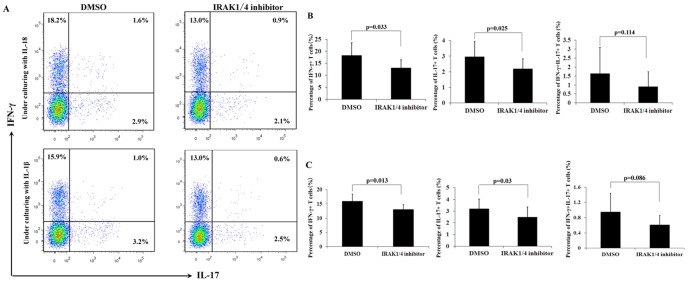
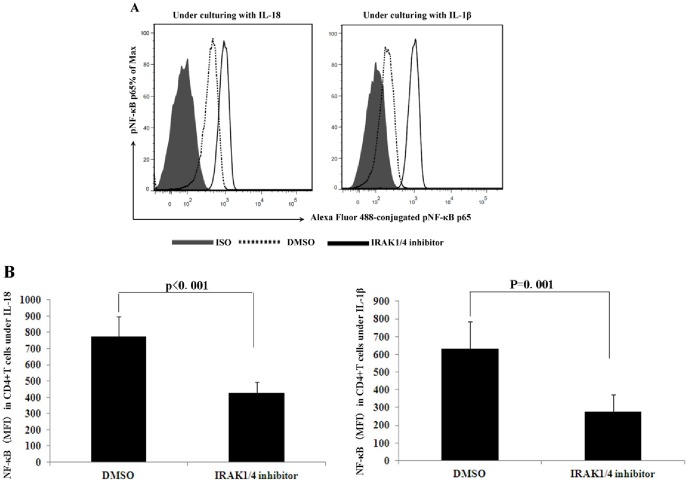
Thirty-nine VKH patients and thirty-two healthy controls were included in this study. The mRNA levels of IRAK1 and IRAK4 from active VKH patients, inactive VKH patients, and normal controls in peripheral blood mononuclear cells (PBMCs) were detected using real-time quantitative PCR. CD4(+)T cells were purified from PBMCs obtained from active VKH patients and normal controls. The effect of IRAK1/4 inhibition on CD4(+)T cell proliferation following stimulation with IL-18 or IL-1β was measured using a modified MTT assay. CD4(+)T cell expression of IFN-γ and IL-17 were detected by flow cytometry (FCM) and enzyme-linked immunosorbent assay (ELISA). The effect of IRAK1/4 inhibition on NF-κB, STAT1, and STAT3 activation was detected by FCM.
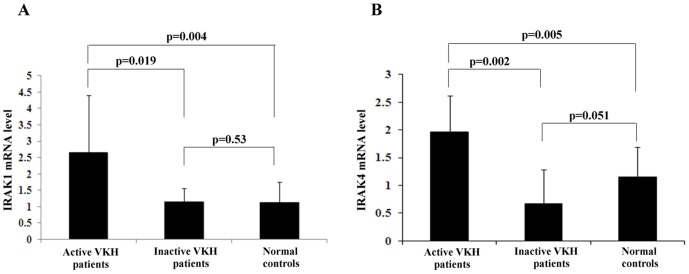
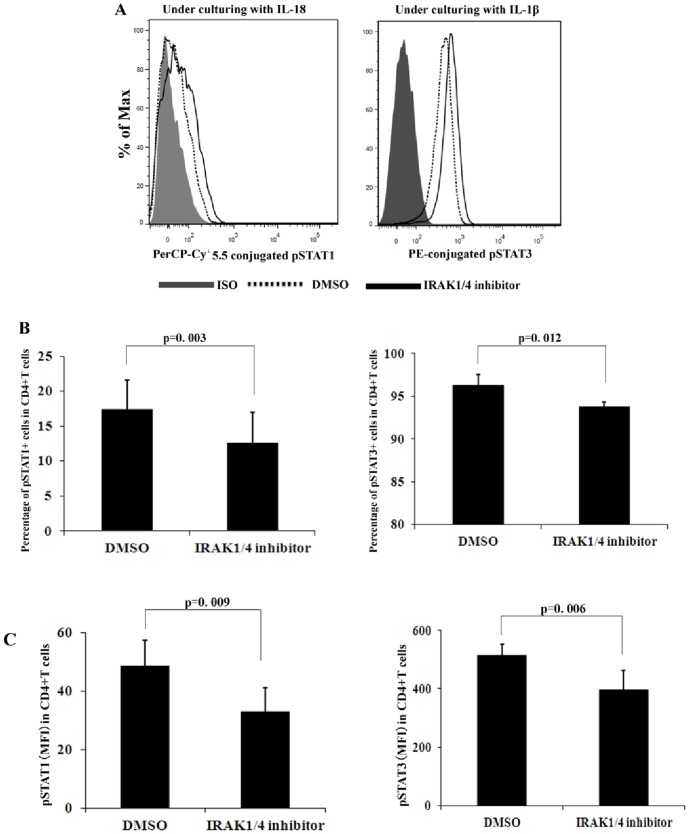
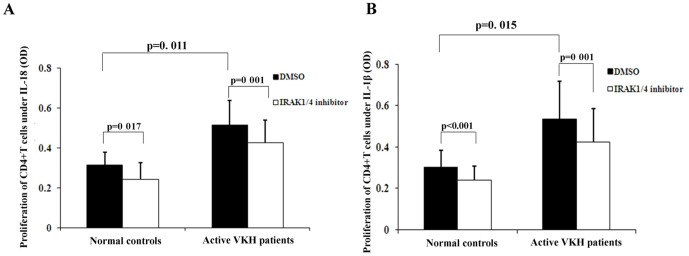
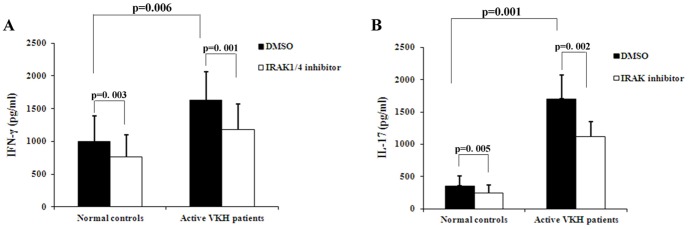
The mRNA levels of IRAK1 and IRAK4 were both significantly increased in active VKH patients compared to inactive VKH patients and healthy controls. No difference in the IRAK1 or IRAK4 mRNA level could be detected between inactive patients and healthy controls. After incubation with IRAK1/4 inhibitor, the proliferation of CD4(+)T cells was inhibited both in the active VKH patients and in the healthy controls. IRAK1/4 inhibition was also associated with a decreased expression of IFN-γ and IL-17. Phosphorylation of NF-κB, STAT1, and STAT3 in CD4(+)T from healthy controls was significantly decreased after inhibition of IRAK1/4.
High mRNA levels of IRAK1 and IRAK4 correlated with VKH disease activity. IRAK1 and IRAK4 play a role in the activation and proliferation of CD4(+)T cells and the higher expression observed in VKH may contribute to the pathogenesis of this blinding condition.
探讨白细胞介素 -1 受体相关激酶 1(IRAK1)和白细胞介素 -1 受体相关激酶 4(IRAK4)是否参与葡萄膜大脑炎(VKH)疾病的发病机制。
本研究纳入了 39 例 VKH 患者和 32 名健康对照者。采用实时定量聚合酶链反应检测活动期 VKH 患者、非活动期 VKH 患者及正常对照者外周血单个核细胞(PBMCs)中 IRAK1 和 IRAK4 的 mRNA 水平。从活动期 VKH 患者和正常对照者的 PBMCs 中纯化 CD4(+)T 细胞。使用改良的四唑盐比色法(MTT 法)检测 IRAK1/4 抑制对用白细胞介素 -18(IL -18)或白细胞介素 -1β(IL -1β)刺激后 CD4(+)T 细胞增殖的影响。通过流式细胞术(FCM)和酶联免疫吸附测定(ELISA)检测 CD4(+)T 细胞中γ干扰素(IFN -γ)和白细胞介素 -17(IL -17)的表达。通过 FCM 检测 IRAK1/4 抑制对核因子κB(NF -κB)、信号转导和转录激活因子 1(STAT1)及信号转导和转录激活因子 3(STAT3)激活的影响。
与非活动期 VKH 患者和健康对照者相比,活动期 VKH 患者中 IRAK1 和 IRAK4 的 mRNA 水平均显著升高。非活动期患者与健康对照者之间未检测到 IRAK1 或 IRAK4 mRNA 水平的差异。在用 IRAK1/4 抑制剂孵育后,活动期 VKH 患者和健康对照者中 CD4(+)T 细胞的增殖均受到抑制。IRAK1/4 抑制还与 IFN -γ和 IL -17 的表达降低有关。抑制 IRAK1/4 后,健康对照者 CD4(+)T 细胞中 NF -κB、STAT1 和 STAT3 的磷酸化水平显著降低。
IRAK1 和 IRAK4 的高 mRNA 水平与 VKH 疾病活动相关。IRAK1 和 IRAK4 在 CD4(+)T 细胞的激活和增殖中起作用,在 VKH 中观察到的较高表达可能有助于这种致盲疾病的发病机制。