Cho Sung-Yeon, Choi Jung-Hyun
Division of Infectious Diseases, Department of Internal Medicine, The Catholic University of Korea College of Medicine, Seoul, Korea. ; Vaccine Bio Research Institute, The Catholic University of Korea College of Medicine, Seoul, Korea.
Infect Chemother. 2014 Mar;46(1):1-12. doi: 10.3947/ic.2014.46.1.1. Epub 2014 Mar 21.
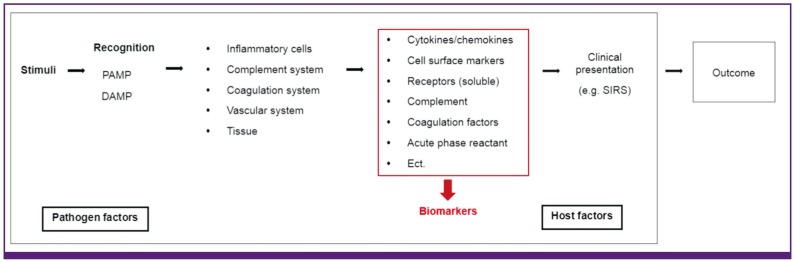
Sepsis remains a leading cause of death in critically ill patients, despite efforts to improve patient outcome. Thus far, no magic drugs exist for severe sepsis and septic shock. Instead, early diagnosis and prompt initial management such as early goal-directed therapy are key to improve sepsis outcome. For early detection of sepsis, biological markers (biomarkers) can help clinicians to distinguish infection from host response to inflammation. Ideally, biomarkers can be used for risk stratification, diagnosis, monitoring of treatment responses, and outcome prediction. More than 170 biomarkers have been identified as useful for evaluating sepsis, including C-reactive protein, procalcitonin, various cytokines, and cell surface markers. Recently, studies have reported on the usefulness of biomarker-guided antibiotic stewardships. However, the other side of these numerous biomarkers is that no novel single laboratory marker can diagnose, predict, and track the treatment of sepsis. The purpose of this review is to summarize several key biomarkers from recent sepsis studies.
尽管人们努力改善患者预后,但脓毒症仍是重症患者死亡的主要原因。迄今为止,针对严重脓毒症和脓毒性休克尚无神奇药物。相反,早期诊断和及时的初始治疗,如早期目标导向治疗,是改善脓毒症预后的关键。为了早期检测脓毒症,生物标志物可帮助临床医生区分感染与宿主对炎症的反应。理想情况下,生物标志物可用于风险分层、诊断、治疗反应监测和预后预测。已鉴定出170多种生物标志物可用于评估脓毒症,包括C反应蛋白、降钙素原、各种细胞因子和细胞表面标志物。最近,有研究报道了生物标志物指导下抗生素管理的有效性。然而,这些众多生物标志物的另一面是,没有一种新的单一实验室标志物能够诊断、预测和跟踪脓毒症的治疗。本综述的目的是总结近期脓毒症研究中的几种关键生物标志物。