Caddeo Giacomo, Williams Simon T, McIntyre Christopher W, Selby Nicholas M
Department of Urology, Royal Derby Hospital, Derby, UK.
Department of Renal Medicine, Royal Derby Hospital, Derby, UK ; Division of Medical Sciences and Graduate Entry Medicine, School of Medicine, University of Nottingham, Nottingham, UK.
Nephrourol Mon. 2013 Nov;5(5):955-61. doi: 10.5812/numonthly.12721. Epub 2013 Nov 13.
Acute kidney injury (AKI) is common in hospitalised patients and is associated with high mortality rates. However, the epidemiology of AKI in urology patients may differ due to a higher proportion of post-renal causes and surgical procedures that result in the intentional removal of renal parenchyma.
We performed a study to examine the incidence, aetiology and outcomes of AKI in a urological population.
We performed a single-centre observational study including all hospitalised patients who sustained AKI within the Urology Department over an 18 month period. Patients with AKI were prospectively identified by a hospital-wide, electronic AKI reporting system that also allows demographic, hospital admission and co-morbidity data collection. Data regarding aetiology of AKI and details of surgical procedures were added retrospectively by manual case-note search.
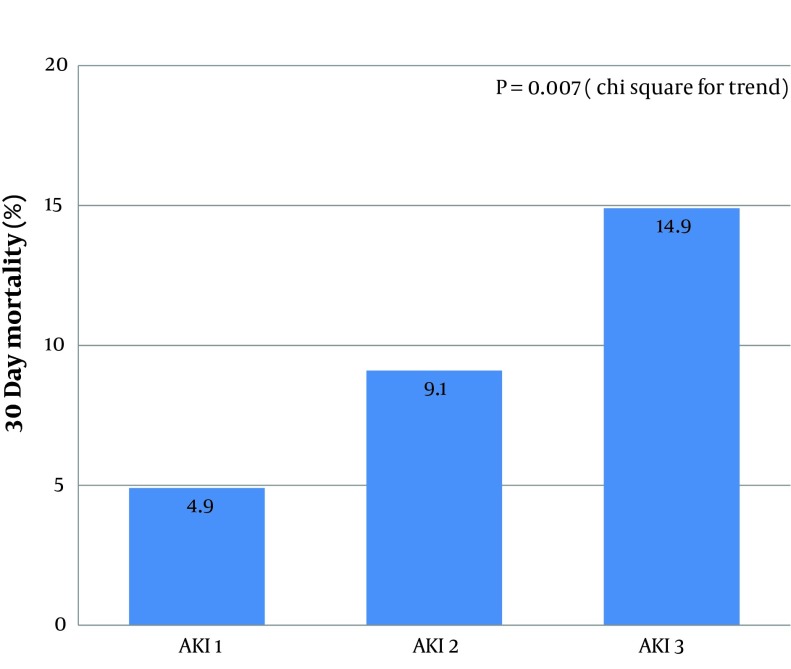
587 episodes of AKI occurred in 410 urology patients, giving an overall incidence of 6.7%. 137 (33.4%) were elective cases of whom 58 had undergone nephrectomy (radical and partial). Urinary obstruction and sepsis were the predominant causes of AKI in the 273 patients (66.6%) admitted as an emergency. Overall 30-day mortality was 7.8%; increasing severity of AKI was associated with mortality (4.8% in stage 1, 9.1% in stage 2, 14.9% in stage 3, P = 0.007). At time of discharge, only 57.7% of patients had recovered pre-morbid renal function. The observational nature of this study is a limitation, preventing determination of causality of associations.
AKI is common in urology patients. The underlying aetiologies of AKI in this group may explain a lower overall mortality, although increasing AKI severity remains a marker of patients at higher risk of poor outcomes. The low rate of renal recovery suggests that urology patients who sustain AKI are exposed to a significant risk of CKD and its attendant consequences for long term health.
急性肾损伤(AKI)在住院患者中很常见,且与高死亡率相关。然而,由于肾后性病因及导致肾实质被有意切除的外科手术比例较高,泌尿外科患者中AKI的流行病学情况可能有所不同。
我们开展了一项研究,以调查泌尿外科患者中AKI的发病率、病因及转归。
我们进行了一项单中心观察性研究,纳入了在18个月期间泌尿外科内发生AKI的所有住院患者。通过全院范围的电子AKI报告系统前瞻性识别AKI患者,该系统还可收集人口统计学、住院及合并症数据。通过人工查阅病例记录,回顾性补充AKI病因及外科手术细节的数据。
410例泌尿外科患者共发生587次AKI发作,总体发病率为6.7%。137例(33.4%)为择期病例,其中58例接受了肾切除术(根治性和部分性)。在273例急诊入院患者中,尿路梗阻和脓毒症是AKI的主要病因(66.6%)。总体30天死亡率为7.8%;AKI严重程度增加与死亡率相关(1期为4.8%,2期为9.1%,3期为14.9%,P = 0.007)。出院时,只有57.7%的患者恢复了病前肾功能。本研究的观察性本质是一个局限,妨碍了对关联因果关系的判定。
AKI在泌尿外科患者中很常见。该组患者中AKI的潜在病因可能解释了总体死亡率较低的原因,尽管AKI严重程度增加仍是患者预后不良风险较高的一个标志。肾脏恢复率较低表明,发生AKI的泌尿外科患者面临慢性肾脏病及其伴随的长期健康后果的重大风险。