Department of Radiotherapy and Radiosurgery, Clinical Institute Humanitas Cancer Center, Rozzano(Milan), Italy.
Radiat Oncol. 2014 Apr 2;9(1):91. doi: 10.1186/1748-717X-9-91.
Data in the literature suggest the existence of oligometastatic disease, a state in which metastases are limited in number and site. Different kinds of local therapies have been used for the treatment of limited metastases and in the recent years reports on the use of Stereotactic Ablative radiotherapy (SABR) are emerging and the early results on local control are promising.
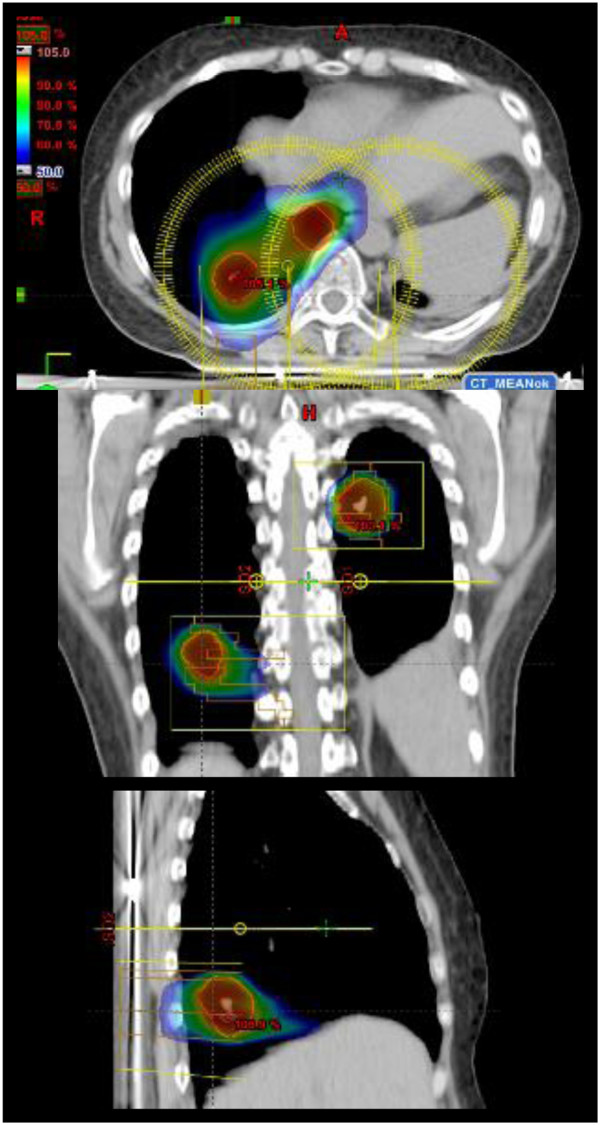
From October 2010 to February 2012, 76 consecutive patients for 118 lung lesions were treated. SABR was performed in case of controlled primary tumor, long-term of progression disease, exclusion of surgery, and number of metastatic sites ≤ 5. Different kinds of primary tumors were treated, the most common were lung and colon-rectal cancer. The total dose prescribed varied according to tumor site and maximum diameter. Dose prescription was 48 Gy in 4 fractions for peripheral lesions, 60 Gy in 8 fractions for central lesions and 60 Gy in 3 fractions for peripheral lesions with diameter ≤ 2 cm.
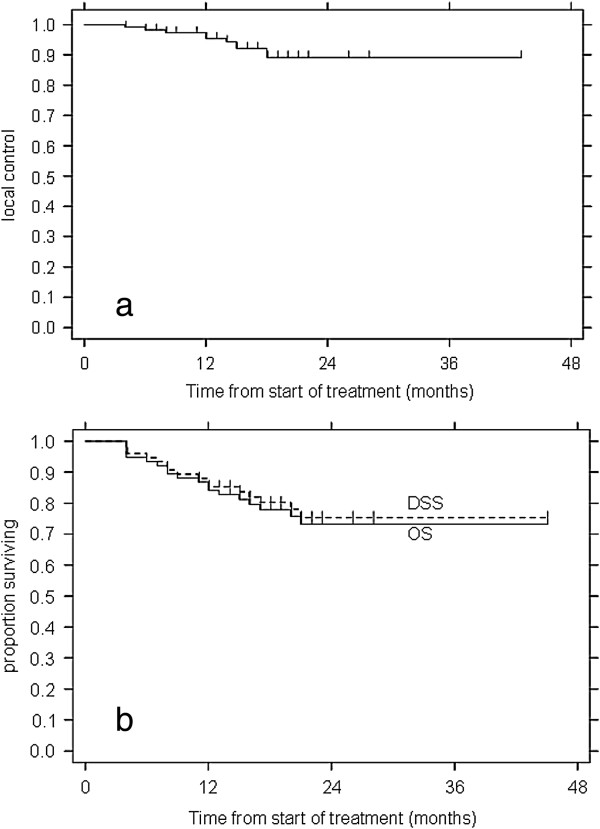
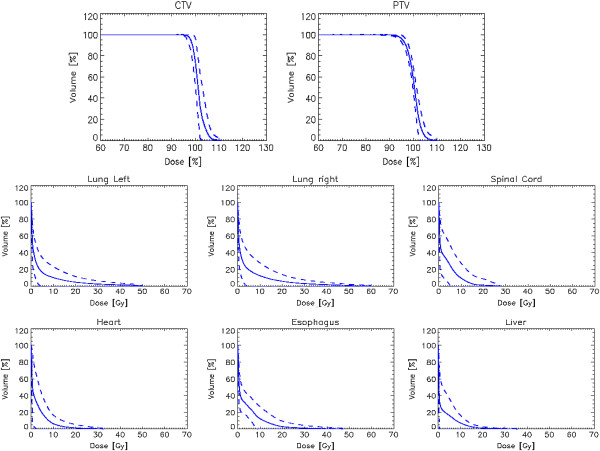
Dosimetric planning objectives were met for the cohort of patients with in particular V98% = 98.1 ± 3.4% for the CTV and mean lung dose of 3.7 ± 3.8 Gy. Radiological response was obtained in the vast majority of patients. The local control at 1, 2 and 3 years was 95%, 89% and 89% respectively. No major pulmonary toxicity, chest pain or rib fracture occurred. The median follow up was 20 months (range 6-45 months). Overall Survival (OS) at 1, 2 and 3 years was 84.1%, 73% and 73% respectively.
SABR is feasible with limited morbidity and promising results in terms of local control, survival and toxicity.
文献中的数据表明存在寡转移疾病,即转移灶数量和部位有限的状态。已经使用了不同类型的局部治疗方法来治疗有限的转移灶,近年来,立体定向消融放疗(SABR)的应用报告不断涌现,局部控制的早期结果令人鼓舞。
从 2010 年 10 月到 2012 年 2 月,对 76 例 118 个肺病变的连续患者进行了治疗。如果控制了原发性肿瘤、疾病长期进展、排除手术以及转移灶数量≤5,则进行 SABR。治疗了不同类型的原发性肿瘤,最常见的是肺癌和结肠直肠癌。根据肿瘤部位和最大直径,规定的总剂量有所不同。外周病变的处方剂量为 48 Gy 分 4 次,中央病变为 60 Gy 分 8 次,直径≤2 cm 的外周病变为 60 Gy 分 3 次。
该患者队列的剂量规划目标得到了满足,特别是 CTV 的 V98%=98.1±3.4%,平均肺剂量为 3.7±3.8 Gy。绝大多数患者获得了放射学反应。1、2 和 3 年的局部控制率分别为 95%、89%和 89%。没有发生重大肺毒性、胸痛或肋骨骨折。中位随访时间为 20 个月(6-45 个月)。1、2 和 3 年的总生存率(OS)分别为 84.1%、73%和 73%。
SABR 具有有限的发病率,在局部控制、生存和毒性方面具有良好的结果。