Davis Michelle L, Powers Mark B, Handelsman Pamela, Medina Johnna L, Zvolensky Michael, Smits Jasper A J
Department of Psychology, The University of Texas, Austin, TX, USA
Department of Psychology, The University of Texas, Austin, TX, USA.
Eval Health Prof. 2015 Mar;38(1):94-114. doi: 10.1177/0163278714529970. Epub 2014 Apr 2.
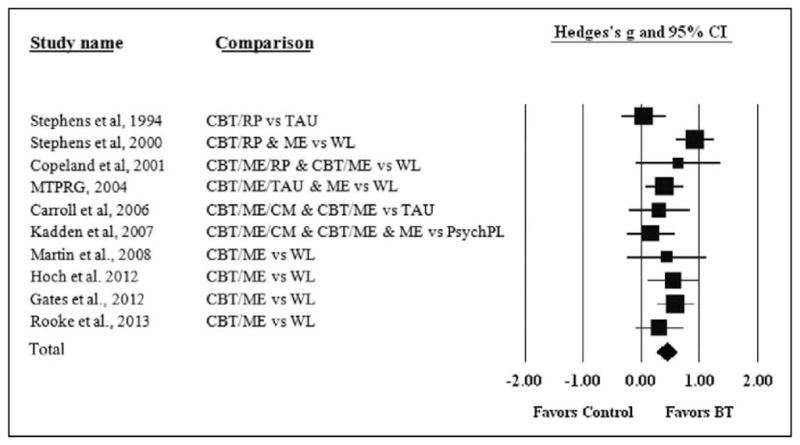
Narrative reviews conclude that behavioral therapies (BTs) produce better outcomes than control conditions for cannabis use disorders (CUDs). However, the strength and consistency of this effect has not been directly empirically examined. The present meta-analysis combined multiple well-controlled studies to help clarify the overall impact of behavioral interventions in the treatment of CUDs. A comprehensive literature search produced 10 randomized controlled trials (RCTs; n = 2,027) that were included in the final analyses. Analyses indicated an effect of BTs (including contingency management, relapse prevention, and motivational interviewing, and combinations of these strategies with cognitive behavioral therapy) over control conditions (including waitlist [WL], psychological placebo, and treatment as usual) across pooled outcomes and time points (Hedges' g = 0.44). These results suggest that the average patient receiving a behavioral intervention fared better than 66% of those in the control conditions. BT also outperformed control conditions when examining primary outcomes alone (frequency and severity of use) and secondary outcomes alone (psychosocial functioning). Effect sizes were not moderated by inclusion of a diagnosis (RCTs including treatment-seeking cannabis users who were not assessed for abuse or dependence vs. RCTs including individuals diagnosed as dependent), dose (number of treatment sessions), treatment format (either group vs. individual treatment or in-person vs. non-in-person treatment), sample size, or publication year. Effect sizes were significantly larger for studies that included a WL control comparison versus those including active control comparisons, such that BT significantly outperformed WL controls but not active control comparisons.
叙述性综述得出结论,对于大麻使用障碍(CUDs),行为疗法(BTs)比对照条件产生更好的治疗效果。然而,这种效果的强度和一致性尚未得到直接的实证检验。本荟萃分析结合了多项严格控制的研究,以帮助阐明行为干预对CUDs治疗的总体影响。全面的文献检索产生了10项随机对照试验(RCTs;n = 2,027),这些试验被纳入最终分析。分析表明,在汇总结果和时间点上,行为疗法(包括应急管理、预防复发、动机访谈以及这些策略与认知行为疗法的组合)比对照条件(包括等待名单[WL]、心理安慰剂和常规治疗)更有效(Hedges' g = 0.44)。这些结果表明,接受行为干预的平均患者比66%的对照条件下的患者表现更好。在单独检查主要结果(使用频率和严重程度)和单独检查次要结果(心理社会功能)时,行为疗法也优于对照条件。效应大小不受诊断(包括未评估滥用或依赖情况的寻求治疗的大麻使用者的RCTs与包括诊断为依赖的个体的RCTs)、剂量(治疗疗程数)、治疗形式(小组治疗与个体治疗或面对面治疗与非面对面治疗)、样本量或出版年份的影响。与包括积极对照比较的研究相比,包括等待名单对照比较的研究的效应大小显著更大,因此行为疗法显著优于等待名单对照,但不优于积极对照比较。