University of Konstanz, 78457, Konstanz, Germany.
Eur J Neurosci. 2014 Jun;39(11):1784-95. doi: 10.1111/ejn.12558. Epub 2014 Apr 3.
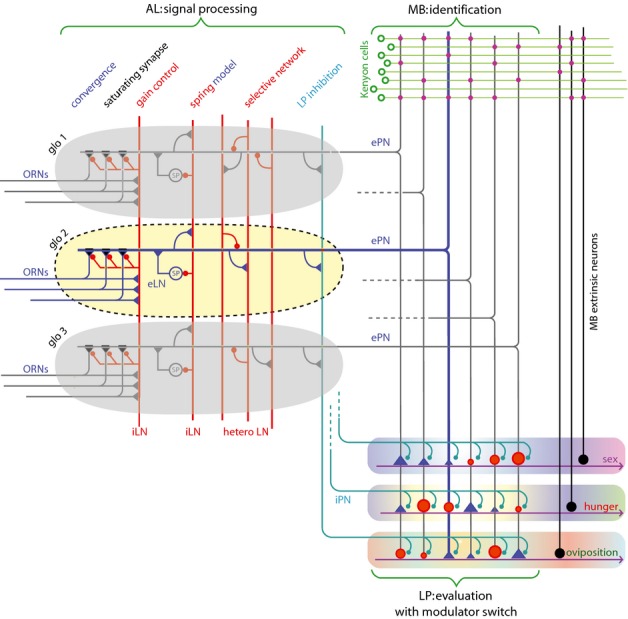
Much progress has been made recently in understanding how olfactory coding works in insect brains. Here, I propose a wiring diagram for the major steps from the first processing network (the antennal lobe) to behavioral readout. I argue that the sequence of lateral inhibition in the antennal lobe, non-linear synapses, threshold-regulating gated spring network, selective lateral inhibitory networks across glomeruli, and feedforward inhibition to the lateral protocerebrum cover most of the experimental results from different research groups and model species. I propose that the main difference between mushroom bodies and the lateral protocerebrum is not about learned vs. innate behavior. Rather, mushroom bodies perform odor identification, whereas the lateral protocerebrum performs odor evaluation (both learned and innate). I discuss the concepts of labeled line and combinatorial coding and postulate that, under restrictive experimental conditions, these networks lead to an apparent existence of 'labeled line' coding for special odors. Modulatory networks are proposed as switches between different evaluating systems in the lateral protocerebrum. A review of experimental data and theoretical conjectures both contribute to this synthesis, creating new hypotheses for future research.
最近在理解昆虫大脑中的嗅觉编码工作方式方面取得了很大进展。在这里,我提出了一个从第一个处理网络(触角叶)到行为输出的主要步骤的连接图。我认为,触角叶中的侧抑制序列、非线性突触、门控弹簧网络的阈值调节、跨越神经球的选择性侧抑制网络以及对侧原脑的前馈抑制,涵盖了来自不同研究小组和模式物种的大部分实验结果。我提出,蘑菇体和侧原脑之间的主要区别不是关于学习与先天行为。相反,蘑菇体执行气味识别,而侧原脑执行气味评估(包括学习和先天)。我讨论了标记线和组合编码的概念,并假设在限制实验条件下,这些网络导致了对特殊气味的“标记线”编码的明显存在。调制网络被提议作为侧原脑中不同评估系统之间的开关。对实验数据和理论推测的回顾都为这一综合做出了贡献,为未来的研究提出了新的假设。