Ruan Ting, Lin Yu-Jung, Hsu Tien-Huan, Lu Shing-Hwa, Jow Guey-Mei, Kou Yu Ru
School of Medicine, Fu Jen Catholic University, New Taipei City, Taiwan; Department of Physiology, School of Medicine, Chung Shan Medical University, Taichung, Taiwan.
Department of Physiology, School of Medicine, National Yang-Ming University, Taipei, Taiwan.
PLoS One. 2014 Apr 3;9(4):e91763. doi: 10.1371/journal.pone.0091763. eCollection 2014.
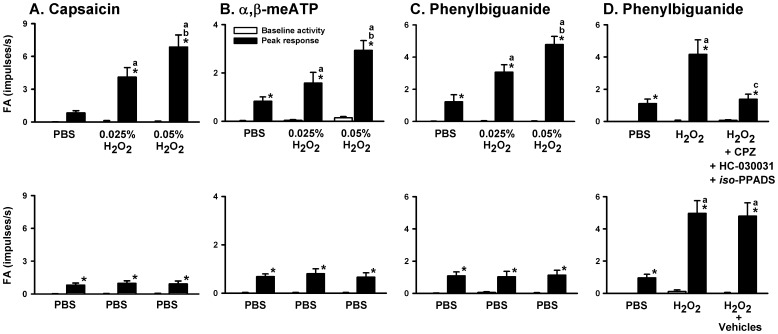
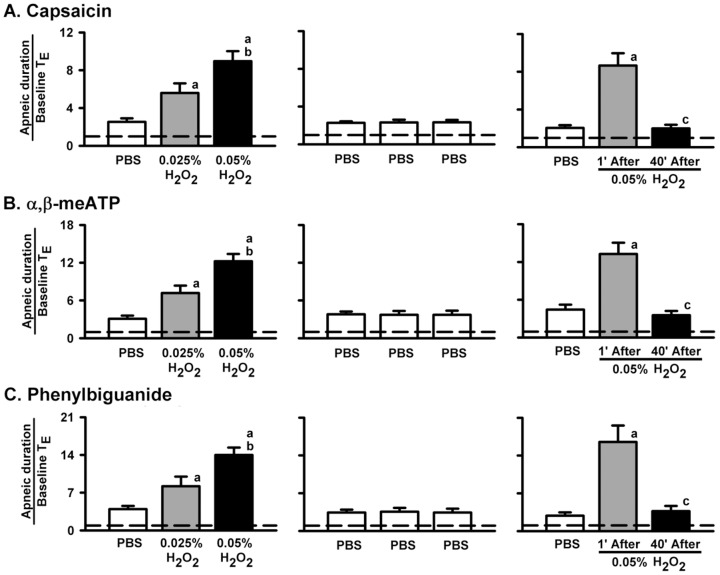
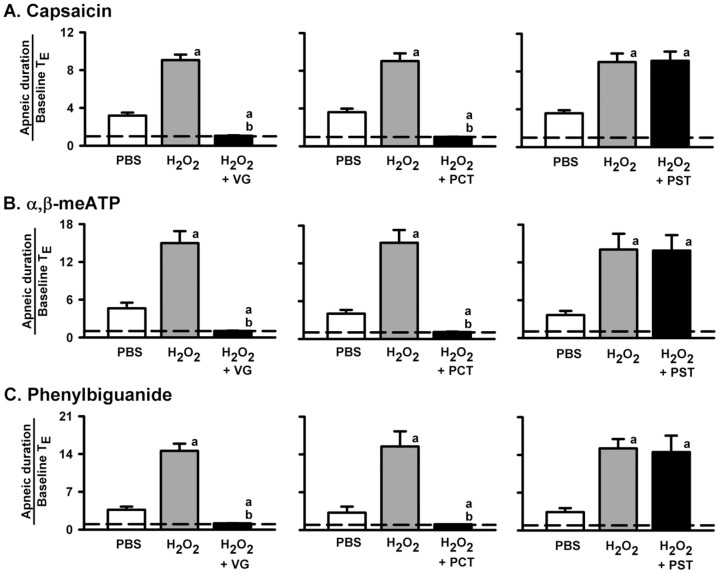
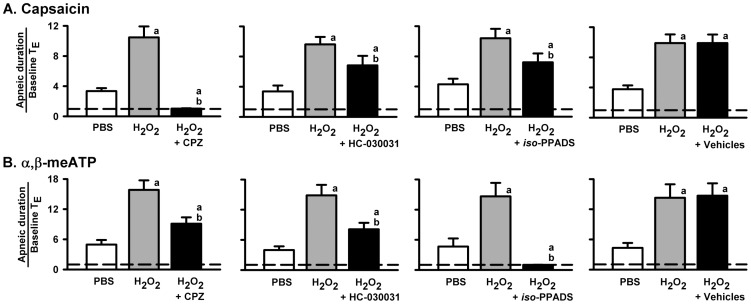
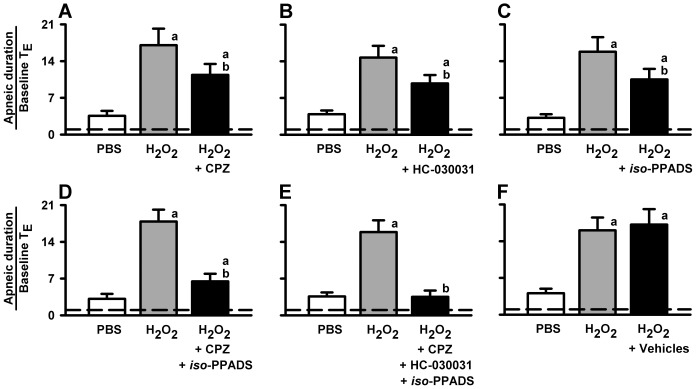
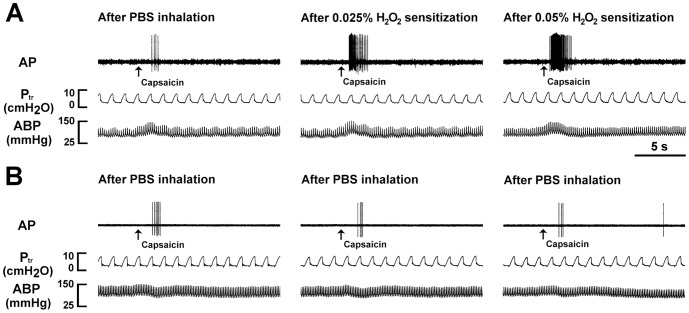
Sensitization of vagal lung C-fibers (VLCFs) induced by mediators contributes to the pathogenesis of airway hypersensitivity, which is characterized by exaggerated sensory and reflex responses to stimulants. Reactive oxygen species (ROS) are mediators produced during airway inflammation. However, the role of ROS in VLCF-mediated airway hypersensitivity has remained elusive. Here, we report that inhalation of aerosolized 0.05% H2O2 for 90 s potentiated apneic responses to intravenous capsaicin (a TRPV1 receptor agonist), α,β-methylene-ATP (a P2X receptor agonist), and phenylbiguanide (a 5-HT3 receptor agonist) in anesthetized rats. The apneic responses to these three stimulants were abolished by vagatomy or by perivagal capsaicin treatment, a procedure that blocks the neural conduction of VLCFs. The potentiating effect of H2O2 on the apneic responses to these VLCF stimulants was prevented by catalase (an enzyme that degrades H2O2) and by dimethylthiourea (a hydroxyl radical scavenger). The potentiating effect of H2O2 on the apneic responses to capsaicin was attenuated by HC-030031 (a TRPA1 receptor antagonist) and by iso-pyridoxalphosphate-6-azophenyl-2',5'-disulphonate (a P2X receptor antagonist). The potentiating effect of H2O2 on the apneic responses to α,β-methylene-ATP was reduced by capsazepine (a TRPV1 receptor antagonist), and by HC-030031. The potentiating effect of H2O2 on the apneic responses to phenylbiguanide was totally abolished when all three antagonists were combined. Consistently, our electrophysiological studies revealed that airway delivery of aerosolized 0.05% H2O2 for 90 s potentiated the VLCF responses to intravenous capsaicin, α,β-methylene-ATP, and phenylbiguanide. The potentiating effect of H2O2 on the VLCF responses to phenylbiguanide was totally prevented when all antagonists were combined. Inhalation of 0.05% H2O2 indeed increased the level of ROS in the lungs. These results suggest that 1) increased lung ROS sensitizes VLCFs, which leads to exaggerated reflex responses in rats and 2) the TRPV1, TRPA1, and P2X receptors are all involved in the development of this airway hypersensitivity.
介质诱导的迷走神经肺C纤维(VLCFs)致敏作用参与气道高敏反应的发病机制,气道高敏反应的特征是对刺激物的感觉和反射反应过度增强。活性氧(ROS)是气道炎症过程中产生的介质。然而,ROS在VLCF介导的气道高敏反应中的作用仍不清楚。在此,我们报告在麻醉大鼠中,雾化吸入0.05% H2O2 90秒可增强对静脉注射辣椒素(一种TRPV1受体激动剂)、α,β-亚甲基-ATP(一种P2X受体激动剂)和苯乙双胍(一种5-HT3受体激动剂)的呼吸暂停反应。对这三种刺激物产生的呼吸暂停反应可通过迷走神经切断术或迷走神经周围注射辣椒素处理(一种阻断VLCFs神经传导的方法)而消除。过氧化氢酶(一种降解H2O2的酶)和二甲基硫脲(一种羟自由基清除剂)可阻止H2O2对这些VLCF刺激物呼吸暂停反应的增强作用。HC-030031(一种TRPA1受体拮抗剂)和异吡哆醛磷酸-6-偶氮苯-2',5'-二磺酸盐(一种P2X受体拮抗剂)可减弱H2O2对辣椒素呼吸暂停反应的增强作用。辣椒素(一种TRPV1受体拮抗剂)和HC-030031可降低H2O2对α,β-亚甲基-ATP呼吸暂停反应的增强作用。当三种拮抗剂联合使用时,H2O2对苯乙双胍呼吸暂停反应的增强作用完全被消除。同样,我们的电生理研究表明,雾化吸入0.05% H2O2 90秒可增强VLCF对静脉注射辣椒素、α,β-亚甲基-ATP和苯乙双胍的反应。当所有拮抗剂联合使用时,H2O2对VLCF对苯乙双胍反应的增强作用完全被阻止。吸入0.05% H2O2确实会增加肺内ROS水平。这些结果表明:1)肺内ROS增加使VLCFs致敏,导致大鼠反射反应过度增强;2)TRPV1、TRPA1和P2X受体均参与了这种气道高敏反应的发生发展。