Bodenmann Patrick, Favrat Bernard, Wolff Hans, Guessous Idris, Panese Francesco, Herzig Lilli, Bischoff Thomas, Casillas Alejandra, Golano Thomas, Vaucher Paul
Vulnerable Population Unit, Department of Ambulatory Care and Community Medicine, University of Lausanne, Lausanne, Switzerland.
Department of Ambulatory Care and Community Medicine, University of Lausanne, Lausanne, Switzerland.
PLoS One. 2014 Apr 3;9(4):e94006. doi: 10.1371/journal.pone.0094006. eCollection 2014.
Growing social inequities have made it important for general practitioners to verify if patients can afford treatment and procedures. Incorporating social conditions into clinical decision-making allows general practitioners to address mismatches between patients' health-care needs and financial resources.
Identify a screening question to, indirectly, rule out patients' social risk of forgoing health care for economic reasons, and estimate prevalence of forgoing health care and the influence of physicians' attitudes toward deprivation.
Multicenter cross-sectional survey.
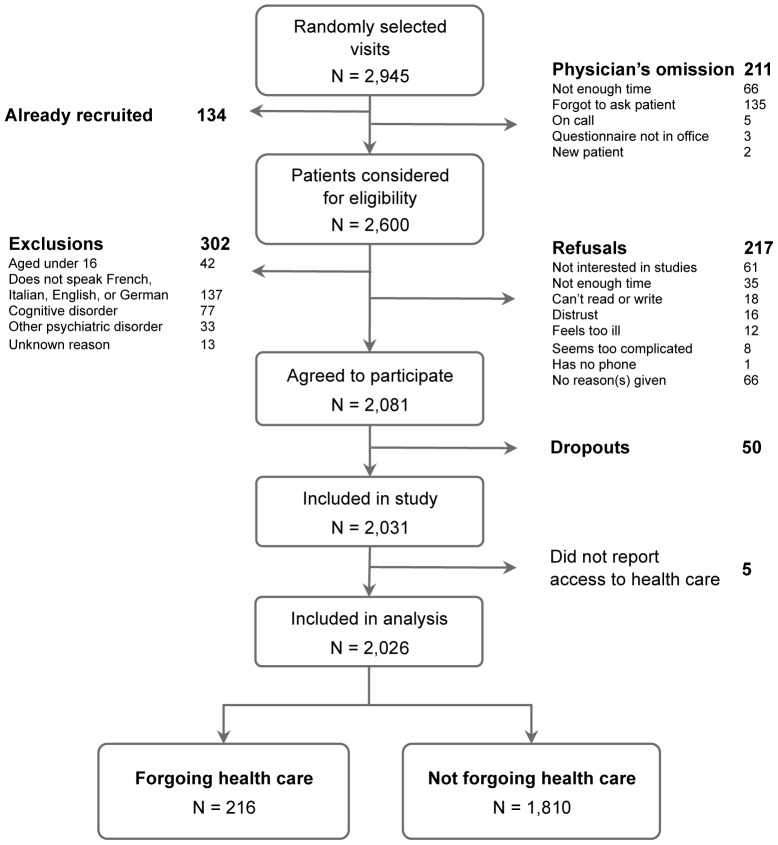
Forty-seven general practitioners working in the French-speaking part of Switzerland enrolled a random sample of patients attending their private practices.
Patients who had forgone health care were defined as those reporting a household member (including themselves) having forgone treatment for economic reasons during the previous 12 months, through a self-administered questionnaire. Patients were also asked about education and income levels, self-perceived social position, and deprivation levels.
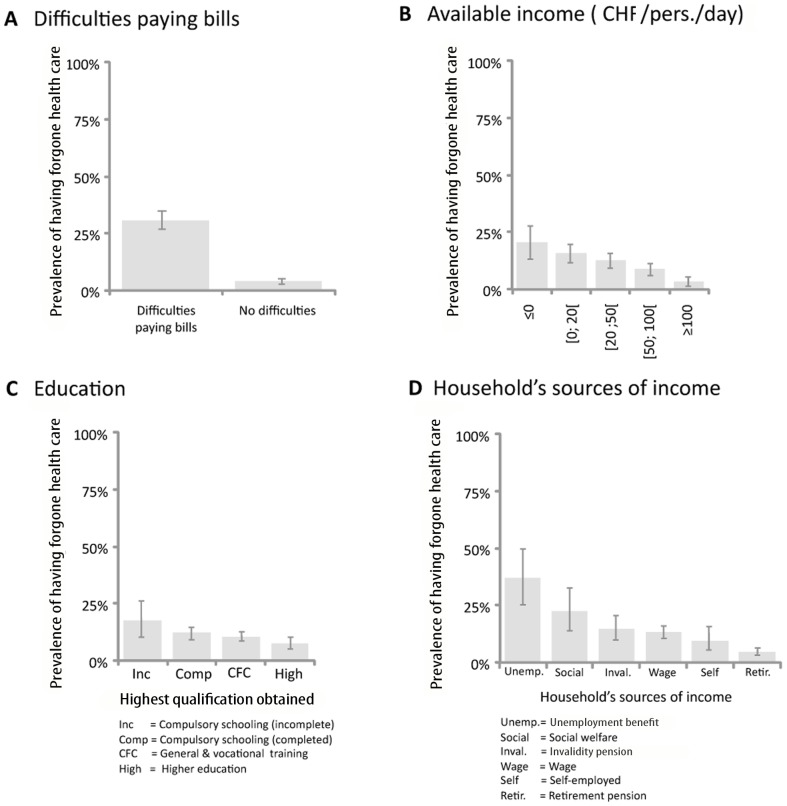
Overall, 2,026 patients were included in the analysis; 10.7% (CI95% 9.4-12.1) reported a member of their household to have forgone health care during the 12 previous months. The question "Did you have difficulties paying your household bills during the last 12 months" performed better in identifying patients at risk of forgoing health care than a combination of four objective measures of socio-economic status (gender, age, education level, and income) (R(2) = 0.184 vs. 0.083). This question effectively ruled out that patients had forgone health care, with a negative predictive value of 96%. Furthermore, for physicians who felt powerless in the face of deprivation, we observed an increase in the odds of patients forgoing health care of 1.5 times.
General practitioners should systematically evaluate the socio-economic status of their patients. Asking patients whether they experience any difficulties in paying their bills is an effective means of identifying patients who might forgo health care.
社会不平等现象日益加剧,这使得全科医生核实患者是否负担得起治疗和医疗程序变得至关重要。将社会状况纳入临床决策,能让全科医生解决患者医疗保健需求与经济资源之间的不匹配问题。
确定一个筛查问题,以间接排除患者因经济原因放弃医疗保健的社会风险,并估计放弃医疗保健的患病率以及医生对贫困态度的影响。
多中心横断面调查。
在瑞士法语区工作的47名全科医生,随机抽取了在其私人诊所就诊的患者样本。
通过一份自填问卷,将在过去12个月内报告有家庭成员(包括其本人)因经济原因放弃治疗的患者定义为放弃医疗保健的患者。还询问了患者的教育和收入水平、自我感知的社会地位以及贫困程度。
总体而言,2026名患者纳入分析;10.7%(95%置信区间9.4 - 12.1)报告其家庭成员在过去12个月内放弃了医疗保健。“在过去12个月里,您支付家庭账单有困难吗?”这个问题在识别有放弃医疗保健风险的患者方面,比社会经济地位的四项客观指标(性别、年龄、教育水平和收入)的组合表现更好(R² = 0.184对0.083)。这个问题有效地排除了患者放弃医疗保健的情况,阴性预测值为96%。此外,对于那些面对贫困感到无力的医生,我们观察到患者放弃医疗保健的几率增加了1.5倍。
全科医生应系统地评估患者的社会经济状况。询问患者支付账单是否有困难是识别可能放弃医疗保健患者的有效方法。