Recla Jill M, Robledo Raymond F, Gatti Daniel M, Bult Carol J, Churchill Gary A, Chesler Elissa J
IGERT Program in Functional Genomics, Graduate School of Biomedical Sciences and Engineering, The University of Maine, Orono, ME, 04469, USA,
Mamm Genome. 2014 Jun;25(5-6):211-22. doi: 10.1007/s00335-014-9508-0. Epub 2014 Apr 5.
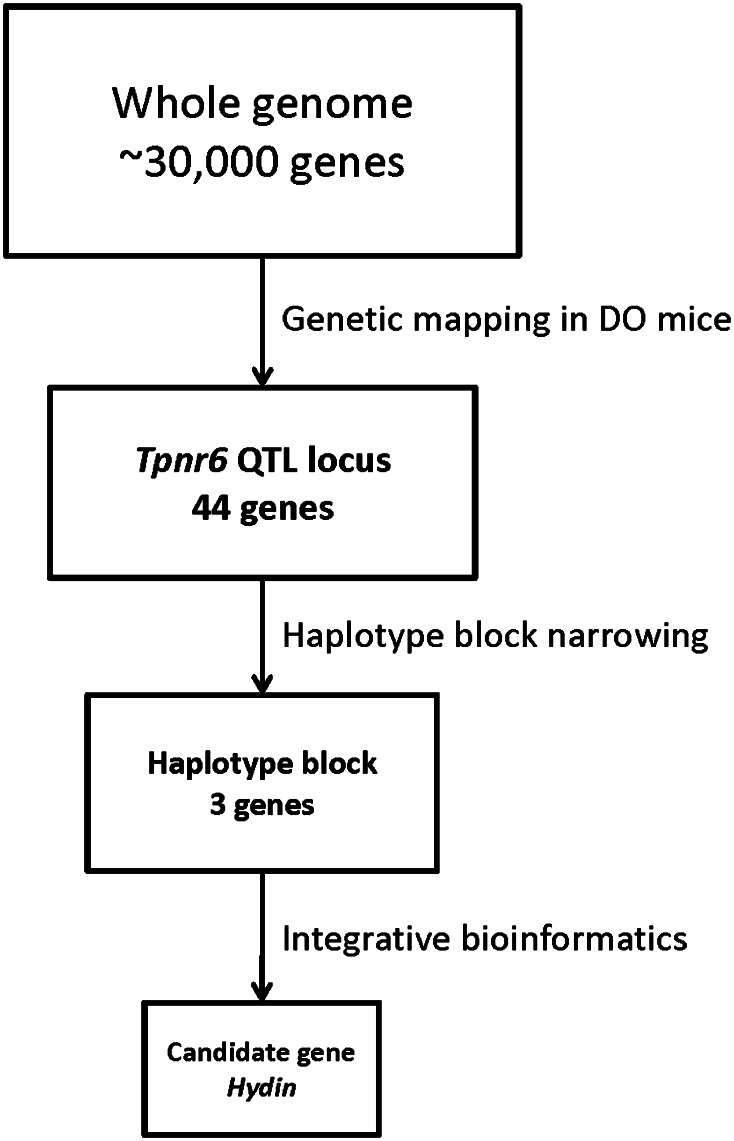
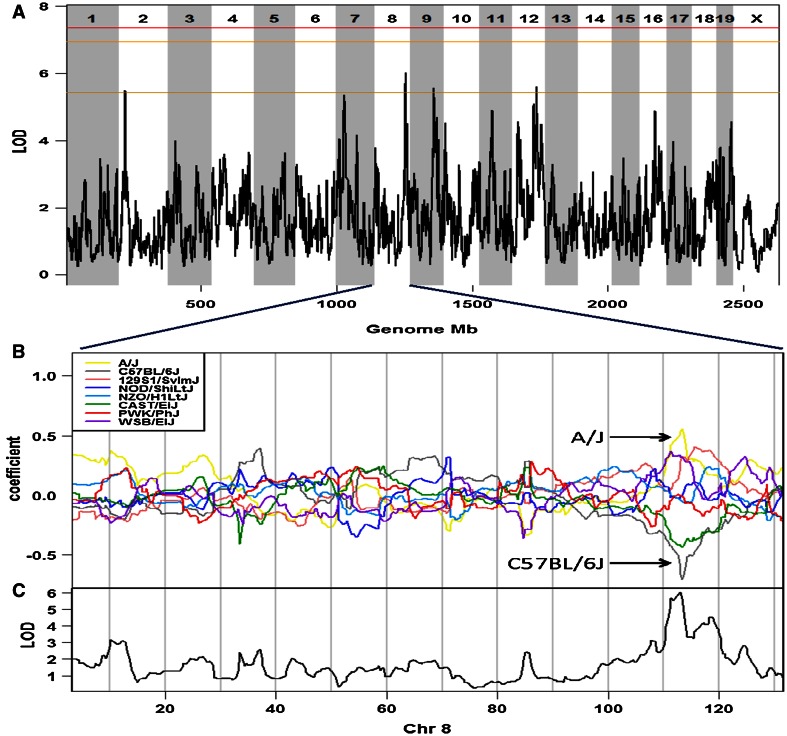
Mouse genetics is a powerful approach for discovering genes and other genome features influencing human pain sensitivity. Genetic mapping studies have historically been limited by low mapping resolution of conventional mouse crosses, resulting in pain-related quantitative trait loci (QTL) spanning several megabases and containing hundreds of candidate genes. The recently developed Diversity Outbred (DO) population is derived from the same eight inbred founder strains as the Collaborative Cross, including three wild-derived strains. DO mice offer increased genetic heterozygosity and allelic diversity compared to crosses involving standard mouse strains. The high rate of recombinatorial precision afforded by DO mice makes them an ideal resource for high-resolution genetic mapping, allowing the circumvention of costly fine-mapping studies. We utilized a cohort of ~300 DO mice to map a 3.8 Mbp QTL on chromosome 8 associated with acute thermal pain sensitivity, which we have tentatively named Tpnr6. We used haplotype block partitioning to narrow Tpnr6 to a width of ~230 Kbp, reducing the number of putative candidate genes from 44 to 3. The plausibility of each candidate gene's role in pain response was assessed using an integrative bioinformatics approach, combining data related to protein domain, biological annotation, gene expression pattern, and protein functional interaction. Our results reveal a novel, putative role for the protein-coding gene, Hydin, in thermal pain response, possibly through the gene's role in ciliary motility in the choroid plexus-cerebrospinal fluid system of the brain. Real-time quantitative-PCR analysis showed no expression differences in Hydin transcript levels between pain-sensitive and pain-resistant mice, suggesting that Hydin may influence hot-plate behavior through other biological mechanisms.
小鼠遗传学是发现影响人类疼痛敏感性的基因和其他基因组特征的有力方法。传统小鼠杂交的低定位分辨率一直限制着遗传图谱研究,导致与疼痛相关的数量性状位点(QTL)跨越几个兆碱基,包含数百个候选基因。最近开发的多样性远交(DO)群体与协作杂交群体一样,源自相同的八个近交奠基品系,包括三个野生衍生品系。与涉及标准小鼠品系的杂交相比,DO小鼠具有更高的遗传杂合性和等位基因多样性。DO小鼠提供的高重组精度使其成为高分辨率遗传图谱绘制的理想资源,从而无需进行成本高昂的精细图谱研究。我们利用一组约300只DO小鼠,在8号染色体上定位了一个与急性热痛敏感性相关的3.8兆碱基对的QTL,我们暂时将其命名为Tpnr6。我们使用单倍型块划分将Tpnr6缩小到约230千碱基对的宽度,将推定的候选基因数量从44个减少到3个。使用综合生物信息学方法评估了每个候选基因在疼痛反应中作用的合理性,该方法结合了与蛋白质结构域、生物学注释、基因表达模式和蛋白质功能相互作用相关的数据。我们的结果揭示了蛋白质编码基因Hydin在热痛反应中的一种新的推定作用,可能是通过该基因在脑脉络丛 - 脑脊液系统中纤毛运动的作用。实时定量PCR分析表明,疼痛敏感小鼠和疼痛抵抗小鼠之间Hydin转录本水平没有表达差异,这表明Hydin可能通过其他生物学机制影响热板行为。