Otieno Nickson Erick, Analo Caleb
National Museums of Kenya, Nairobi, Kenya.
Kakamega Environmental Education Project, Shinyalu, Kenya.
F1000Res. 2012 Oct 31;1:40. doi: 10.12688/f1000research.1-40.v2. eCollection 2012.
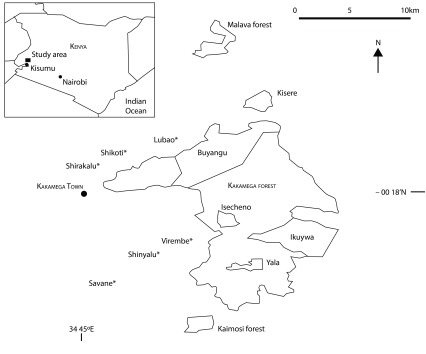
Kakamega forest is Kenya's only rainforest and is distinguishably rich in biodiversity but threatened by agricultural encroachment and other forms of human activity. It is also one of Kenya's Important Bird Areas and a significant source of natural products to neighboring rural communities, such as medicinal plants, food, wood and other fibers. By using structured questionnaires for direct interviews, local indigenous knowledge was tapped through involvement of a focal group of elderly key informants in three blocks of the forest. Forty key species of medicinal plants used by local people were identified and recorded. Fifty-five percent of these were shrubs, thirty-two percent trees, seven-and-a-half percent lower plants such as herbs or forbs while five percent were climbers. About seventy percent of the medicinal plants occurred inside the forest itself and thirty percent around the edge and the immediate surroundings outside the forest. Thirty-eight (95%) of the plants were indigenous to Kenya and two (5%) exotic. Such extensive indigenous knowledge of the medicinal uses of the plants, including their distribution trends in the forest, may be tapped for decision support in rural health service planning, policy formulation for conserving the forest, tracking and mitigation of climate change impacts.
卡卡梅加森林是肯尼亚唯一的雨林,生物多样性极为丰富,但受到农业侵占和其他人类活动形式的威胁。它也是肯尼亚的重要鸟类栖息地之一,是周边农村社区天然产品的重要来源,如药用植物、食物、木材和其他纤维。通过使用结构化问卷进行直接访谈,通过让森林三个区域的老年关键信息提供者组成的焦点小组参与,挖掘了当地的本土知识。确定并记录了当地人使用的40种主要药用植物。其中55%是灌木,32%是树木,7.5%是草本植物或杂草等较低等植物,5%是攀缘植物。约70%的药用植物生长在森林内部,30%生长在森林边缘及紧邻森林的周边地区。38种(95%)植物原产于肯尼亚,2种(5%)是外来植物。这种关于植物药用用途的广泛本土知识,包括它们在森林中的分布趋势,可用于农村卫生服务规划的决策支持、森林保护政策制定、气候变化影响的跟踪和缓解。