
肯尼亚一个旱地植物园及其周边地区的民族植物学调查:穆托莫山植物保护区
An Ethnobotanical Survey of a Dryland Botanical Garden and Its Environs in Kenya: The Mutomo Hill Plant Sanctuary.
作者信息
Mutie Fredrick Munyao, Gao Lun-Lun, Kathambi Vivian, Rono Peninah Cheptoo, Musili Paul Mutuku, Ngugi Grace, Hu Guang-Wan, Wang Qing-Feng
机构信息
CAS Key Laboratory of Plant Germplasm Enhancement and Speciality Agriculture, Wuhan Botanical Garden, Chinese Academy of Sciences, Wuhan 430074, China.
Sino-Africa Joint Research Center, Chinese Academy of Sciences, Wuhan 430074, China.
出版信息
Evid Based Complement Alternat Med. 2020 Mar 17;2020:1543831. doi: 10.1155/2020/1543831. eCollection 2020.
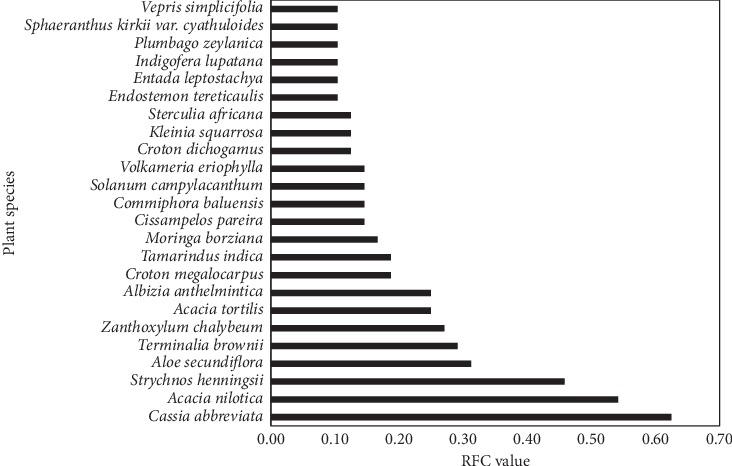
Mutomo hill plant sanctuary is a ten-hectare piece of land in Kenya listed as a botanical garden under the Botanical Gardens Conservation International, originally established in 1964 with the aim of conserving indigenous flora from destructive anthropogenic activities. This paper presents ethnobotanical documentation of medicinal plants of Mutomo hill plant sanctuary and its environs. An ethnobotanical survey was carried out in Mutomo hill plant sanctuary and its environs with 48 herbalists aged between 32 and 96 years from July 2018 to February 2019 using a semistructured open-ended questionnaire. The plants were collected through random surveys with each herbalist in different ecotypes around the villages and within the Mutomo hill plant sanctuary. The Relative Frequency of Citation (RFC) for each species reported was calculated to determine the plant species frequently collected. In total, 68 different plant species distributed in 28 families and 54 genera were reported. The frequently used plant families were Leguminosae (13 species), Lamiaceae (6 species), and Euphorbiaceae (6 species). Shrubs (37%) and trees (34%) were the dominant growth habits reported. The most cited plant species were Oliv. (RFC = 0.63), (L.). Delile (RFC = 0.54), Gilg (RFC = 0.46), and Engl. (RFC = 0.31). Root (19 species) and bark (19 species) were the frequently collected plant parts. Infectious diseases (33) and digestive system disorders (24) were reported to be managed with the majority of the plant species. This study contributes to safeguarding the traditional knowledge on medicinal plants in the study area, which is useful in appreciating and acknowledging the cultural heritage of the Kamba people from the local perspective of Mutomo area in Kenya. It also adds to the knowledge base and documentation of medicinal plants, which is useful information as potential data for drug development.
穆托莫山植物保护区位于肯尼亚,占地10公顷,被国际植物园保护联盟列为植物园。该保护区最初建于1964年,旨在保护本土植物免受破坏性人类活动的影响。本文介绍了穆托莫山植物保护区及其周边地区药用植物的民族植物学记录。2018年7月至2019年2月,对穆托莫山植物保护区及其周边地区48名年龄在32岁至96岁之间的草药医生进行了民族植物学调查,采用半结构化开放式问卷。通过在村庄周围不同生态类型以及穆托莫山植物保护区内对每位草药医生进行随机调查来收集植物。计算所报告的每个物种的相对引用频率(RFC),以确定经常收集的植物物种。总共报告了分布在28个科和54个属中的68种不同植物物种。常用的植物科为豆科(13种)、唇形科(6种)和大戟科(6种)。报告的主要生长习性为灌木(37%)和乔木(34%)。引用最多的植物物种是奥利弗(RFC = 0.63)、(L.)。德利尔(RFC = 0.54)、吉尔格(RFC = 0.46)和恩格尔(RFC = 0.31)。根(19种)和树皮(19种)是经常收集的植物部位。据报告,大多数植物物种用于治疗传染病(33种)和消化系统疾病(24种)。本研究有助于保护研究区域内关于药用植物的传统知识,这对于从肯尼亚穆托莫地区的当地视角欣赏和认可坎巴人的文化遗产很有用。它还增加了药用植物的知识库和记录,作为药物开发的潜在数据,这些信息很有用。


 Zotero 插件