Kumaravel V, Shriraam Vanishree, Anitharani M, Mahadevan S, Balamurugan A N, Sathiyasekaran B W C
Institute of Diabetes and Endocrinology, Alpha Hospital and Research Center, Madurai, Tamil Nadu, India.
Department of Community Medicine, Sri Ramachandra Medical College and Research Institute, Porur, Chennai, Tamil Nadu, India.
Indian J Endocrinol Metab. 2014 Jan;18(1):56-62. doi: 10.4103/2230-8210.126541.
India currently is posed by the double threat of thinness and overweight/obesity among children. Different growth charts have taken different population and give different cut-off points to assess these conditions.
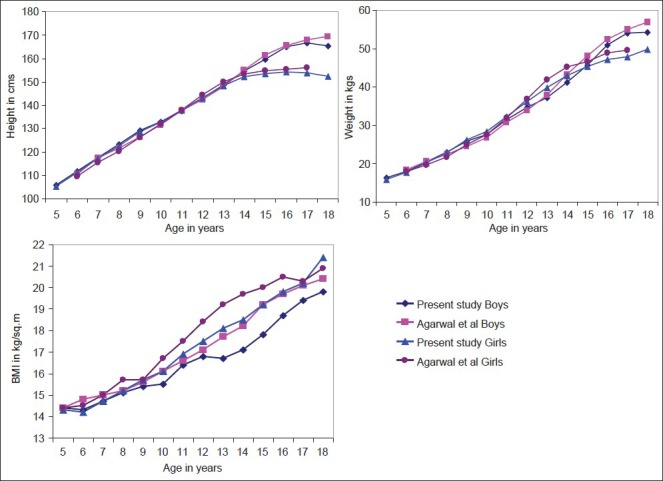
The objective of this study is to assess the anthropometry of school children, 5-18 years of age and thereby estimate the prevalence of childhood thinness, overweight and obesity. To analyze how the study population compares with that of Agarwal's growth chart.
The anthropometric measurements of all the students who were studying from 1(st) to 12(th) standards were taken from 27 randomly selected Government and private schools. Prevalence of thinness, overweight and obesity were assessed using two standards - Indian standard given by Agarwal and International Standards given by International Obesity Task Force (IOTF).
The prevalence of thinness, overweight and obesity among 18,001 students enrolled as per Indian standard were 12.2%, 9.5% and 3% and as per International standard were 15.3%, 8.1% and 2.6% respectively. The mean and the 95(th) percentile values of body mass index for both boys and girls at all ages in this study are falling short of Agarwal's and IOTF values. Using international cut-offs as well as Indian cut-offs given by Agarwal, underestimate the prevalence of obesity among boys and girls of all age groups.
This study shows that under and over-nutrition among school children is in almost equal proportions. There is an underestimation of obesity among children whenever an Indian or an International growth chart is used. Thus, this study brings out the need for a really representative growth chart.
印度目前面临儿童消瘦和超重/肥胖的双重威胁。不同的生长图表针对不同人群,给出不同的临界点来评估这些情况。
本研究的目的是评估5至18岁学童的人体测量数据,从而估计儿童消瘦、超重和肥胖的患病率。分析研究人群与阿加瓦尔生长图表的人群相比情况如何。
从27所随机选取的政府和私立学校中,对所有就读于1年级至12年级的学生进行人体测量。使用阿加瓦尔给出的印度标准和国际肥胖问题工作组(IOTF)给出的国际标准这两种标准,评估消瘦、超重和肥胖的患病率。
按照印度标准登记的18001名学生中,消瘦、超重和肥胖的患病率分别为12.2%、9.5%和3%;按照国际标准分别为15.3%、8.1%和2.6%。本研究中所有年龄段男孩和女孩的体重指数均值及第95百分位数均低于阿加瓦尔和IOTF的值。使用国际临界点以及阿加瓦尔给出的印度临界点,均低估了各年龄组男孩和女孩的肥胖患病率。
本研究表明,学童中营养不足和营养过剩的比例几乎相等。无论使用印度还是国际生长图表,儿童肥胖率都被低估。因此,本研究表明需要一个真正具有代表性的生长图表。