Huang Zhiquan, Tan Ning, Guo Weijie, Wang Lili, Li Haigang, Zhang Tianyu, Liu Xiaojia, Xu Qin, Li Jinsong, Guo Zhongmin
Department of Oral and Maxillofacial Surgery, Sun Yat-sen Memorial Hospital, Sun Yat-sen University, Guangzhou, Guangdong, China.
Guangxi Key Laboratory of Molecular Medicine in Liver Injury and Repair, Guilin Medical College, Guilin, Guangxi, China.
PLoS One. 2014 Apr 4;9(4):e91596. doi: 10.1371/journal.pone.0091596. eCollection 2014.
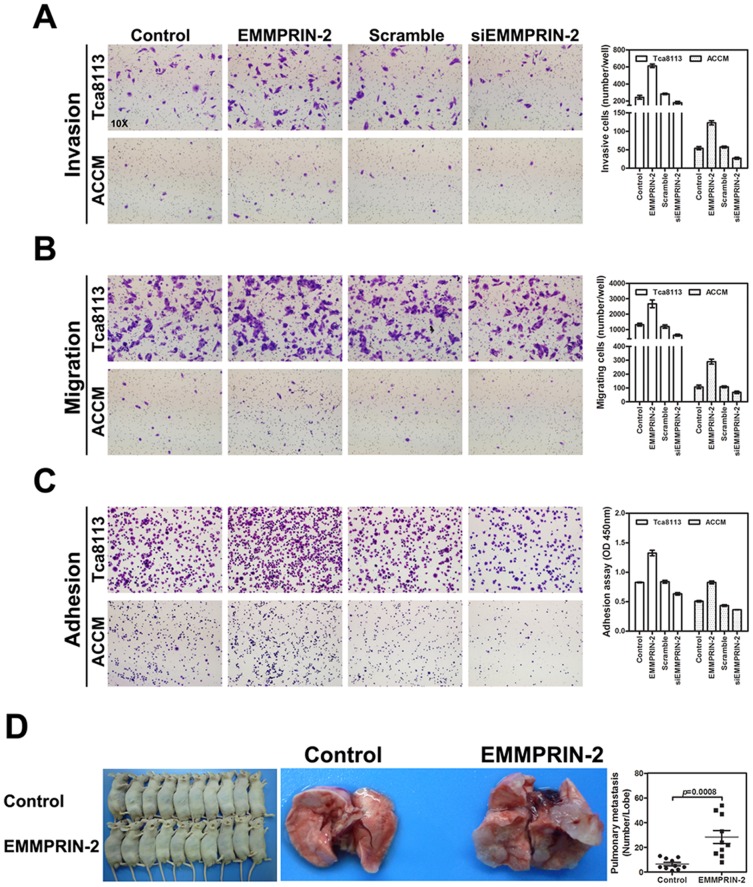
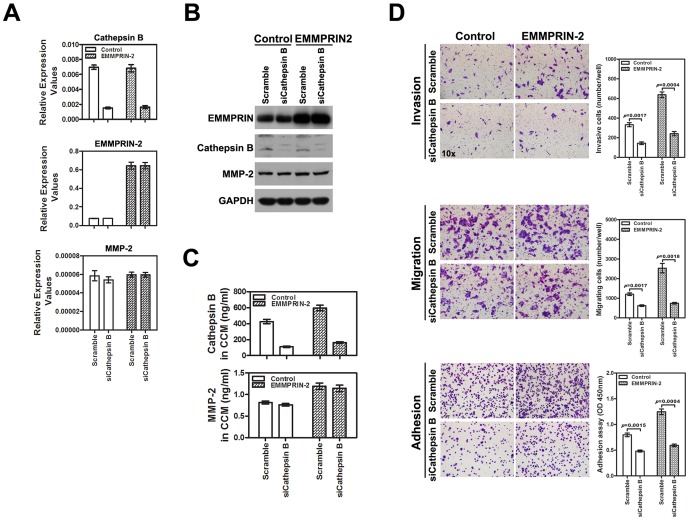
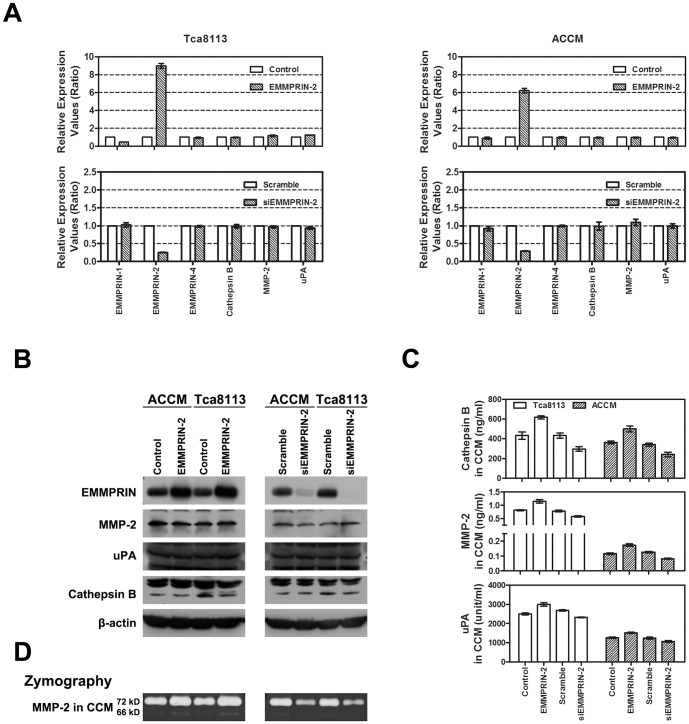
Extracellular matrix metalloproteinase inducer (EMMPRIN), a plasma membrane protein of the immunoglobulin (Ig) superfamily, has been reported to promote cancer cell invasion and metastasis in several human malignancies. However, the roles of the different EMMPRIN isoforms and their associated mechanisms in head and neck cancer progression remain unknown. Using quantitative real-time PCR, we found that EMMPRIN isoform 2 (EMMPRIN-2) was the only isoform that was overexpressed in both head and neck cancer tissues and cell lines and that it was associated with head and neck cancer metastasis. To determine the effects of EMMPRIN-2 on head and neck cancer progression, we transfected head and neck cancer cells with an EMMPRIN-2 expression vector and EMMPRIN-2 siRNA to exogenously modulate EMMPRIN-2 expression and examined the functional importance of EMMPRIN-2 in head and neck cancer invasion and metastasis. We found that EMMPRIN-2 promoted head and neck cancer cell invasion, migration, and adhesion in vitro and increased lung metastasis in vivo. Mechanistic studies revealed that EMMPRIN-2 overexpression promoted the secretion of extracellular signaling molecules, including matrix metalloproteinases-2(MMP-2), urokinase-type plasminogen activator(uPA) and Cathepsin B, in head and neck cancer cells. While MMP-2 and uPA have been demonstrated to be important mediators of EMMPRIN signaling, the role of Cathepsin B in EMMPRIN-mediated molecular cascades and tumorigenesis has not been established. We found that EMMPRIN-2 overexpression and Cathepsin B down-regulation significantly inhibited the invasion, migration and adhesion of Tca8133 cells, suggesting that Cathepsin B is required for EMMPRIN-2 enhanced cell migration and invasion in head and neck cancer. The results of our study demonstrate the important role of EMMPRIN-2 in head and neck cancer progression for the first time and reveal that increased extracellular secretion of Cathepsin B may be a novel mechanism underlying EMMPRIN-2 enhanced tumor progression in head and neck cancer.
细胞外基质金属蛋白酶诱导剂(EMMPRIN)是免疫球蛋白(Ig)超家族的一种质膜蛋白,据报道在多种人类恶性肿瘤中可促进癌细胞的侵袭和转移。然而,不同EMMPRIN亚型及其相关机制在头颈癌进展中的作用仍不清楚。通过定量实时PCR,我们发现EMMPRIN亚型2(EMMPRIN-2)是头颈癌组织和细胞系中唯一过表达的亚型,且它与头颈癌转移相关。为了确定EMMPRIN-2对头颈癌进展的影响,我们用EMMPRIN-2表达载体和EMMPRIN-2 siRNA转染头颈癌细胞,以外源调节EMMPRIN-2表达,并研究EMMPRIN-2在头颈癌侵袭和转移中的功能重要性。我们发现EMMPRIN-2在体外促进头颈癌细胞的侵袭、迁移和黏附,并在体内增加肺转移。机制研究表明,EMMPRIN-2过表达促进头颈癌细胞中细胞外信号分子的分泌,包括基质金属蛋白酶-2(MMP-2)、尿激酶型纤溶酶原激活剂(uPA)和组织蛋白酶B。虽然MMP-2和uPA已被证明是EMMPRIN信号的重要介质,但组织蛋白酶B在EMMPRIN介导的分子级联反应和肿瘤发生中的作用尚未明确。我们发现EMMPRIN-2过表达和组织蛋白酶B下调显著抑制Tca8133细胞的侵袭、迁移和黏附,表明组织蛋白酶B是EMMPRIN-2增强头颈癌细胞迁移和侵袭所必需的。我们的研究结果首次证明了EMMPRIN-2在头颈癌进展中的重要作用,并揭示组织蛋白酶B细胞外分泌增加可能是EMMPRIN-2促进头颈癌肿瘤进展的新机制。