Sim Sung Hoon, Kang Mi-Hyun, Kim Yu Jung, Lee Keun-Wook, Kim Duck-Woo, Kang Sung-Bum, Eom Keun-Yong, Kim Jae-Sung, Lee Hye Seung, Kim Jee Hyun
Department of Internal Medicine, Seoul National University Bundang Hospital, Seoul National University College of Medicine, 82, Gumi-ro 173 beon-gil, Bundang-gu, Seongnam 463-707, Korea.
BMC Cancer. 2014 Apr 4;14:241. doi: 10.1186/1471-2407-14-241.
Pre-operative chemoradiotherapy (CRT) is the standard treatment in clinical stage T3/4 or node positive rectal cancer. However, there are no established biomarkers that can predict the pathological response and clinical outcome to CRT.
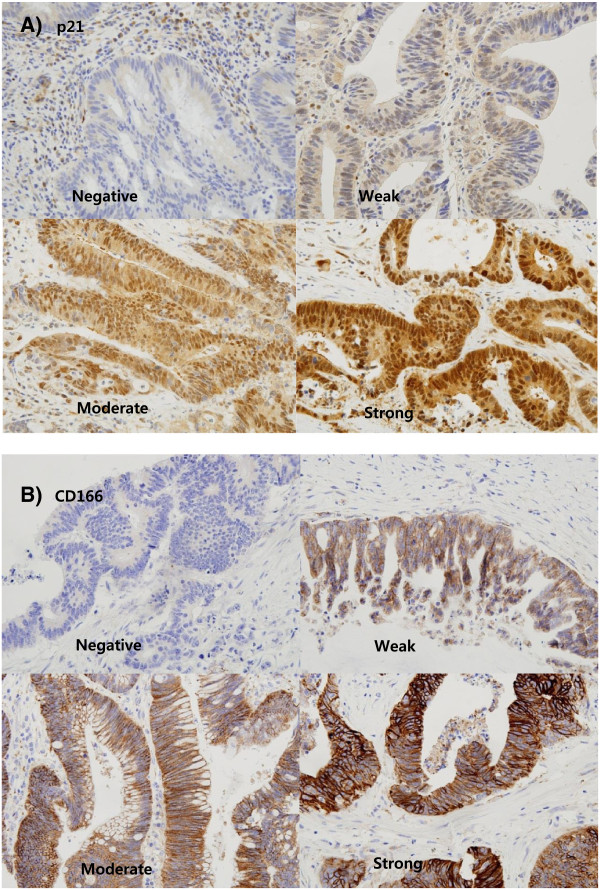
Immunohistochemical staining was performed in tissue arrays constructed from core tissue specimens taken before treatment and from operative specimens from 112 patients who received 5-FU based pre-operative CRT and surgery. Expression of Ki67, TS, BAX, EpCAM, p53, p21, EGFR, CD44, CD133, CD166, HIF1α and ALDH1 were assessed and correlated with tumor regression grades and disease free survival.
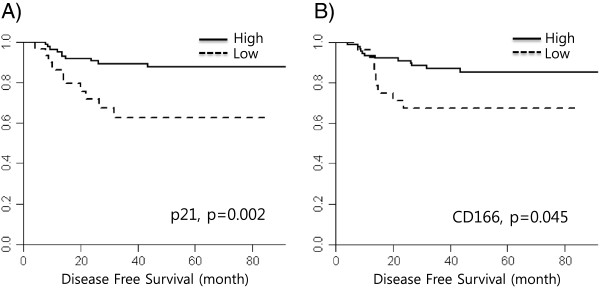
Of the 112 patients (M/F 74/38, median age: 62), 20 (17.9%) patients achieved pathologic complete remission (pCR). In analyzing the associations between marker expressions and tumor regression grades, high p21 expression at the pretreatment biopsy was significantly associated with non-pCR (p = 0.022) and poor disease free survival (median DFS - low vs high p21: 75.8 vs 58.1 months, p = 0.002). In the multivariate analysis, high p21 expression level at the pre-treatment biopsy was significantly associated with poor DFS (p = 0.001, HR 6.14; 95% CI 2.03, 18.55). High CD166 expression level at the pretreatment biopsy was also associated with poor DFS (p = 0.003; HR 5.61; 95% CI 1.81, 17.35).
These show high p21 and CD166 expression at the pretreatment biopsy were associated with tumor regression and poor prognosis in patients treated with 5-FU based CRT. Larger, prospective and functional studies are warranted to determine the role of p21 and CD166 as predictive biomarker of response to CRT.
术前放化疗(CRT)是临床分期为T3/4期或淋巴结阳性直肠癌的标准治疗方法。然而,目前尚无已确立的生物标志物能够预测CRT的病理反应和临床结局。
对112例接受基于5-氟尿嘧啶的术前CRT及手术治疗的患者,在治疗前采集的核心组织标本及手术标本构建的组织芯片上进行免疫组织化学染色。评估Ki67、胸苷合成酶(TS)、BAX、上皮细胞黏附分子(EpCAM)、p53、p21、表皮生长因子受体(EGFR)、CD44、CD133、CD166、缺氧诱导因子1α(HIF1α)和乙醛脱氢酶1(ALDH1)的表达,并将其与肿瘤消退分级和无病生存期相关联。
112例患者(男/女为74/38,中位年龄62岁)中,20例(17.9%)患者达到病理完全缓解(pCR)。在分析标志物表达与肿瘤消退分级之间的关联时,治疗前活检时p21高表达与非pCR显著相关(p = 0.022)且无病生存期较差(中位无病生存期 - p21低表达组与高表达组:75.8个月对58.1个月,p = 0.002)。在多因素分析中,治疗前活检时p21高表达水平与较差的无病生存期显著相关(p = 0.001,风险比6.14;95%置信区间2.03, 18.55)。治疗前活检时CD166高表达水平也与较差的无病生存期相关(p = 0.003;风险比5.61;95%置信区间1.81, 17.35)。
这些结果表明,治疗前活检时p21和CD166高表达与接受基于5-氟尿嘧啶的CRT治疗患者的肿瘤消退及不良预后相关。有必要开展更大规模的前瞻性和功能性研究,以确定p21和CD166作为CRT反应预测生物标志物的作用。