van Dijk Peter R, Logtenberg Susan J J, Groenier Klaas H, Gans Rijk O B, Kleefstra Nanne, Bilo Henk Jg
Diabetes Centre, Isala, P,O, box 10400, 8000G,K Zwolle, The Netherlands.
BMC Endocr Disord. 2014 Apr 7;14:30. doi: 10.1186/1472-6823-14-30.
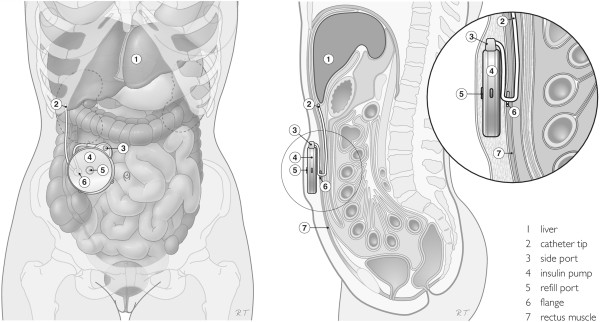
Continuous intraperitoneal insulin infusion (CIPII) with an implantable pump is a treatment option for patients with type 1 diabetes mellitus (T1DM). Aim of the present study was to describe the long-term course of glycaemic control, complications, health related quality of life (HRQOL) and treatment satisfaction among T1DM patients treated with CIPII.
Nineteen patients that participated in a randomized cross-over trial comparing CIPII and subcutaneous (SC) therapy in 2006 were followed until 2012. Laboratory, continuous glucose monitoring, HRQOL and treatment satisfaction measurements were performed at the start of the study, the end of the SC-, the end of the CIPII treatment phase in 2006 and during CIPII therapy in 2012. Linear mixed models were used to calculate estimated values and to test differences between the moments in time.
In 2012, more time was spent in hyperglycaemia than after the CIPII treatment phase in 2006: 37% (95% CI 29, 44) vs. 55% (95% CI 48, 63), mean difference 19.8% (95% CI 3.0, 36.6). HbA1c was 65 mmol/mol (95% CI 60, 71) at the end of the SC treatment phase in 2006, 58 mmol/mol (95% CI 53, 64) at the end of the CIPII treatment phase and 65 mmol/mol (95% CI 60, 71) in 2012, respectively (p > 0.05). In 2012, the median number of grade 2 hypoglycaemic events per week (1 (95% CI 0, 2)) was still significantly lower than during prior SC therapy (3 (95% CI 2, 4)): mean change -1.8 (95% CI -3.4, -0.4). Treatment satisfaction with CIPII was better than with SC insulin therapy and HRQOL remained stable. Pump or catheter dysfunction of the necessitated re-operation in 7 patients. No mortality was reported.
After 6 years of CIPII treatment, glycaemic regulation is stable and the number of hypoglycaemic events decreased compared to SC insulin therapy. Treatment satisfaction with CIPII is superior to SC insulin therapy, HRQOL is stable and complications are scarce. CIPII is a safe and effective treatment option for selected patients with T1DM, also on longer term.
使用植入式泵进行持续腹腔内胰岛素输注(CIPII)是1型糖尿病(T1DM)患者的一种治疗选择。本研究的目的是描述接受CIPII治疗的T1DM患者血糖控制的长期过程、并发症、健康相关生活质量(HRQOL)和治疗满意度。
19名在2006年参与比较CIPII和皮下(SC)治疗的随机交叉试验的患者被随访至2012年。在研究开始时、2006年SC治疗阶段结束时、2006年CIPII治疗阶段结束时以及2012年CIPII治疗期间进行实验室检查、连续血糖监测、HRQOL和治疗满意度测量。使用线性混合模型计算估计值并检验不同时间点之间的差异。
2012年,高血糖持续时间比2006年CIPII治疗阶段后更长:37%(95%CI 29,44)对55%(95%CI 48,63),平均差异19.8%(95%CI 3.0,36.6)。2006年SC治疗阶段结束时糖化血红蛋白(HbA1c)为65 mmol/mol(95%CI 60,71),2006年CIPII治疗阶段结束时为58 mmol/mol(95%CI 53,64),2012年为65 mmol/mol(95%CI 60,71)(p>0.05)。2012年,每周2级低血糖事件的中位数(1(95%CI 0,2))仍显著低于之前的SC治疗期间(3(95%CI 2,4)):平均变化-1.8(95%CI -3.4,-0.4)。对CIPII的治疗满意度优于SC胰岛素治疗,且HRQOL保持稳定。7名患者因泵或导管功能障碍需要再次手术。无死亡报告。
CIPII治疗6年后,血糖调节稳定,与SC胰岛素治疗相比低血糖事件数量减少。对CIPII的治疗满意度优于SC胰岛素治疗,HRQOL稳定且并发症少见。CIPII是部分T1DM患者的一种安全有效的治疗选择,长期应用亦是如此。