Oshiro Akiko, Yanagida Yuichiro, Gando Satoshi, Henzan Naomi, Takahashi Isao, Makise Hiroshi
Crit Care. 2014 Apr 3;18(2):R61. doi: 10.1186/cc13816.
We tested two hypotheses that disseminated intravascular coagulation (DIC) and acute coagulopathy of trauma-shock (ACOTS) in the early phase of trauma are similar disease entities and that the DIC score on admission can be used to predict the prognosis of patients with coagulopathy of trauma.
We conducted a retrospective study of 562 trauma patients, including 338 patients whose data were obtained immediately after admission to the emergency department. We collected serial data for the platelet counts, global markers of coagulation and fibrinolysis, and antithrombin levels. DIC was diagnosed according to the Japanese Association for Acute Medicine (JAAM) DIC scoring system, and ACOTS was defined as a prothrombin-time ratio of >1.2.
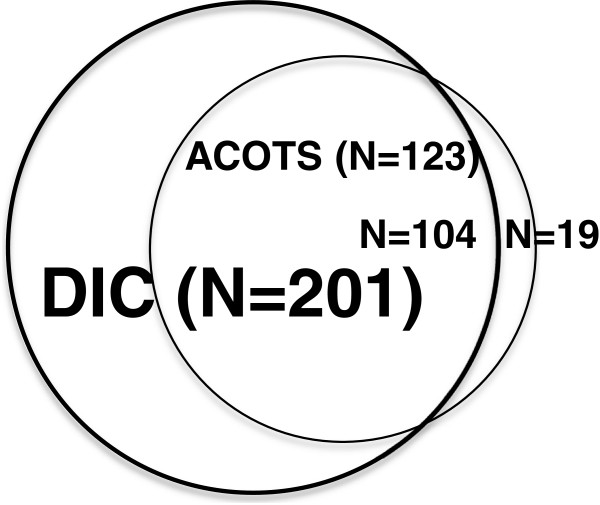
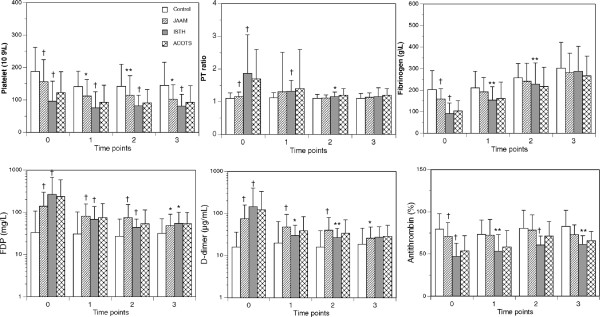
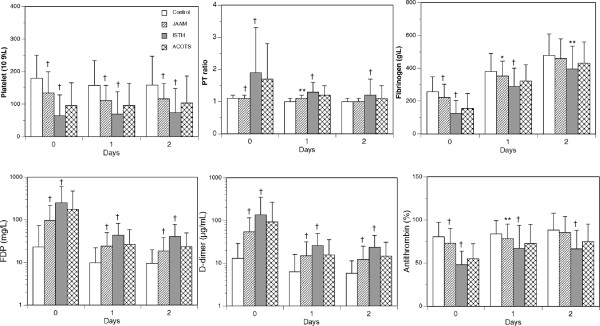
The higher levels of fibrin/fibrinogen degradation products (FDP) and D-dimer and greater FDP/D-dimer ratios in the DIC patients suggested DIC with the fibrinolytic phenotype. The DIC patients with the fibrinolytic phenotype exhibited persistently lower platelet counts and fibrinogen levels, increased prothrombin time ratios, higher FDP and D-dimer levels, and lower antithrombin levels compared with the non-DIC patients on arrival to the emergency department and during the early stage of trauma. Almost all ACOTS patients met the criteria for a diagnosis of DIC; therefore, the same changes were observed in the platelet counts, global markers of coagulation and fibrinolysis, and antithrombin levels as noted in the DIC patients. The JAAM DIC score obtained immediately after arrival to the emergency department was an independent predictor of massive transfusion and death due to trauma and correlated with the amount of blood transfused.
Patients who develop DIC with the fibrinolytic phenotype during the early stage of trauma exhibit consumption coagulopathy associated with increased fibrin(ogen)olysis and lower levels of antithrombin. The same is true in patients with ACOTS. The JAAM DIC score can be used to predict the prognosis of patients with coagulopathy of trauma.
我们检验了两个假说,即创伤早期的弥散性血管内凝血(DIC)和创伤性休克急性凝血病(ACOTS)是相似的疾病实体,以及入院时的DIC评分可用于预测创伤凝血病患者的预后。
我们对562例创伤患者进行了一项回顾性研究,其中338例患者的数据是在急诊科入院后立即获取的。我们收集了血小板计数、凝血和纤维蛋白溶解的整体标志物以及抗凝血酶水平的系列数据。根据日本急性医学协会(JAAM)DIC评分系统诊断DIC,ACOTS定义为凝血酶原时间比值>1.2。
DIC患者中纤维蛋白/纤维蛋白原降解产物(FDP)和D - 二聚体水平较高以及FDP/D - 二聚体比值更大,提示为具有纤维蛋白溶解表型的DIC。与非DIC患者相比,具有纤维蛋白溶解表型的DIC患者在到达急诊科时和创伤早期血小板计数和纤维蛋白原水平持续较低,凝血酶原时间比值升高,FDP和D - 二聚体水平较高,抗凝血酶水平较低。几乎所有ACOTS患者都符合DIC诊断标准;因此,在血小板计数、凝血和纤维蛋白溶解的整体标志物以及抗凝血酶水平方面观察到与DIC患者相同的变化。到达急诊科后立即获得的JAAM DIC评分是大量输血和创伤死亡的独立预测指标,并且与输血量相关。
在创伤早期发生具有纤维蛋白溶解表型DIC的患者表现出与纤维蛋白(原)溶解增加和抗凝血酶水平降低相关的消耗性凝血病。ACOTS患者也是如此。JAAM DIC评分可用于预测创伤凝血病患者的预后。