Hayakawa Mineji
Emergency and Critical Care Center, Hokkaido University Hospital, N14W5 Kita-ku, Sapporo, 060-8648, Japan.
J Intensive Care. 2017 Jan 20;5(1):3. doi: 10.1186/s40560-016-0199-3.
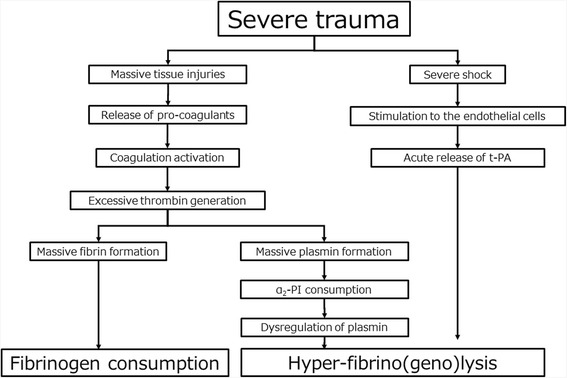
Fibrinogen is a unique precursor of fibrin and cannot be compensated for by other coagulation factors. If plasma fibrinogen concentrations are insufficient, hemostatic clots cannot be formed with the appropriate firmness. In severe trauma patients, plasma fibrinogen concentrations decrease earlier and more frequently than other coagulation factors, predicting massive bleeding and death. We review the mechanisms of plasma fibrinogen concentration decrease, which include coagulation activation-induced consumption, hyper-fibrino(geno)lysis-induced degradation, and dilution by infusion/transfusion. Understanding the mechanisms of plasma fibrinogen concentration decrease in severe trauma patients is crucial.
纤维蛋白原是纤维蛋白的独特前体,不能被其他凝血因子代偿。如果血浆纤维蛋白原浓度不足,就无法形成具有适当强度的止血凝块。在严重创伤患者中,血浆纤维蛋白原浓度比其他凝血因子更早、更频繁地降低,这预示着大出血和死亡。我们综述了血浆纤维蛋白原浓度降低的机制,包括凝血激活诱导的消耗、高纤维蛋白(原)溶解诱导的降解以及输注/输血引起的稀释。了解严重创伤患者血浆纤维蛋白原浓度降低的机制至关重要。