Laboratory of Signal-dependent Transcription, Department of Translational Pharmacology, Consorzio Mario Negri Sud, Santa Maria Imbaro (CH) 66030, Italy.
Cells. 2012 Aug 21;1(3):535-57. doi: 10.3390/cells1030535.
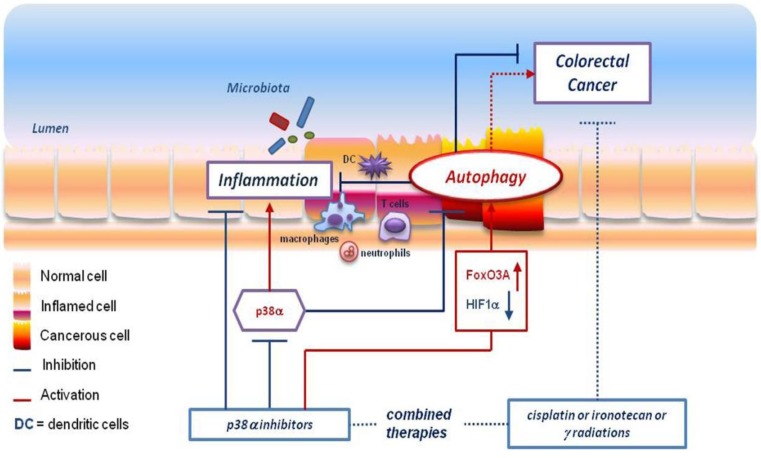
The intestine lies at the interface between the organism and its environment and responds to infection/inflammation in a multi-leveled manner, potentially leading to chronic inflammatory pathologies and cancer formation. Indeed, the immune response at the intestinal epithelium has been found to be involved in the origin and development of colorectal cancer, which is the third most commonly diagnosed neoplastic disease. Among the mechanisms induced upon inflammation, autophagy appears as a defensive strategy for the clearance of invading microbes and intracellular waste components. Autophagy has also been found to play an important role in colorectal cancer, where it seems to have a pro-survival or pro-death function depending on the stage of the neoplastic process. In this paper we discuss the dual role of autophagy in colorectal cancer and review evidence showing that modulation of autophagy affects the immune response and cancer biology. The study of key players involved in autophagy might contribute to the design of new approaches for colorectal cancer, consisting in combined therapies capable of modifying cancer-specific metabolism rather than simply evoking a generic apoptotic and/or autophagic response, thus enhancing the efficacy of currently used drugs and treatments.
肠道位于机体与环境的交界处,以多层次的方式对感染/炎症做出反应,可能导致慢性炎症性病理和癌症形成。事实上,已经发现肠道上皮的免疫反应参与了结直肠癌的起源和发展,结直肠癌是第三大常见的肿瘤疾病。在炎症诱导的机制中,自噬似乎是清除入侵微生物和细胞内废物成分的防御策略。自噬在结直肠癌中也发挥着重要作用,它似乎具有促进生存或促进死亡的功能,具体取决于肿瘤过程的阶段。在本文中,我们讨论了自噬在结直肠癌中的双重作用,并回顾了表明自噬调节会影响免疫反应和癌症生物学的证据。研究自噬涉及的关键分子可能有助于设计新的结直肠癌治疗方法,包括联合治疗,这种治疗方法能够改变肿瘤特异性代谢,而不仅仅是引发通用的凋亡和/或自噬反应,从而提高现有药物和治疗方法的疗效。