Rahmanian Abdolkarim, Seifzadeh Babak, Razmkon Ali, Petramfar Peyman, Kivelev Juri, Alibai Ehsan-Ali, Hernesniemi Juha
Department of Neurosurgery, Shiraz University of Medical Sciences, Nemazee Hospital, P.O. Box: 71937-11351, Shiraz, Iran.
Department of Neurosurgery, Shiraz University of Medical Sciences, Nemazee Hospital, P.O. Box: 71937-11351, Shiraz, Iran ; Shiraz Neuroscience Research Center, Shiraz University of Medical Sciences, Shiraz, Iran.
Springerplus. 2014 Feb 28;3:115. doi: 10.1186/2193-1801-3-115. eCollection 2014.
Malignant cerebral infarction is a well-recognized disease, comprising 10-15% of all cases with cerebral infarction and causing herniation and death in 80% of cases. In this study, we compare the effects of decompressive craniectomy versus conventional medical treatment on mortality rate and functional and neurological outcome in patients with malignant MCA infarction.
We performed a prospective case-control study on 60 patients younger than 80years of age suffering malignant MCA cerebral infarction. The case group underwent decompressive craniectomy in addition to routine aggressive medical care; while the control group received routine medical treatment. Patient outcome was assessed using Glasgow outcome scale and modified Rankin scale within three months of follow-up. The data were analyzed by SPSS version 16.0 software using Chi Square, One-way ANOVA and Mann-Whitney tests.
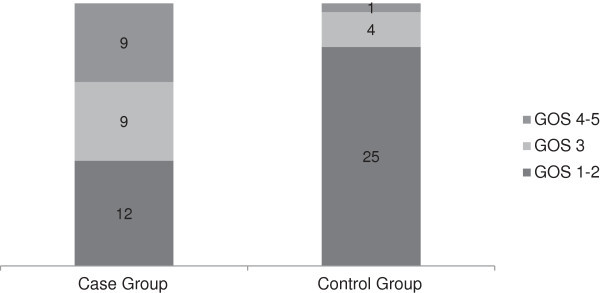
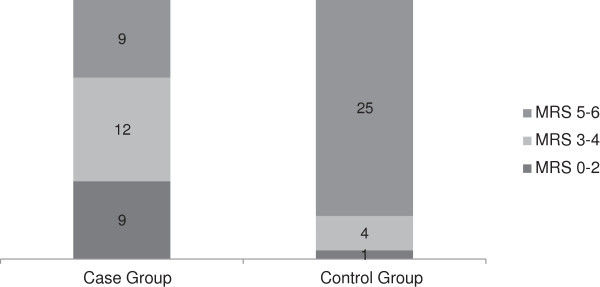
There were 27 male and 33 female patients with a mean age of 60.6 years (SD = 12.3). Glasgow outcome scale score averaged 2.93 in the surgical versus 1.53 in the medical group; this difference was significant (p = 0.001). Outcome in modified Rankin scale was also significantly lower in the surgical (3.27) versus medical (5.27) group (p < 0.001). Surgery could decrease the mortality rate about 47%.
In this study, decompressive craniectomy could decrease mortality rate, and improve neurological and functional outcome, and decrease long-term disability in patients with malignant MCA infarction.
恶性大脑梗死是一种公认的疾病,占所有脑梗死病例的10% - 15%,80%的病例会导致脑疝和死亡。在本研究中,我们比较了减压颅骨切除术与传统药物治疗对恶性大脑中动脉梗死患者死亡率、功能和神经学转归的影响。
我们对60例年龄小于80岁的恶性大脑中动脉脑梗死患者进行了前瞻性病例对照研究。病例组除接受常规积极药物治疗外,还接受减压颅骨切除术;而对照组接受常规药物治疗。在随访的三个月内,使用格拉斯哥预后量表和改良Rankin量表评估患者的转归。数据采用SPSS 16.0软件,通过卡方检验、单因素方差分析和曼 - 惠特尼检验进行分析。
共有27例男性和33例女性患者,平均年龄为60.6岁(标准差 = 12.3)。手术组格拉斯哥预后量表评分平均为2.93,而药物治疗组为1.53;差异具有统计学意义(p = 0.001)。手术组改良Rankin量表的转归也显著优于药物治疗组(分别为3.27和5.27)(p < 0.001)。手术可使死亡率降低约47%。
在本研究中,减压颅骨切除术可降低恶性大脑中动脉梗死患者的死亡率,改善神经学和功能转归,并减少长期残疾。