Karantanos Theodoros, Gazouli Maria
Department of Biology, School of Medicine, University of Athens, Greece.
Ann Gastroenterol. 2011;24(3):164-172.
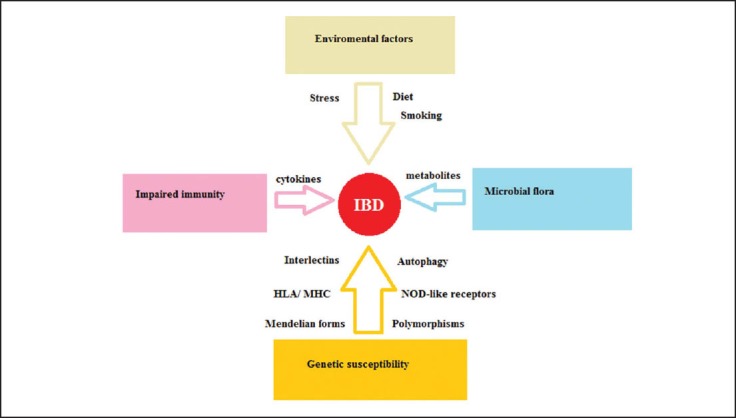
The chronic inflammatory bowel diseases (IBD), Crohn's disease and ulcerative colitis, are recognized as important causes of gastrointestinal disease in children and adults. Insight into IBD is advancing rapidly owing to a plethora of investigations into intestinal inflammation in animal models, advances in the interrogation of diseases inherited as complex genetic traits, and the development of methods to define the composition of the intestinal microbiota. These advances offer a better understanding of the genetically determined interplay between the commensal microbiota, intestinal cells and the immune system, and the manner in which this interaction might be modified by environmental factors in the pathogenesis of IBD. The present review highlights recent advances in IBD research.
慢性炎症性肠病(IBD),即克罗恩病和溃疡性结肠炎,被认为是儿童和成人胃肠道疾病的重要病因。由于对动物模型肠道炎症进行了大量研究、在对作为复杂遗传性状遗传的疾病的探究方面取得进展以及确定肠道微生物群组成的方法的发展,对IBD的认识正在迅速推进。这些进展有助于更好地理解共生微生物群、肠道细胞和免疫系统之间由基因决定的相互作用,以及在IBD发病机制中这种相互作用可能如何被环境因素改变。本综述重点介绍了IBD研究的最新进展。