Fei Fan, Bowdish Dawn M E, McCarry Brian E
Department of Chemistry and Chemical Biology, McMaster University, Hamilton, L8S4M1, Canada.
Anal Bioanal Chem. 2014 Jun;406(15):3723-33. doi: 10.1007/s00216-014-7797-5. Epub 2014 Apr 10.
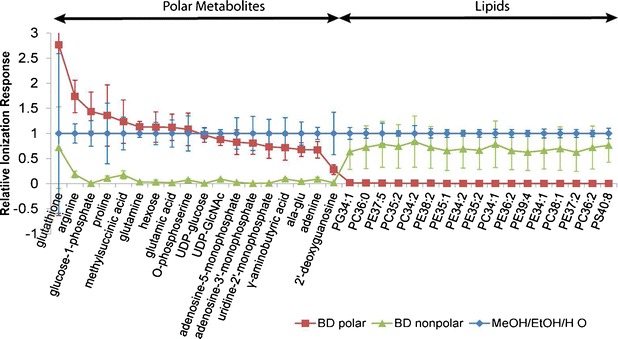
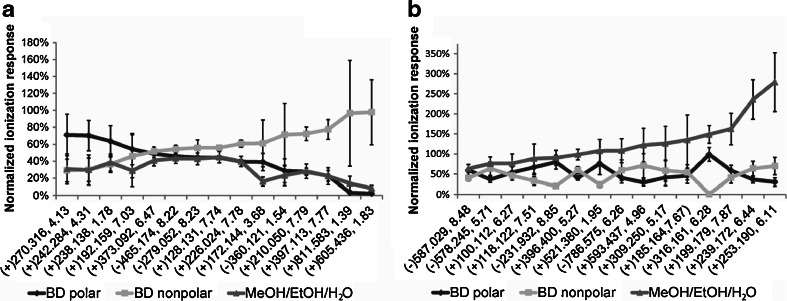
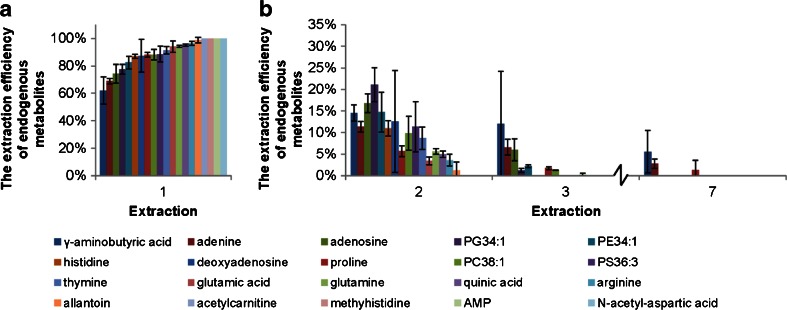
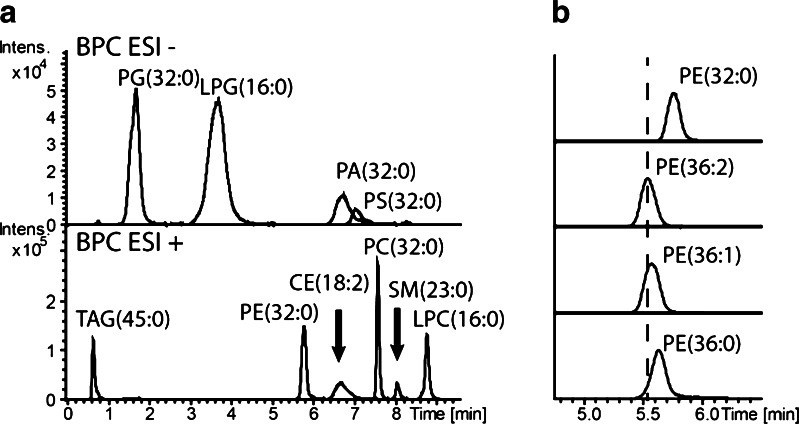
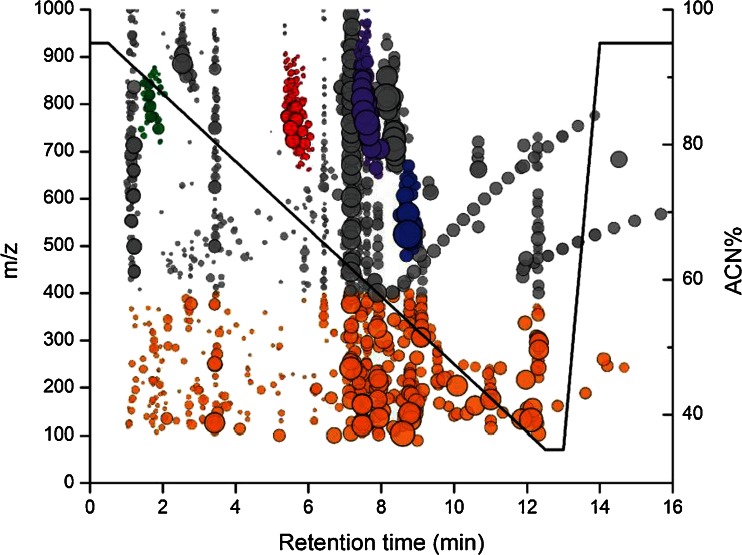
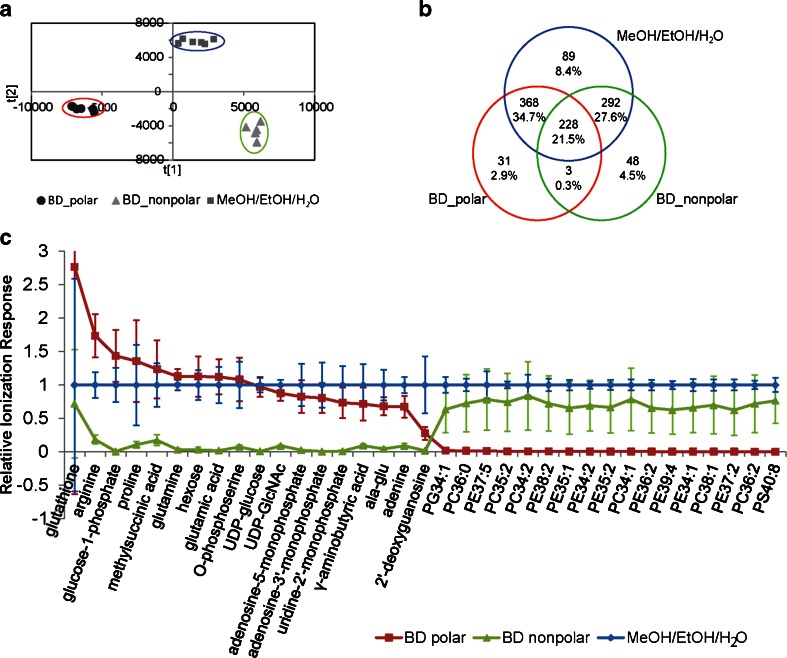
The comprehensive metabolomic analyses using eukaryotic and prokaryotic cells are an effective way to identify biomarkers or biochemical pathways which can then be used to characterize disease states, differences between cell lines or inducers of cellular stress responses. One of the most commonly used extraction methods for comprehensive metabolomics is the Bligh and Dyer method (BD) which separates the metabolome into polar and nonpolar fractions. These fractions are then typically analysed separately using hydrophilic interaction liquid chromatography (HILIC) and reversed-phase (RP) liquid chromatography (LC), respectively. However, this method has low sample throughput and can also be biased to either polar or nonpolar metabolites. Here, we introduce a MeOH/EtOH/H2O extraction paired with HILIC-time-of-flight (TOF)-mass spectrometry (MS) for comprehensive and simultaneous detection of both polar and nonpolar metabolites that is compatible for a wide array of cellular species cultured in different growth media. This method has been shown to be capable of separating polar metabolites by a HILIC mechanism and classes of lipids by an adsorption-like mechanism. Furthermore, this method is scalable and offers a substantial increase in sample throughput compared to BD with comparable extraction efficiency. This method was able to cover 92.2% of the detectable metabolome of Gram-negative bacterium Sinorhizobium meliloti, as compared to 91.6% of the metabolome by a combination of BD polar (59.4%) and BD nonpolar (53.9%) fractions. This single-extraction HILIC approach was successfully used to characterize the endometabolism of Gram-negative and Gram-positive bacteria as well as mammalian macrophages.
使用真核细胞和原核细胞进行的综合代谢组学分析是识别生物标志物或生化途径的有效方法,这些生物标志物或生化途径随后可用于表征疾病状态、细胞系之间的差异或细胞应激反应的诱导剂。综合代谢组学最常用的提取方法之一是布莱-戴尔方法(BD),该方法将代谢组分离为极性和非极性部分。然后,这些部分通常分别使用亲水相互作用液相色谱(HILIC)和反相(RP)液相色谱(LC)进行分析。然而,这种方法的样品通量较低,并且可能对极性或非极性代谢物存在偏差。在这里,我们介绍一种甲醇/乙醇/水提取方法,并与HILIC-飞行时间(TOF)-质谱(MS)联用,用于全面同时检测极性和非极性代谢物,该方法适用于在不同生长培养基中培养的多种细胞类型。已证明该方法能够通过HILIC机制分离极性代谢物,并通过类似吸附的机制分离脂质类别。此外,该方法具有可扩展性,与BD相比,在提取效率相当的情况下,样品通量有显著提高。与BD极性部分(59.4%)和BD非极性部分(53.9%)组合覆盖的91.6%的代谢组相比,该方法能够覆盖革兰氏阴性细菌苜蓿中华根瘤菌92.2%的可检测代谢组。这种单提取HILIC方法已成功用于表征革兰氏阴性和革兰氏阳性细菌以及哺乳动物巨噬细胞的内膜代谢。