Cavazos-Rehg Patricia A, Krauss Melissa J, Spitznagel Edward L, Grucza Richard A, Bierut Laura Jean
Department of Psychiatry, Washington University School of Medicine, St Louis, MO, USA.
Addiction. 2014 Aug;109(8):1371-80. doi: 10.1111/add.12567. Epub 2014 May 23.
To examine the associations between youth poly-tobacco use and substance use disorders.
Analysis of data from the 2007-11 US National Survey on Drug Use and Health.
Randomly selected, household-dwelling adolescents from the non-institutionalized, civilian population of the United States.
A total of 91 152 adolescents (aged 12-17 years).
Logistic regression models were used to examine the associations between type of tobacco user (non-user, users of alternative tobacco products only, users of cigarettes only and users of cigarettes plus alternative tobacco products) with past year alcohol, marijuana or other illicit drug use disorders, adjusting for demographic and social variables.
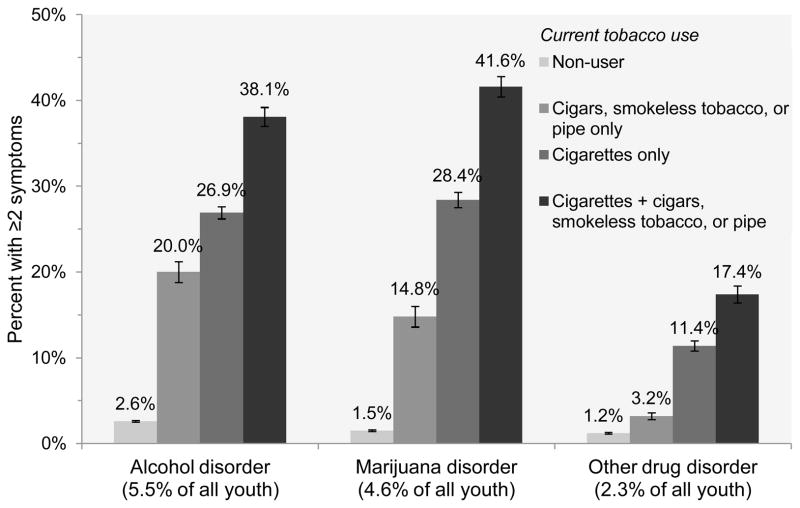
Compared with non-users of tobacco, the greatest risk for substance use disorders was among users of cigarettes plus alternative tobacco products [alcohol disorder adjusted odds ratio (aOR) = 18.3, 95% confidence interval (CI) = 16.2-20.6; marijuana disorder aOR = 37.2, 95% CI = 32.5-42.7; other drug disorder aOR = 18.4, 95% CI = 15.4-21.8], followed by users of cigarettes only (alcohol disorder aOR = 9.6, 95% CI = 8.8-10.6; marijuana disorder aOR = 20.4, 95% CI = 18.1-23.0; other drug disorder aOR = 9.4, 95% CI = 7.8-11.4), then users of alternative tobacco products only (alcohol disorder aOR = 8.1, 95% CI = 6.7-9.6; marijuana disorder aOR = 9.2, 95% CI = 7.5-11.4; other drug disorder aOR = 3.2, 95% CI = 2.4-4.3).
Tobacco use in adolescence is associated with higher rates of substance use disorders across all tobacco users, especially among those who use cigarettes plus other tobacco products.
研究青少年多种烟草使用与物质使用障碍之间的关联。
对2007 - 2011年美国国家药物使用和健康调查数据进行分析。
从美国非机构化平民人口中随机选取的居住在家中的青少年。
共91152名青少年(年龄在12 - 17岁之间)。
采用逻辑回归模型,在对人口统计学和社会变量进行调整的情况下,研究烟草使用者类型(非使用者、仅使用替代烟草产品者、仅使用香烟者以及同时使用香烟和替代烟草产品者)与过去一年酒精、大麻或其他非法药物使用障碍之间的关联。
与非烟草使用者相比,物质使用障碍风险最高的是同时使用香烟和替代烟草产品的人群[酒精障碍调整比值比(aOR)= 18.3,95%置信区间(CI)= 16.2 - 20.6;大麻障碍aOR = 37.2,95% CI = 32.5 - 42.7;其他药物障碍aOR = 18.4,95% CI = 15.4 - 21.8],其次是仅使用香烟的人群(酒精障碍aOR = 9.6,95% CI = 8.8 - 10.6;大麻障碍aOR = 20.4,95% CI = 18.1 - 23.0;其他药物障碍aOR = 9.4,95% CI = 7.8 - 11.4),然后是仅使用替代烟草产品的人群(酒精障碍aOR = 8.1,95% CI = 6.7 - 9.6;大麻障碍aOR = 9.2,95% CI = 7.5 - 11.4;其他药物障碍aOR = 3.2,95% CI = 2.4 - 4.3)。
在所有烟草使用者中,青少年吸烟与物质使用障碍的较高发生率相关,尤其是那些同时使用香烟和其他烟草产品的人。