Graduate School of Management of Technology, Sogang University, Sinsu-Dong, Mapo-Gu, Seoul, Korea.
Division of Biomedical Informatics, Center for Genome Science, National Institute of Health, KCDC, Cheongwon-gun, Chungcheongbuk-do, Korea.
PLoS One. 2014 Apr 9;9(4):e86395. doi: 10.1371/journal.pone.0086395. eCollection 2014.
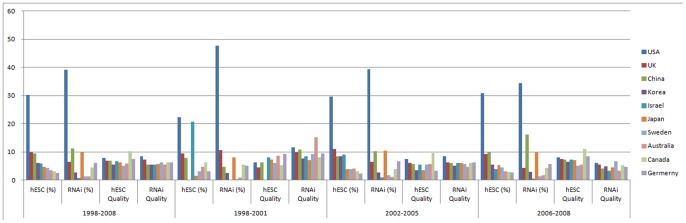
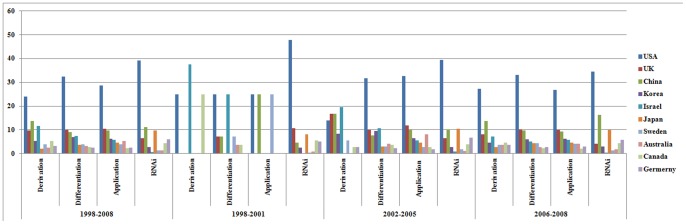
In this research, we examine how restrictive policy influenced performance in human embryonic stem cell research (hESC) between 1998 and 2008. In previous research, researchers argued whether restrictive policy decreased the performance of stem cell research in some nations, especially in the US. Here, we hypothesize that this policy influenced specific subfields of the hESC research. To investigate the selective policy effects, we categorize hESC research publications into three subfields-derivation, differentiation, and medical application research. Our analysis shows that restrictive policy had different effects on different subfields. In general, the US outperformed in overall hESC research throughout these periods. In the derivation of hESC, however, the US almost lost its competence under restrictive policy. Interestingly, the US scientific community showed prominent resilience in hESC research through international collaboration. We concluded that the US resilience and performance stemmed from the wide breadth of research portfolio of US scientists across the hESC subfields, combined with their strategic efforts to collaborate internationally on derivation research.
在这项研究中,我们考察了 1998 年至 2008 年间限制政策如何影响人类胚胎干细胞研究(hESC)的表现。在之前的研究中,研究人员争论了限制政策是否降低了一些国家,特别是美国的干细胞研究表现。在这里,我们假设该政策影响了 hESC 研究的特定子领域。为了研究选择性政策的影响,我们将 hESC 研究出版物分为三个子领域——衍生、分化和医学应用研究。我们的分析表明,限制政策对不同的子领域产生了不同的影响。总体而言,美国在整个研究期间都在 hESC 研究方面表现出色。然而,在美国的限制政策下,其在 hESC 衍生方面几乎失去了竞争力。有趣的是,美国科学界通过国际合作在 hESC 研究中表现出了明显的弹性。我们得出的结论是,美国的弹性和表现源于美国科学家在 hESC 子领域广泛的研究组合,以及他们在衍生研究方面进行国际合作的战略努力。