Lu Songtao, Chen Yan, Wu Xiaohong, Wang Zhida, Li Yang
Department of Chemistry, Harbin Institute of Technology, Harbin, 150001, P. R. China.
Sci Rep. 2014 Apr 10;4:4629. doi: 10.1038/srep04629.
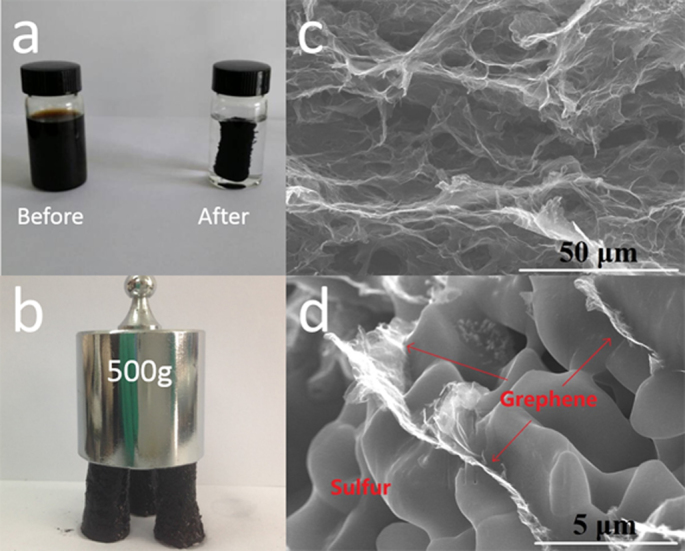
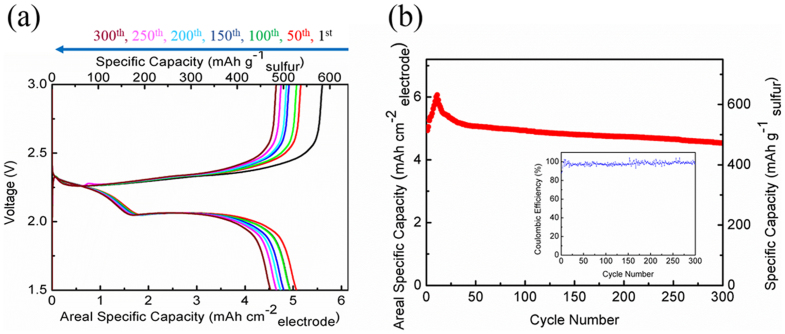
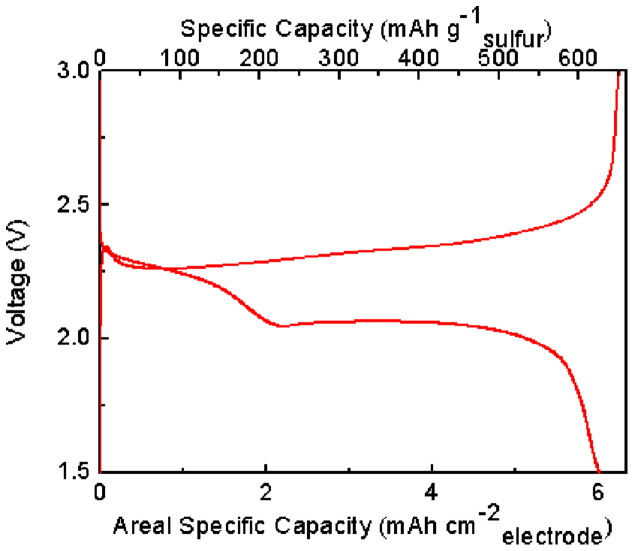
In this communication, we introduce the concept of three dimensional (3D) battery electrodes to enhance the capacity per footprint area for lithium-sulfur battery. In such a battery, 3D electrode of sulfur embedded into porous graphene sponges (S-GS) was directly used as the cathode with large areal mass loading of sulfur (12 mg cm(-2)), approximately 6-12 times larger than that of most reports. The graphene sponges (GS) worked as a framework that can provide high electronic conductive network, abilities to absorb the polysulfides intermediate, and meanwhile mechanical support to accommodate the volume changes during charge and discharge. As a result, the S-GS electrode with 80 wt.% sulfur can deliver an extremely high areal specific capacitance of 6.0 mAh cm(-2) of the 11(th) cycle, and maintain 4.2 mAh cm(-2) after 300 charge-discharge cycles at a rate of 0.1C, representing an extremely low decay rate (0.08% per cycle after 300 cycles), which could be the highest areal specific capacity with comparable cycle stability among the rechargeable Li/S batteries reported ever.
在本通讯中,我们引入了三维(3D)电池电极的概念,以提高锂硫电池每单位面积的容量。在这种电池中,嵌入多孔石墨烯海绵(S-GS)中的硫的3D电极被直接用作阴极,硫的面质量负载量很大(12 mg cm⁻²),约为大多数报道的6-12倍。石墨烯海绵(GS)起到框架的作用,它能提供高电子导电网络,具备吸收多硫化物中间体的能力,同时在充放电过程中提供机械支撑以适应体积变化。结果,含80 wt.%硫的S-GS电极在第11次循环时可提供6.0 mAh cm⁻²的极高面积比电容,并在0.1C倍率下经过300次充放电循环后保持4.2 mAh cm⁻²,衰减率极低(300次循环后每循环0.08%),这可能是所有报道的可充电锂硫电池中具有可比循环稳定性的最高面积比容量。