Loveday Marian, Padayatchi Nesri, Wallengren Kristina, Roberts Jacquelin, Brust James C M, Ngozo Jacqueline, Master Iqbal, Voce Anna
Health Systems Research Unit, South African Medical Research Council, Cape Town, South Africa.
Centre for the AIDS Programme of Research in South Africa (CAPRISA), University of KwaZulu-Natal, Durban, South Africa.
PLoS One. 2014 Apr 9;9(4):e94016. doi: 10.1371/journal.pone.0094016. eCollection 2014.
To improve the treatment of MDR-TB and HIV co-infected patients, we investigated the relationship between health system performance and patient treatment outcomes at 4 decentralised MDR-TB sites.
In this mixed methods case study which included prospective comparative data, we measured health system performance using a framework of domains comprising key health service components. Using Pearson Product Moment Correlation coefficients we quantified the direction and magnitude of the association between health system performance and MDR-TB treatment outcomes. Qualitative data from participant observation and interviews analysed using systematic text condensation (STC) complemented our quantitative findings.
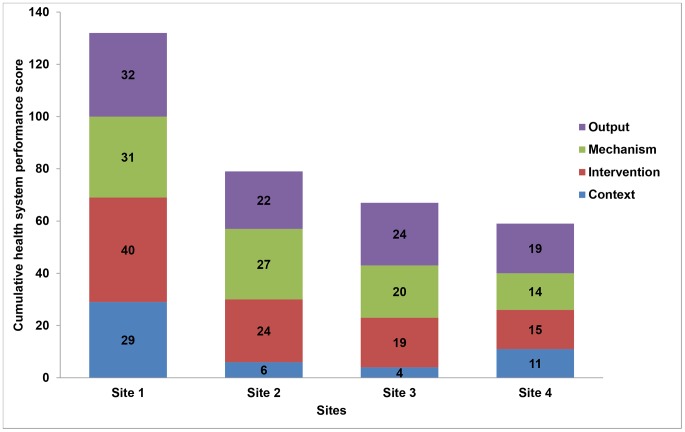
We found significant differences in treatment outcomes across the sites with successful outcomes varying from 72% at Site 1 to 52% at Site 4 (p<0.01). Health systems performance scores also varied considerably across the sites. Our findings suggest there is a correlation between treatment outcomes and overall health system performance which is significant (r = 0.99, p<0.01), with Site 1 having the highest number of successful treatment outcomes and the highest health system performance. Although the 'integration' domain, which measured integration of MDR-TB services into existing services appeared to have the strongest association with successful treatment outcomes (r = 0.99, p<0.01), qualitative data indicated that the 'context' domain influenced the other domains.
We suggest that there is an association between treatment outcomes and health system performance. The chance of treatment success is greater if decentralised MDR-TB services are integrated into existing services. To optimise successful treatment outcomes, regular monitoring and support are needed at a district, facility and individual level to ensure the local context is supportive of new programmes and implementation is according to guidelines.
为改善耐多药结核病与艾滋病毒合并感染患者的治疗,我们调查了4个分散的耐多药结核病治疗点的卫生系统绩效与患者治疗结果之间的关系。
在这项包含前瞻性比较数据的混合方法案例研究中,我们使用一个包含关键卫生服务组成部分的领域框架来衡量卫生系统绩效。我们使用皮尔逊积矩相关系数来量化卫生系统绩效与耐多药结核病治疗结果之间关联的方向和强度。通过系统文本浓缩(STC)分析的来自参与观察和访谈的定性数据补充了我们的定量研究结果。
我们发现各治疗点的治疗结果存在显著差异,成功结果从治疗点1的72%到治疗点4的52%不等(p<0.01)。各治疗点的卫生系统绩效得分也有很大差异。我们的研究结果表明治疗结果与整体卫生系统绩效之间存在显著相关性(r = 0.99,p<0.01),治疗点1的成功治疗结果数量最多且卫生系统绩效最高。尽管衡量耐多药结核病服务与现有服务整合情况的“整合”领域似乎与成功治疗结果的关联最强(r = 0.99,p<0.01),但定性数据表明“背景”领域影响了其他领域。
我们认为治疗结果与卫生系统绩效之间存在关联。如果将分散的耐多药结核病服务整合到现有服务中,治疗成功的机会更大。为了优化成功治疗结果,需要在地区、机构和个人层面进行定期监测和支持,以确保当地环境有利于新计划的实施且实施符合指南要求。