Dittmann Marie T, Runge Ullrich, Lang Richard A, Moser Dario, Galeffi Cordula, Kreuzer Michael, Clauss Marcus
Clinic for Zoo Animals, Exotic Pets and Wildlife, Vetsuisse Faculty Zurich, University of Zurich, Zurich, Switzerland; ETH Zurich, Institute for Agricultural Sciences, Zurich, Switzerland.
Kamelhof Olmerswil, Neukirch/Thur, Switzerland.
PLoS One. 2014 Apr 9;9(4):e94363. doi: 10.1371/journal.pone.0094363. eCollection 2014.
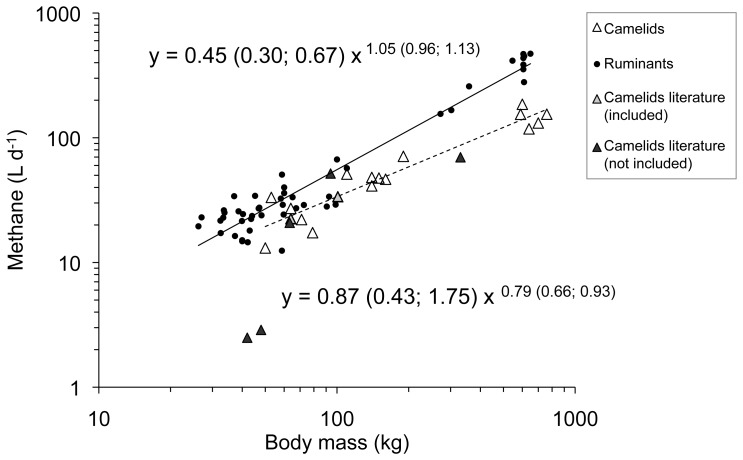
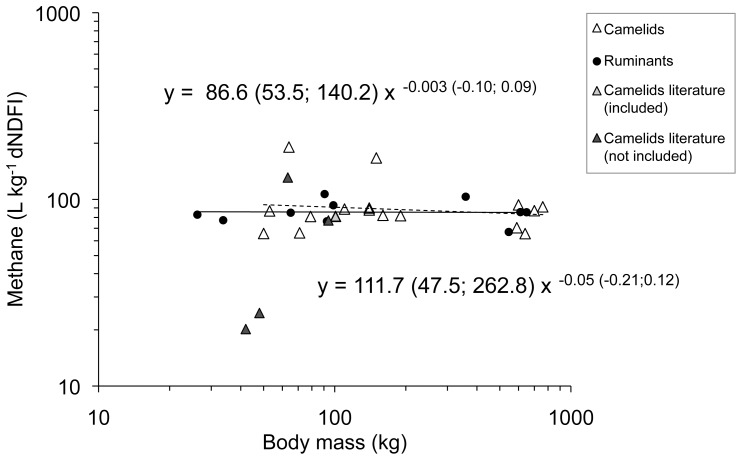
Methane emissions from ruminant livestock have been intensively studied in order to reduce contribution to the greenhouse effect. Ruminants were found to produce more enteric methane than other mammalian herbivores. As camelids share some features of their digestive anatomy and physiology with ruminants, it has been proposed that they produce similar amounts of methane per unit of body mass. This is of special relevance for countrywide greenhouse gas budgets of countries that harbor large populations of camelids like Australia. However, hardly any quantitative methane emission measurements have been performed in camelids. In order to fill this gap, we carried out respiration chamber measurements with three camelid species (Vicugna pacos, Lama glama, Camelus bactrianus; n = 16 in total), all kept on a diet consisting of food produced from alfalfa only. The camelids produced less methane expressed on the basis of body mass (0.32±0.11 L kg⁻¹ d⁻¹) when compared to literature data on domestic ruminants fed on roughage diets (0.58±0.16 L kg⁻¹ d⁻¹). However, there was no significant difference between the two suborders when methane emission was expressed on the basis of digestible neutral detergent fiber intake (92.7±33.9 L kg⁻¹ in camelids vs. 86.2±12.1 L kg⁻¹ in ruminants). This implies that the pathways of methanogenesis forming part of the microbial digestion of fiber in the foregut are similar between the groups, and that the lower methane emission of camelids can be explained by their generally lower relative food intake. Our results suggest that the methane emission of Australia's feral camels corresponds only to 1 to 2% of the methane amount produced by the countries' domestic ruminants and that calculations of greenhouse gas budgets of countries with large camelid populations based on equations developed for ruminants are generally overestimating the actual levels.
为了减少反刍家畜对温室效应的影响,人们对其甲烷排放进行了深入研究。研究发现,反刍动物产生的肠道甲烷比其他食草哺乳动物更多。由于骆驼科动物在消化解剖学和生理学方面与反刍动物有一些共同特征,有人提出它们每单位体重产生的甲烷量相似。这对于像澳大利亚这样拥有大量骆驼科动物的国家的全国温室气体预算具有特别重要的意义。然而,几乎没有对骆驼科动物进行过任何定量的甲烷排放测量。为了填补这一空白,我们对三种骆驼科动物(小羊驼、大羊驼、双峰驼;总共16只)进行了呼吸室测量,所有动物都只以苜蓿生产的食物为食。与以粗饲料为食的家养反刍动物的文献数据(0.58±0.16升/千克⁻¹天⁻¹)相比,骆驼科动物按体重计算产生的甲烷较少(0.32±0.11升/千克⁻¹天⁻¹)。然而,当根据可消化中性洗涤纤维摄入量来表示甲烷排放时,两个亚目之间没有显著差异(骆驼科动物为92.7±33.9升/千克⁻¹,反刍动物为86.2±12.1升/千克⁻¹)。这意味着前胃中纤维微生物消化过程中形成甲烷的途径在两组动物中相似,骆驼科动物较低的甲烷排放可以用它们通常较低的相对食物摄入量来解释。我们的结果表明,澳大利亚野生骆驼的甲烷排放量仅相当于该国家养反刍动物产生的甲烷量的1%至2%,并且基于为反刍动物开发的方程式对拥有大量骆驼科动物的国家的温室气体预算进行的计算通常高估了实际水平。