Heart and Vascular Center, Semmelweis University, Városmajor str, 68, 1122 Budapest, Hungary.
BMC Cardiovasc Disord. 2014 Apr 11;14:47. doi: 10.1186/1471-2261-14-47.
According to previous studies, aortic diameter alone seems to be insufficient to predict the event of aortic dissection in Marfan syndrome (MFS). Determining the optimal schedule for preventive aortic root replacement (ARR) aortic growth rate is of importance, as well as family history, however, none of them appear to be decisive. Thus, the aim of this study was to search for potential predictors of aortic dissection in MFS.
A Marfan Biobank consisting of 79 MFS patients was established. Thirty-nine MFS patients who underwent ARR were assigned into three groups based on the indication for surgery (dissection, annuloaortic ectasia and prophylactic surgery). The prophylactic surgery group was excluded from the study. Transforming growth factor-β (TGF-β) serum levels were measured by ELISA, relative expression of c-Fos, matrix metalloproteinase 3 and 9 (MMP-3 and -9) were assessed by RT-PCR. Clinical parameters, including anthropometric variables - based on the original Ghent criteria were also analyzed.
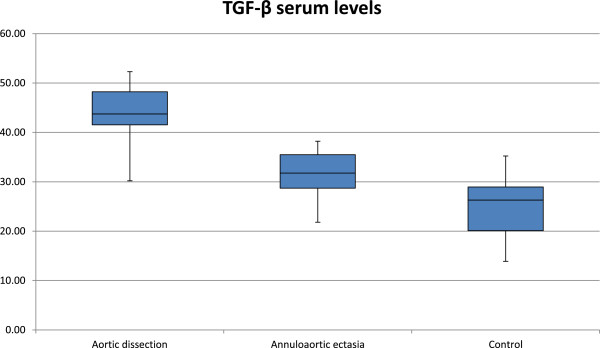
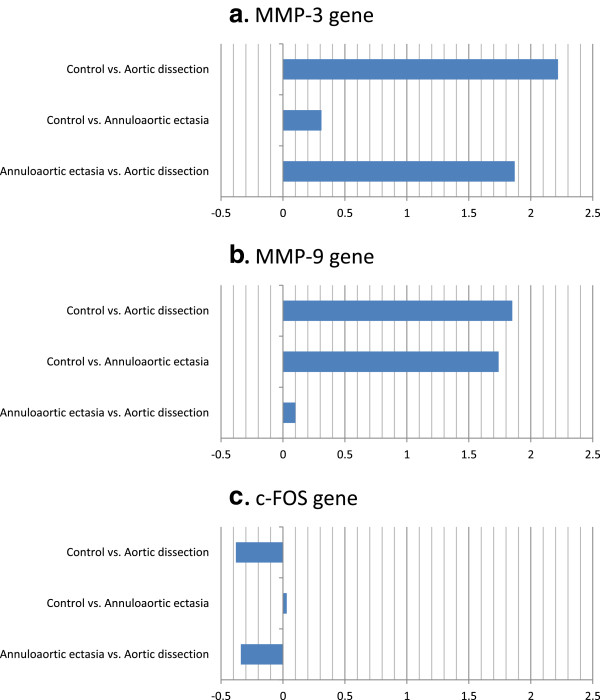
Among patients with aortic dissection, TGF-β serum level was elevated (43.78 ± 6.51 vs. 31.64 ± 4.99 ng/l, p < 0.0001), MMP-3 was up-regulated (Ln2α = 1.87, p = 0.062) and striae atrophicae were more common (92% vs. 41% p = 0.027) compared to the annuloaortic ectasia group.
We found three easily measurable parameters (striae atrophicae, TGF-β serum level, MMP-3) that may help to predict the risk of aortic dissection in MFS. Based on these findings a new classification of MFS, that is benign or malignant is also proposed, which could be taken into consideration in determining the timing of prophylactic ARR.
根据以往的研究,单纯的主动脉直径似乎不足以预测马凡综合征(MFS)患者主动脉夹层的发生。确定预防性主动脉根部置换术(ARR)主动脉生长速度的最佳方案很重要,家族史也是如此,但它们似乎都不是决定性的。因此,本研究旨在寻找 MFS 患者主动脉夹层的潜在预测因子。
建立了一个包含 79 名 MFS 患者的马凡氏综合征生物库。根据手术指征(夹层、主动脉瓣环扩张和预防性手术),将 39 名接受 ARR 的 MFS 患者分为三组。排除预防性手术组进行研究。通过 ELISA 测量转化生长因子-β(TGF-β)血清水平,通过 RT-PCR 评估 c-Fos、基质金属蛋白酶 3 和 9(MMP-3 和 MMP-9)的相对表达。还分析了临床参数,包括基于原始根特标准的人体测量变量。
在主动脉夹层患者中,TGF-β 血清水平升高(43.78 ± 6.51 vs. 31.64 ± 4.99 ng/l,p < 0.0001),MMP-3 上调(Ln2α = 1.87,p = 0.062),萎缩纹更常见(92% vs. 41%,p = 0.027)。
我们发现了三个易于测量的参数(萎缩纹、TGF-β 血清水平、MMP-3),它们可能有助于预测 MFS 患者主动脉夹层的风险。基于这些发现,提出了一种新的 MFS 分类,即良性或恶性,这可能有助于确定预防性 ARR 的时机。