Frentz Dineke, van de Vijver David, Abecasis Ana, Albert Jan, Hamouda Osamah, Jørgensen Louise, Kücherer Claudia, Struck Daniel, Schmit Jean-Claude, Vercauteren Jurgen, Asjö Birgitta, Balotta Claudia, Bergin Colm, Beshkov Danail, Camacho Ricardo, Clotet Bonaventura, Griskevicius Algirdas, Grossman Zehava, Horban Andrzej, Kolupajeva Tatjana, Korn Klaus, Kostrikis Leondios, Linka Kirsi Liitsola Marek, Nielsen Claus, Otelea Dan, Paraskevis Dimitrios, Paredes Roger, Poljak Mario, Puchhammer-Stöckl Elisabeth, Sönnerborg Anders, Stanekova Danica, Stanojevic Maja, Vandamme Anne-Mieke, Boucher Charles, Wensing Annemarie
Department of virology, Erasmus Medical Center, Rotterdam, the Netherlands.
Centro de Malária e outras Doenças Tropicais, Instituto de Higiene e Medicina Tropical, Universidade Nova de Lisboa, Lisboa, Portugal.
PLoS One. 2014 Apr 10;9(4):e94495. doi: 10.1371/journal.pone.0094495. eCollection 2014.
In Europe, a continuous programme (SPREAD) has been in place for ten years to study transmission of drug resistant HIV. We analysed time trends of transmitted drug resistance mutations (TDRM) in relation to the risk behaviour reported.
HIV-1 patients newly diagnosed in 27 countries from 2002 through 2007 were included. Inclusion was representative for risk group and geographical distribution in the participating countries in Europe. Trends over time were calculated by logistic regression.
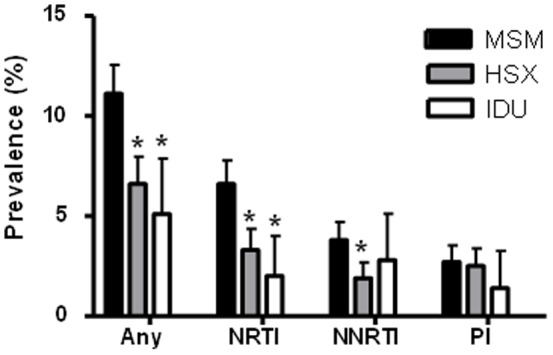
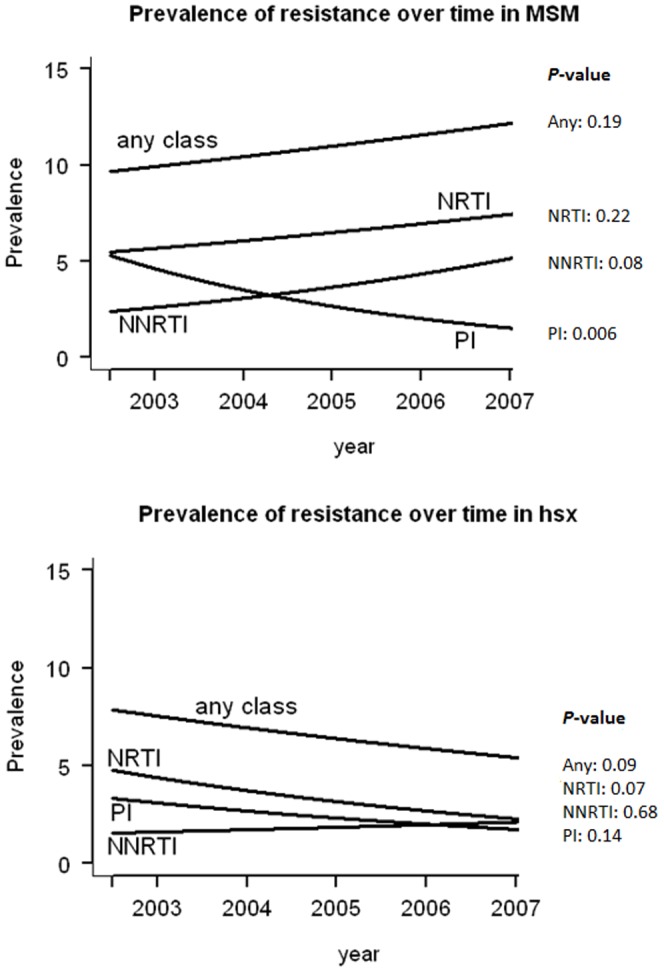
From the 4317 patients included, the majority was men-having-sex-with-men -MSM (2084, 48%), followed by heterosexuals (1501, 35%) and injection drug users (IDU) (355, 8%). MSM were more often from Western Europe origin, infected with subtype B virus, and recently infected (<1 year) (p<0.001). The prevalence of TDRM was highest in MSM (prevalence of 11.1%), followed by heterosexuals (6.6%) and IDU (5.1%, p<0.001). TDRM was predominantly ascribed to nucleoside reverse transcriptase inhibitors (NRTI) with a prevalence of 6.6% in MSM, 3.3% in heterosexuals and 2.0% in IDU (p = 0.001). A significant increase in resistance to non- nucleoside reverse transcriptase inhibitors (NNRTIs) and a decrease in resistance to protease inhibitors was observed in MSM (p = 0.008 and p = 0.006, respectively), but not in heterosexual patients (p = 0.68 and p = 0.14, respectively).
MSM showed to have significantly higher TDRM prevalence compared to heterosexuals and IDU. The increasing NNRTI resistance in MSM is likely to negatively influence the therapy response of first-line therapy, as most include NNRTI drugs.
在欧洲,一项持续进行的项目(SPREAD)已开展十年,用于研究耐药性艾滋病毒的传播情况。我们分析了与所报告的风险行为相关的传播耐药性突变(TDRM)的时间趋势。
纳入了2002年至2007年期间在27个国家新诊断的HIV-1患者。纳入情况代表了欧洲参与国的风险群体和地理分布。通过逻辑回归计算时间趋势。
在纳入的4317名患者中,大多数是男男性行为者(MSM)(2084名,48%),其次是异性恋者(1501名,35%)和注射吸毒者(IDU)(355名,8%)。MSM更多来自西欧,感染B亚型病毒,且近期感染(<1年)(p<0.001)。TDRM的患病率在MSM中最高(患病率为11.1%),其次是异性恋者(6.6%)和IDU(5.1%,p<0.001)。TDRM主要归因于核苷类逆转录酶抑制剂(NRTI),在MSM中的患病率为6.6%,在异性恋者中为3.3%,在IDU中为2.0%(p = 0.001)。在MSM中观察到对非核苷类逆转录酶抑制剂(NNRTI)的耐药性显著增加,对蛋白酶抑制剂的耐药性降低(分别为p = 0.008和p = 0.006),但在异性恋患者中未观察到(分别为p = 0.68和p = 0.14)。
与异性恋者和IDU相比,MSM的TDRM患病率显著更高。MSM中NNRTI耐药性的增加可能会对一线治疗的疗效产生负面影响,因为大多数一线治疗方案都包含NNRTI药物。