Liu Ning, Wu Shan, Van Houten Jason, Wang Ying, Ding Biao, Fei Zhangjun, Clarke Thomas H, Reed Jason W, van der Knaap Esther
The Ohio State University, Ohio Agricultural Research and Development Center, Department of Horticulture and Crop Science, Wooster, OH 44691, USA.
The Ohio State University, Department of Molecular Genetics, Columbus, OH 43210, USA.
J Exp Bot. 2014 Jun;65(9):2507-20. doi: 10.1093/jxb/eru141. Epub 2014 Apr 10.
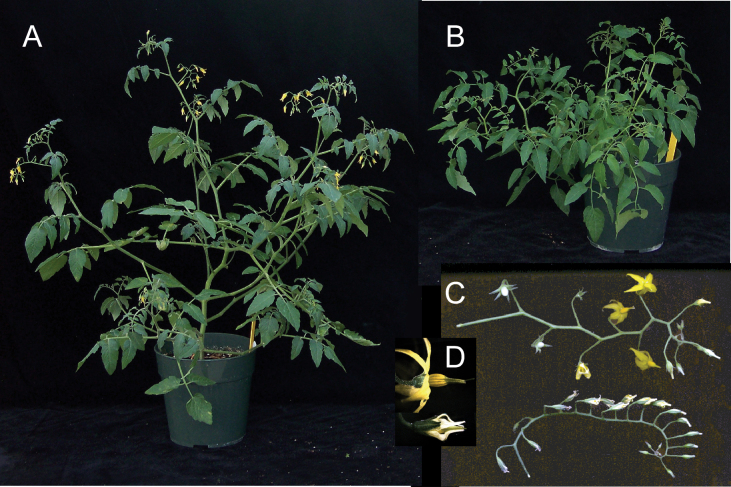
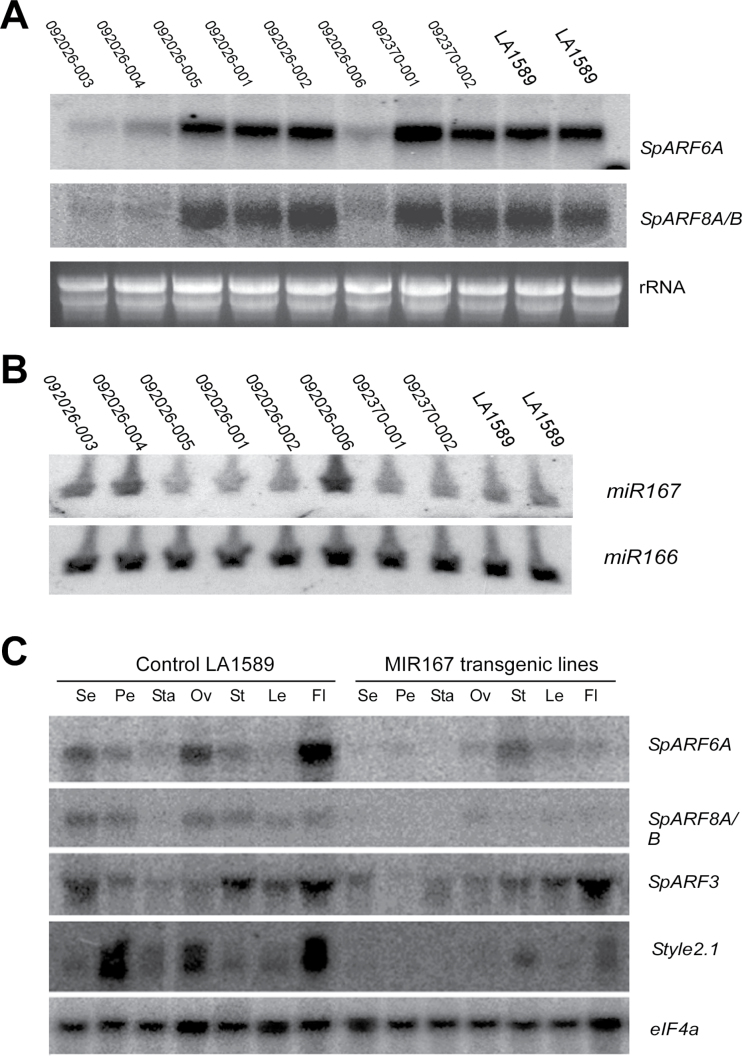
Auxin regulates the expression of diverse genes that affect plant growth and development. This regulation requires AUXIN RESPONSE FACTORS (ARFs) that bind to the promoter regions of these genes. ARF6 and ARF8 in Arabidopsis thaliana are required to promote inflorescence stem elongation and late stages of petal, stamen, and gynoecium development. All seed plants studied thus far have ARF6 and ARF8 orthologues as well as the microRNA miR167, which targets ARF6 and ARF8. Whether these genes have broadly conserved roles in flower development is not known. To address this question, the effects of down-regulation of ARF6 and ARF8 were investigated through transgenic expression of Arabidopsis MIR167a in tomato, which diverged from Arabidopsis before the radiation of dicotyledonous plants approximately 90-112 million years ago. The transgenic tomato plants overexpressing MIR167a exhibited reductions in leaf size and internode length as well as shortened petals, stamens, and styles. More significantly, the transgenic plants were female-sterile as a result of failure of wild-type pollen to germinate on the stigma surface and/or to grow through the style. RNA-Seq analysis identified many genes with significantly altered expression patterns, including those encoding products with functions in 'transcription regulation', 'cell wall' and 'lipid metabolism' categories. Putative orthologues of a subset of these genes were also differentially expressed in Arabidopsis arf6 arf8 mutant flowers. These results thus suggest that ARF6 and ARF8 have conserved roles in controlling growth and development of vegetative and flower organs in dicots.
生长素调节多种影响植物生长和发育的基因的表达。这种调节需要生长素响应因子(ARFs),它们与这些基因的启动子区域结合。拟南芥中的ARF6和ARF8是促进花序茎伸长以及花瓣、雄蕊和雌蕊发育后期所必需的。到目前为止,所有研究过的种子植物都有ARF6和ARF8的直系同源物以及靶向ARF6和ARF8的微小RNA miR167。这些基因在花发育中是否具有广泛保守的作用尚不清楚。为了解决这个问题,通过在番茄中过量表达拟南芥MIR167a来研究下调ARF6和ARF8的影响,番茄在大约9000万至1.12亿年前双子叶植物辐射之前就与拟南芥分化了。过表达MIR167a的转基因番茄植株表现出叶片大小和节间长度减小,以及花瓣、雄蕊和花柱缩短。更显著的是,由于野生型花粉无法在柱头表面萌发和/或无法穿过花柱生长,转基因植株表现为雌性不育。RNA测序分析鉴定出许多表达模式发生显著变化的基因,包括那些编码在“转录调控”、“细胞壁”和“脂质代谢”类别中具有功能的产物的基因。这些基因的一个子集的推定直系同源物在拟南芥arf6 arf8突变体花中也有差异表达。因此,这些结果表明ARF6和ARF8在控制双子叶植物营养器官和花器官的生长和发育中具有保守作用。