Department of Psychology, New York University New York, NY, USA.
Department of Psychology, Lehigh University Bethlehem, PA, USA.
Front Psychol. 2014 Mar 26;5:263. doi: 10.3389/fpsyg.2014.00263. eCollection 2014.
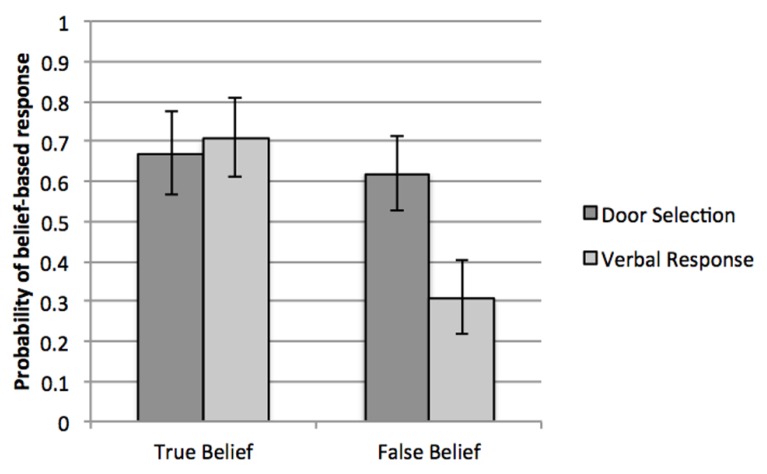
Understanding observable behavior by considering mental representations is central to social cognition. Research reveals quite different developmental trajectories for this ability depending on whether tasks assess implicit or explicit theory of mind (ToM). Yet, how to define implicit vs. explicit ToM, the tasks that elicit each, and the types of behavior that each can support, have remained unclear. The present study (n = 47) found that 3-year-olds incorporate predictions based on false beliefs into their intentional actions, but not - following identical scenarios - into their verbal responses. These data show that implicit ToM supports a broader range of behaviors than previously indicated and further illustrates the entrenched nature of the distinction between implicit and explicit knowledge in early conceptual development.
通过考虑心理表象来理解可观察行为是社会认知的核心。研究表明,根据任务是否评估内隐或外显心理理论(ToM),这种能力的发展轨迹存在明显差异。然而,内隐与外显 ToM 的定义、引发每种理论的任务以及每种理论可以支持的行为类型仍然不清楚。本研究(n=47)发现,3 岁儿童会将基于错误信念的预测纳入他们的意向性动作中,但不会将其纳入他们的口头反应中——尽管场景完全相同。这些数据表明,内隐心理理论支持的行为范围比之前认为的要广泛,进一步说明了内隐和外显知识在早期概念发展中的区别是根深蒂固的。