Ezzati M, Broad K, Kawano G, Faulkner S, Hassell J, Fleiss B, Gressens P, Fierens I, Rostami J, Maze M, Sleigh J W, Anderson B, Sanders R D, Robertson N J
Institute for Women's Health, University College London, London, UK.
Acta Anaesthesiol Scand. 2014 Jul;58(6):733-42. doi: 10.1111/aas.12318. Epub 2014 Apr 13.
The highly selective α2 -adrenoreceptor agonist, dexmedetomidine, exerts neuroprotective, analgesic, anti-inflammatory and sympatholytic properties that may be beneficial for perinatal asphyxia. The optimal safe dose for pre-clinical newborn neuroprotection studies is unknown.
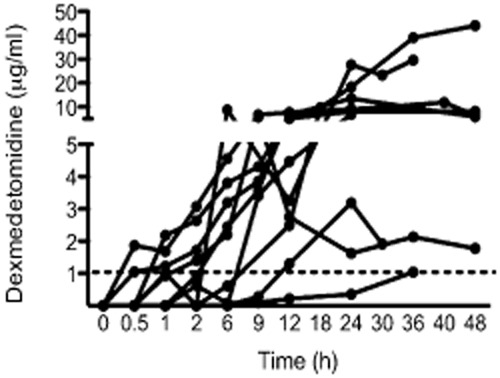
Following cerebral hypoxia-ischaemia, dexmedetomidine was administered to nine newborn piglets in a de-escalation dose study in combination with hypothermia (whole body cooling to 33.5°C). Dexmedetomidine was administered with a loading dose of 1 μg/kg and maintenance infusion at doses from 10 to 0.6 μg/kg/h. One additional piglet was not subjected to hypoxia-ischaemia. Blood for pharmacokinetic analysis was sampled pre-insult and frequently post-insult. A one-compartment linear disposition model was used to fit data. Population parameter estimates were obtained using non-linear mixed effects modelling.
All dexmedetomidine infusion regimens led to plasma concentrations above those associated with sedation in neonates and children (0.4-0.8 μg/l). Seven out of the nine piglets with hypoxia-ischaemia experienced periods of bradycardia, hypotension, hypertension and cardiac arrest; all haemodynamic adverse events occurred in piglets with plasma concentrations greater than 1 μg/l. Dexmedetomidine clearance was 0.126 l/kg/h [coefficient of variation (CV) 46.6.%] and volume of distribution was 3.37 l/kg (CV 191%). Dexmedetomidine clearance was reduced by 32.7% at a temperature of 33.5°C. Dexmedetomidine clearance was reduced by 55.8% following hypoxia-ischaemia.
Dexmedetomidine clearance was reduced almost tenfold compared with adult values in the newborn piglet following hypoxic-ischaemic brain injury and subsequent therapeutic hypothermia. Reduced clearance was related to cumulative effects of both hypothermia and exposure to hypoxia. High plasma levels of dexmedetomidine were associated with major cardiovascular complications.
高选择性α2 -肾上腺素能受体激动剂右美托咪定具有神经保护、镇痛、抗炎和抗交感神经作用,可能对围产期窒息有益。临床前新生儿神经保护研究的最佳安全剂量尚不清楚。
在脑缺氧缺血后,对9只新生仔猪进行了剂量递减研究,将右美托咪定与低温疗法(全身冷却至33.5°C)联合使用。右美托咪定的负荷剂量为1μg/kg,维持输注剂量为10至0.6μg/kg/h。另外1只仔猪未进行缺氧缺血处理。在损伤前和损伤后频繁采集血样进行药代动力学分析。使用单室线性处置模型拟合数据。使用非线性混合效应模型获得群体参数估计值。
所有右美托咪定输注方案导致的血浆浓度均高于新生儿和儿童镇静相关浓度(0.4 - 0.8μg/l)。9只缺氧缺血仔猪中有7只经历了心动过缓、低血压、高血压和心脏骤停期;所有血流动力学不良事件均发生在血浆浓度大于1μg/l的仔猪中。右美托咪定清除率为0.126 l/kg/h [变异系数(CV)46.6%],分布容积为3.37 l/kg(CV 191%)。在33.5°C时,右美托咪定清除率降低了32.7%。缺氧缺血后,右美托咪定清除率降低了55.8%。
在新生仔猪缺氧缺血性脑损伤及随后的治疗性低温后,右美托咪定清除率与成年值相比降低了近10倍。清除率降低与低温和缺氧暴露的累积效应有关。右美托咪定的高血浆水平与主要心血管并发症相关。