Demyanets Svitlana, Tentzeris Ioannis, Jarai Rudolf, Katsaros Katharina M, Farhan Serdar, Wonnerth Anna, Weiss Thomas W, Wojta Johann, Speidl Walter S, Huber Kurt
Department of Internal Medicine II, Medical University of Vienna, Währinger-Gürtel 18-20, 1090 Vienna, Austria; Department of Laboratory Medicine, Medical University of Vienna, Währinger-Gürtel 18-20, 1090 Vienna, Austria.
3rd Medical Department for Cardiology and Emergency Medicine, Wilhelminenhospital, Montleartstraße 37, 1160 Vienna, Austria.
Cytokine. 2014 Jun;67(2):65-70. doi: 10.1016/j.cyto.2014.02.014. Epub 2014 Mar 27.
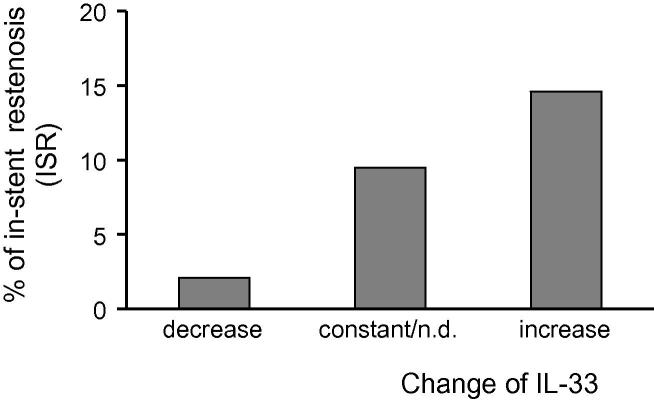
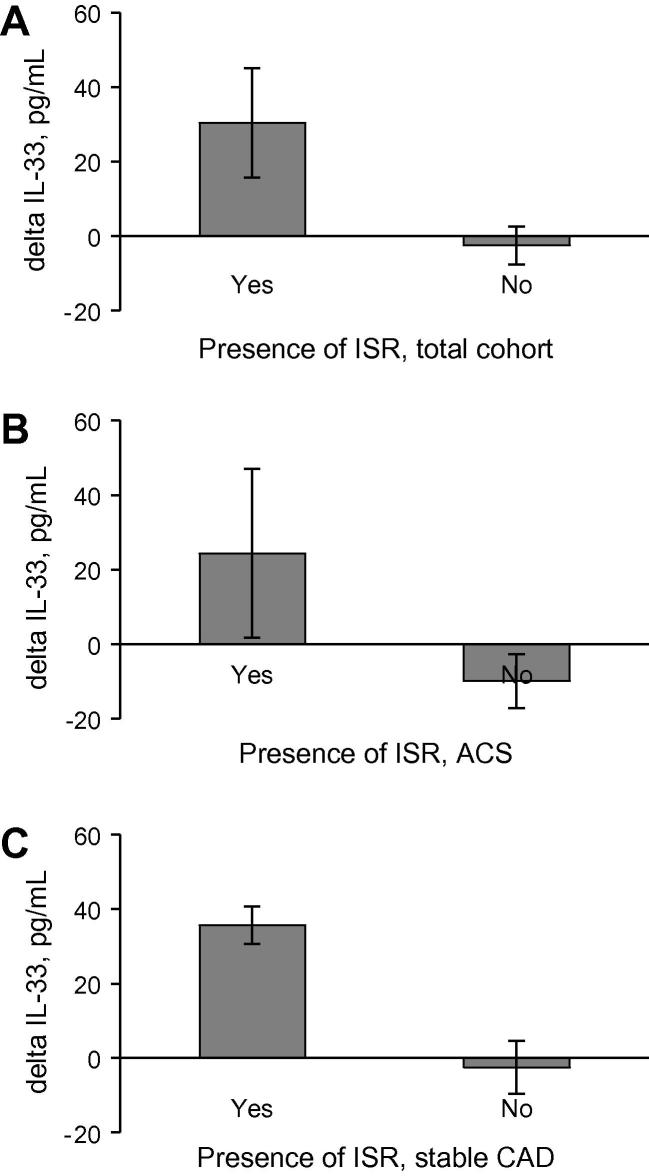
The study aim was to determine the predictive value of interleukin (IL)-33, a recently described member of the IL-1 family of cytokines, for the development of in-stent restenosis (ISR). IL-33 serum levels were measured in 387 consecutive patients undergoing percutaneous coronary intervention (PCI) of whom 193 had stable angina, 93 non-ST elevation myocardial infarction (NSTEMI), and 101 ST-elevation MI (STEMI), respectively. Blood was taken directly before and 24h after stent implantation. The presence of ISR was initially evaluated by clinical means after six to eight months. When presence of myocardial ischemia was suspected, coronary angiography was performed to confirm the suspected diagnosis of ISR. Clinical ISR was present in total in 34 patients (8.8%). IL-33 was detectable in 185 patients and was below detection limit in 202 patients. In patients with decreased IL-33 (n=95), unchanged or non-detectable levels (n=210) or increased levels of IL-33 after PCI (n=82), ISR-rate was 2.1%, 9.5% and 14.6%, respectively (p<0.05). Accordingly, patients with ISR showed a significant increase of IL-33 upon PCI (p<0.05). This association was independent from clinical presentation and risk factors as well as numbers and type of stents. In patients with both stable and unstable coronary artery disease, an increase of IL-33 serum levels after stent implantation is associated with a higher rate of in-stent restenosis.
本研究旨在确定白细胞介素(IL)-33(一种最近被描述的IL-1细胞因子家族成员)对支架内再狭窄(ISR)发生的预测价值。对387例接受经皮冠状动脉介入治疗(PCI)的连续患者测定了IL-33血清水平,其中193例为稳定型心绞痛,93例为非ST段抬高型心肌梗死(NSTEMI),101例为ST段抬高型心肌梗死(STEMI)。在支架植入前及植入后24小时直接采血。ISR的存在最初在6至8个月后通过临床手段进行评估。当怀疑存在心肌缺血时,进行冠状动脉造影以证实疑似的ISR诊断。共有34例患者(8.8%)出现临床ISR。185例患者可检测到IL-33,202例患者低于检测限。在PCI后IL-33水平降低的患者(n=95)、水平不变或不可检测的患者(n=210)以及IL-33水平升高的患者(n=82)中,ISR发生率分别为2.1%、9.5%和14.6%(p<0.05)。因此,发生ISR的患者在PCI后IL-33显著升高(p<0.05)。这种关联独立于临床表现、危险因素以及支架的数量和类型。在稳定型和不稳定型冠状动脉疾病患者中,支架植入后IL-33血清水平升高与较高的支架内再狭窄发生率相关。