Xiang Qin, Xiong Xiao-Yun, Liu Si, Zhang Mei-Jun, Li Ying-Jie, Wang Hui-Wen, Wu Rui, Chen Lu
Department of Nursing, The 2nd Affiliated Hospital, Jiangxi Medical College, Nanchang University, Nanchang, China.
School of Nursing, Jiangxi Medical College, Nanchang University, Nanchang, China.
Front Cardiovasc Med. 2024 Aug 29;11:1445076. doi: 10.3389/fcvm.2024.1445076. eCollection 2024.
The morbidity and mortality rates of coronary heart disease are significant, with PCI being the primary treatment. The high incidence of ISR following PCI poses a challenge to its effectiveness. Currently, there are numerous studies on ISR risk prediction models after PCI, but the quality varies and there is still a lack of systematic evaluation and analysis.
To systematically retrieve and evaluate the risk prediction models for ISR after PCI. A comprehensive search was conducted across 9 databases from inception to March 1, 2024. The screening of literature and extraction of data were independently carried out by two investigators, utilizing the checklist for critical appraisal and data extraction for systematic reviews of prediction modeling studies (CHARMS). Additionally, the risk of bias and applicability were evaluated using the Prediction Model Risk of Bias Assessment Tool (PROBAST).
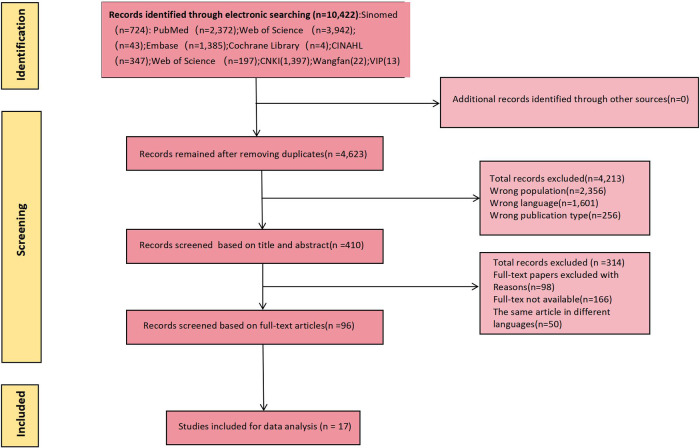
A total of 17 studies with 29 models were included, with a sample size of 175-10,004 cases, and the incidence of outcome events was 5.79%-58.86%. The area under the receiver operating characteristic curve was 0.530-0.953. The top 5 predictors with high frequency were diabetes, number of diseased vessels, age, LDL-C and stent diameter. Bias risk assessment into the research of the risk of higher bias the applicability of the four study better.
The overall risk of bias in the current ISR risk prediction model post-PCI is deemed high. Moving forward, it is imperative to enhance study design and specify the reporting process, optimize and validate the model, and enhance its performance.
冠心病的发病率和死亡率很高,经皮冠状动脉介入治疗(PCI)是主要治疗方法。PCI术后支架内再狭窄(ISR)的高发生率对其有效性构成挑战。目前,关于PCI术后ISR风险预测模型的研究众多,但质量参差不齐,仍缺乏系统的评估与分析。
系统检索和评估PCI术后ISR的风险预测模型。对9个数据库从建库至2024年3月1日进行全面检索。由两名研究人员独立进行文献筛选和数据提取,使用预测建模研究系统评价的关键评估和数据提取清单(CHARMS)。此外,使用预测模型偏倚风险评估工具(PROBAST)评估偏倚风险和适用性。
共纳入17项研究中的29个模型,样本量为175 - 10004例,结局事件发生率为5.79% - 58.86%。受试者工作特征曲线下面积为0.530 - 0.953。高频出现的前5个预测因素为糖尿病、病变血管数、年龄、低密度脂蛋白胆固醇和支架直径。偏倚风险评估显示,四项研究的偏倚风险较高,适用性较好。
目前PCI术后ISR风险预测模型的总体偏倚风险被认为较高。未来,必须加强研究设计并明确报告流程,优化和验证模型,并提高其性能。