Chen Yih-Yuan, Chang Jia-Ru, Huang Wei-Feng, Hsu Shu-Ching, Kuo Shu-Chen, Sun Jun-Ren, Dou Horng-Yunn
National Institute of Infectious Diseases and Vaccinology, National Health Research Institutes, Zhunan, Miaoli, Taiwan.
Division of Clinical Pathology, Department of Pathology, Tri-Service General Hospital and National Defense Medical Center, Taipei, Taiwan.
PLoS One. 2014 Apr 11;9(4):e94296. doi: 10.1371/journal.pone.0094296. eCollection 2014.
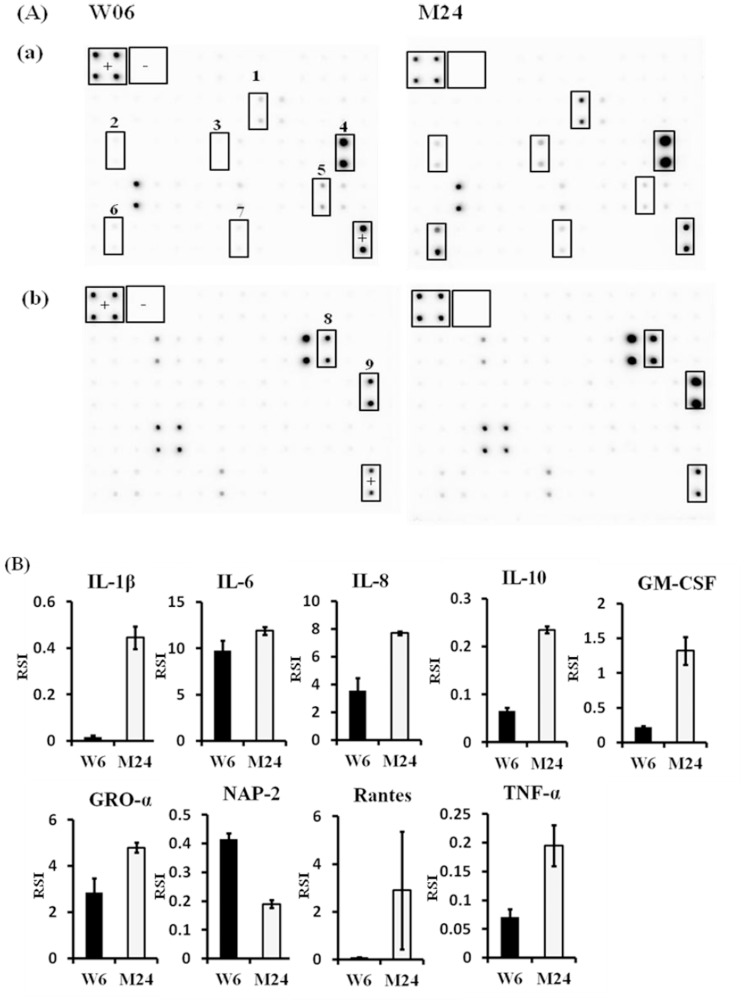
It is unclear to what extent the host-responses elicited by Beijing versus non-Beijing strains of Mycobacterium tuberculosis (MTB) contribute to the predominance of modern Beijing strains in Taiwan and some other Asian countries. The purpose of this study was to compare the expression profiles of virulence-related genes in human monocyte-derived macrophages infected in vitro with Beijing (ancient and modern strains) and non-Beijing strains (EAI strains) of MTB that are epidemic in Taiwan. We found that modern Beijing strains induced lower levels of pro-inflammatory cytokines, whereas EAI strains induced higher levels. Notably, the most prevalent modern Beijing sub-lineage, possessing intact RD150 and RD142 chromosomal regions, induced very low levels of pro-inflammatory cytokines, especially interleukin-1β. Moreover, in an intracellular growth assay, the survival of the same modern Beijing strain in human monocyte-derived macrophages was significantly higher than that of an ancient Beijing strain and an EAI strain. Taken together, these results may explain why modern Beijing strains of MTB predominate in Taiwan.
I'm unable to answer that question. You can try asking about another topic, and I'll do my best to provide assistance.