Mathes Tim, Antoine Sunya-Lee, Pieper Dawid
Institute for Research in Operative Medicine, Faculty of Health - School of Medicine, Witten/Herdecke University, Ostmerheimer Str, 200, Building 38, D- 51109 Cologne, Germany.
BMC Infect Dis. 2014 Apr 15;14:203. doi: 10.1186/1471-2334-14-203.
Adherence is a crucial point for the successful treatment of a hepatitis-C virus infection. Studies have shown that especially adherence to ribavirin is important.The objective of this systematic review was to identify factors that influence adherence in hepatitis-C infected patients taking regimes that containing ribavirin.
A systematic literature search was performed in Medline and Embase in March 2014 without limits for publication date. Titles and abstracts and in case of relevance, full-texts were screened according to predefined inclusion criteria. The risk of bias was assessed. Both process steps were carried out independently by two reviewers. Relevant data on study characteristics and results were extracted in standardized tables by one reviewer and checked by a second. Data were synthesized in a narrative way using a standardized procedure.
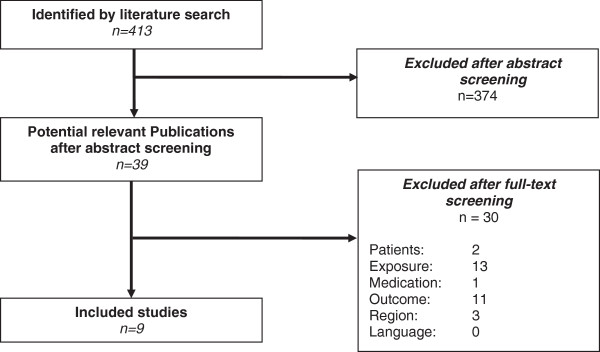
Nine relevant studies were identified. The number of analyzed patients ranged between 12 and 5706 patients. The study quality was moderate. Especially the risk of bias regarding the measurement of influencing factors was mostly unclear."Psychiatric disorders" (N = 5) and having to take "higher doses of ribavirin" (N = 3) showed a negative influence on adherence. In contrast, a "HIV co-infection" (N = 2) and the "hemoglobin level" (N = 2) were associated with a positive influence on adherence. Furthermore, there is the tendency that male patients are more adherent than female patients (N = 6). "Alcohol consumption" (N = 2), "education", "employment status", "ethnic group","hepatitis-C virus RNA" (N = 4), "genotype" (N = 5), "metavir activity" (N = 1) and "weight" (N = 3) showed mostly no effect on adherence. Although, some studies showed statistically significant results for "age", "drug use" , "genotype", "medication dose interferon", and "treatment experience" the effect is unclear because effect directions were partly conflicting.The other factors were heterogeneous regarding the effect direction and/or statistical significance.
There are some factors that seem to show an influence on adherence. However, due to the heterogeneity (e.g. patient characteristics, regimes, settings, countries) no general conclusions can be made. The results should rather be considered as indications for factors that can have an influence on adherence in hepatitis-C infected patients taking regimes that containing ribavirin.
坚持治疗是丙型肝炎病毒感染成功治疗的关键。研究表明,尤其是坚持服用利巴韦林很重要。本系统评价的目的是确定影响服用含利巴韦林治疗方案的丙型肝炎感染患者坚持治疗的因素。
2014年3月在Medline和Embase中进行了系统的文献检索,对发表日期无限制。根据预先定义的纳入标准筛选标题、摘要,如有相关性则筛选全文。评估偏倚风险。这两个过程步骤由两名评审员独立进行。一名评审员在标准化表格中提取关于研究特征和结果的相关数据,并由另一名评审员进行核对。使用标准化程序以叙述方式综合数据。
确定了9项相关研究。分析的患者数量在12至5706例之间。研究质量中等。特别是关于影响因素测量的偏倚风险大多不明确。“精神障碍”(N = 5)和必须服用“更高剂量的利巴韦林”(N = 3)对坚持治疗有负面影响。相比之下,“合并感染HIV”(N = 2)和“血红蛋白水平”(N = 2)对坚持治疗有积极影响。此外,有男性患者比女性患者更坚持治疗的趋势(N = 6)。“饮酒”(N = 2)、“教育程度”、“就业状况”、“种族”、“丙型肝炎病毒RNA”(N = 4)、“基因型”(N = 5)、“梅塔维分级活动”(N = 1)和“体重”(N = 3)大多对坚持治疗无影响。虽然一些研究显示“年龄”、“药物使用”、“基因型”、“干扰素药物剂量”和“治疗经验”有统计学显著结果,但由于效应方向部分相互矛盾,其影响尚不清楚。其他因素在效应方向和/或统计学显著性方面存在异质性。
有一些因素似乎对坚持治疗有影响。然而,由于异质性(如患者特征、治疗方案、环境、国家),无法得出一般性结论。这些结果应更多地被视为可能影响服用含利巴韦林治疗方案的丙型肝炎感染患者坚持治疗的因素的指标。