Martins Samuel C V, Araújo Wagner L, Tohge Takayuki, Fernie Alisdair R, DaMatta Fábio M
Departamento de Biologia Vegetal, Universidade Federal de Viçosa, Viçosa, Minas Gerais, Brazil.
Departamento de Biologia Vegetal, Universidade Federal de Viçosa, Viçosa, Minas Gerais, Brazil; Max-Planck-Partner Group at the Departamento de Biologia Vegetal, Universidade Federal de Viçosa, Viçosa, Minas Gerais, Brazil.
PLoS One. 2014 Apr 14;9(4):e94862. doi: 10.1371/journal.pone.0094862. eCollection 2014.
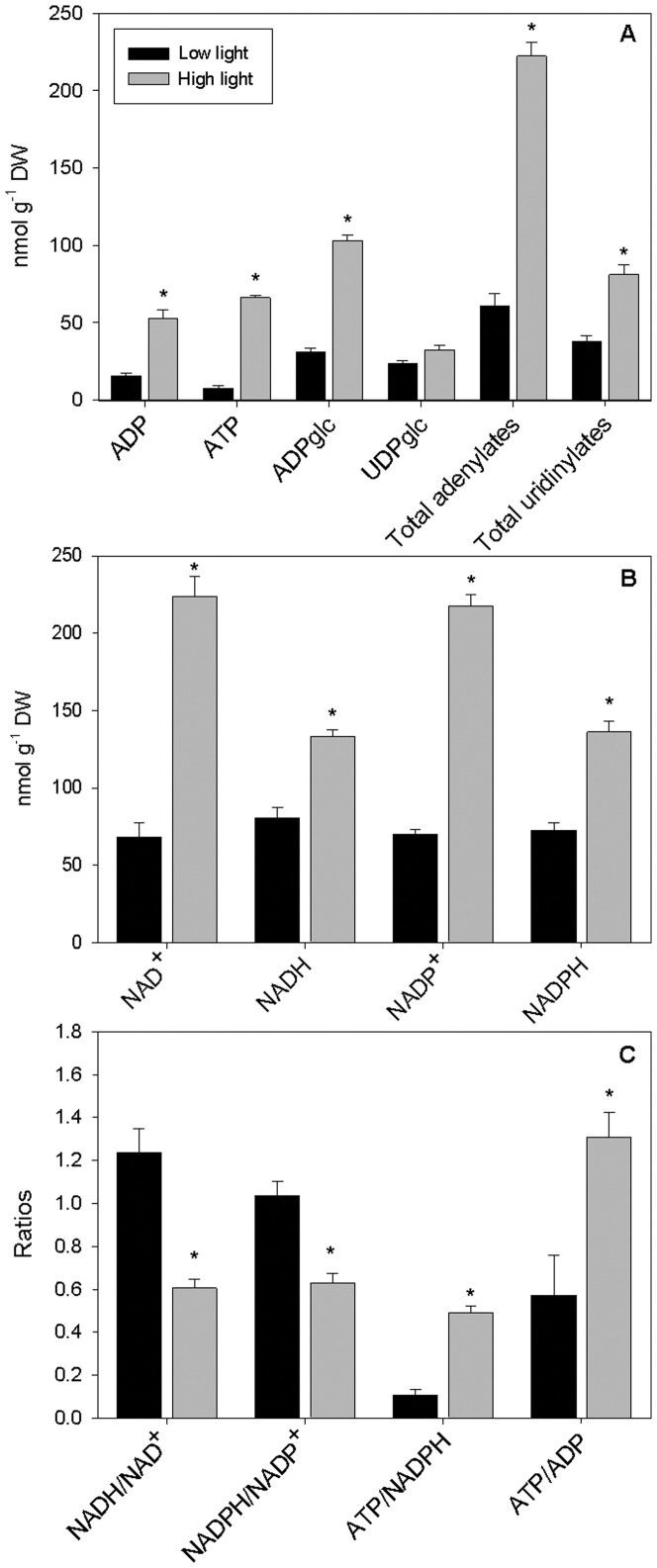
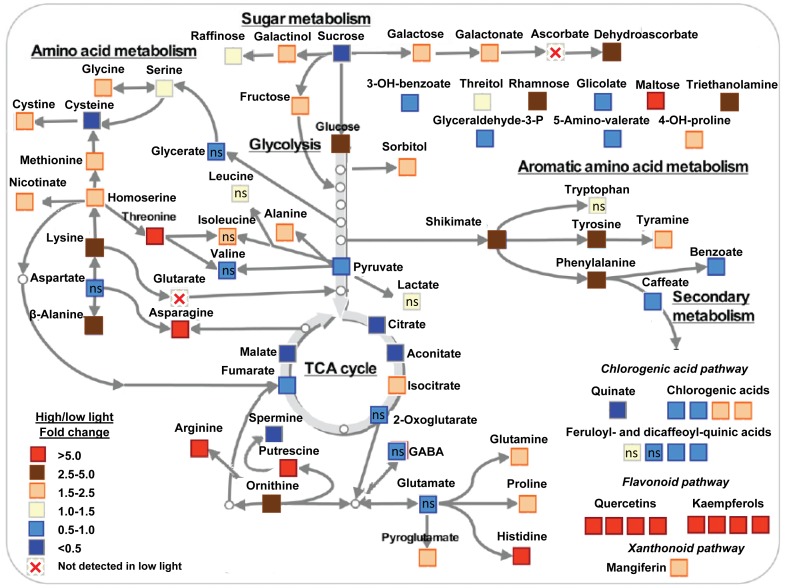
Coffee (Coffea arabica L.) has been traditionally considered as shade-demanding, although it performs well without shade and even out-yields shaded coffee. Here we investigated how coffee plants adjust their metabolic machinery to varying light supply and whether these adjustments are supported by a reprogramming of the primary and secondary metabolism. We demonstrate that coffee plants are able to adjust its metabolic machinery to high light conditions through marked increases in its antioxidant capacity associated with enhanced consumption of reducing equivalents. Photorespiration and alternative pathways are suggested to be key players in reductant-consumption under high light conditions. We also demonstrate that both primary and secondary metabolism undergo extensive reprogramming under high light supply, including depression of the levels of intermediates of the tricarboxylic acid cycle that were accompanied by an up-regulation of a range of amino acids, sugars and sugar alcohols, polyamines and flavonoids such as kaempferol and quercetin derivatives. When taken together, the entire dataset is consistent with these metabolic alterations being primarily associated with oxidative stress avoidance rather than representing adjustments in order to facilitate the plants from utilizing the additional light to improve their photosynthetic performance.
传统上,咖啡(阿拉伯咖啡)被认为是喜阴植物,尽管它在没有遮荫的情况下生长良好,甚至产量超过有遮荫的咖啡。在这里,我们研究了咖啡植株如何调整其代谢机制以适应不同的光照供应,以及这些调整是否受到初级和次级代谢重编程的支持。我们证明,咖啡植株能够通过显著提高其抗氧化能力(与增强还原当量的消耗相关)来调整其代谢机制以适应高光条件。光呼吸和替代途径被认为是高光条件下还原剂消耗的关键因素。我们还证明,在高光供应下,初级和次级代谢都会经历广泛的重编程,包括三羧酸循环中间产物水平的降低,同时伴随着一系列氨基酸、糖类和糖醇、多胺以及黄酮类化合物(如山奈酚和槲皮素衍生物)的上调。综合来看,整个数据集与这些代谢变化主要与避免氧化应激相关一致,而不是代表为了促进植物利用额外光照来提高光合性能而进行的调整。