Multiple Sclerosis Unit, Neuroscience Area, Biodonostia Health Research Institute , San Sebastián , Spain ; Spanish Network on Multiple Sclerosis , Madrid , Spain.
Front Cell Neurosci. 2014 Mar 28;8:100. doi: 10.3389/fncel.2014.00100. eCollection 2014.
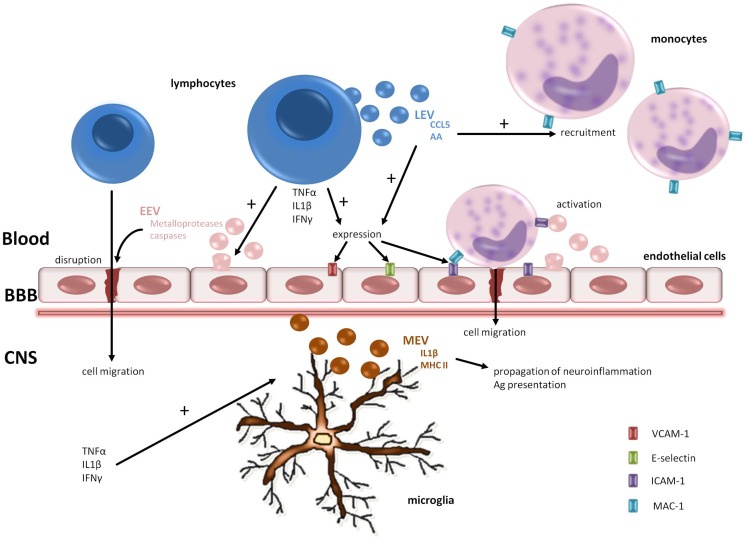
Extracellular vesicles (EVs) are membrane-bound particles secreted by almost all cell types. They are classified depending on their biogenesis and size into exosomes and microvesicles or according to their cell origin. EVs play a role in cell-to-cell communication, including contact-free cell synapsis, carrying active membrane proteins, lipids, and genetic material both inside the particle and on their surface. They have been related to several physiological and pathological conditions. In particular, increasing concentrations of EVs have been found in many autoimmune diseases including multiple sclerosis (MS). MS is a central nervous system (CNS) demyelinating disease characterized by relapsing of symptoms followed by periods of remission. Close interaction between endothelial cells, leukocytes, monocytes, and cells from CNS is crucial for the development of MS. This review summarizes the pathological role of EVs in MS and the relationship of EVs with clinical characteristics, therapy, and biomarkers of the disease.
细胞外囊泡(EVs)是几乎所有细胞类型分泌的膜结合颗粒。它们根据其生物发生和大小分为外泌体和微泡,或根据其细胞来源进行分类。EVs 在细胞间通讯中发挥作用,包括无接触的细胞突触,在颗粒内部和表面携带活性膜蛋白、脂质和遗传物质。它们与多种生理和病理状况有关。特别是,在许多自身免疫性疾病中,包括多发性硬化症(MS),已经发现 EVs 的浓度增加。MS 是一种中枢神经系统(CNS)脱髓鞘疾病,其特征是症状反复发作,随后是缓解期。内皮细胞、白细胞、单核细胞和 CNS 细胞之间的密切相互作用对于 MS 的发展至关重要。这篇综述总结了 EVs 在 MS 中的病理作用以及 EVs 与疾病的临床特征、治疗和生物标志物的关系。