Bufalari Ilaria, Lenggenhager Bigna, Porciello Giuseppina, Serra Holmes Brittany, Aglioti Salvatore M
IRCCS Fondazione Santa Lucia Rome, Italy ; Social and Cognitive Neuroscience Laboratory, Department of Psychology, Sapienza University of Rome Rome, Italy.
IRCCS Fondazione Santa Lucia Rome, Italy ; Department of Neurology, University Hospital Zurich Zurich, Switzerland.
Front Behav Neurosci. 2014 Mar 28;8:102. doi: 10.3389/fnbeh.2014.00102. eCollection 2014.
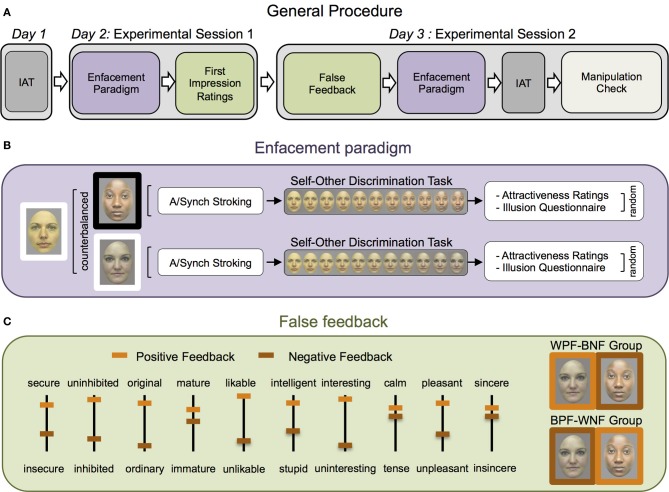
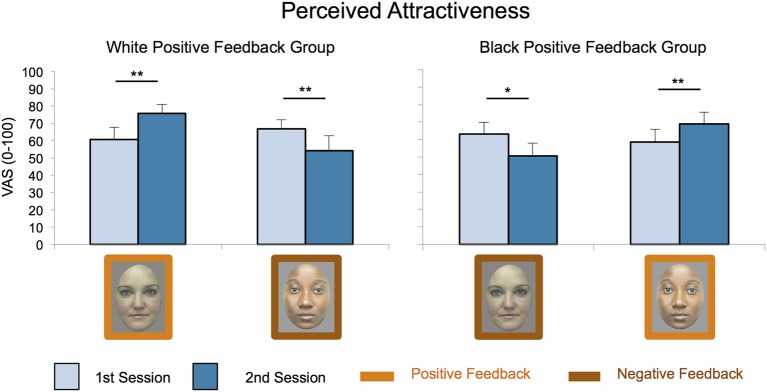
Experiencing tactile facial stimulation while seeing synchronous stimuli on the face of another individual induces "enfacement," i.e., the subjective illusory experience of ownership of the other's face (explicit measure) and the attribution of the others' facial features to one's own face (implicit measure). Here we expanded previous knowledge by investigating if the tendency to include the other into one's own representation is influenced by positive or negative interpersonal attitudes derived either from consolidated socio-cultural stereotypes or from newly acquired, short-term individual interactions with a specific person. To this aim, we tested in Caucasian white participants the enfacement with a white and a black confederate, before and after an experimental procedure inducing a positive or negative perception of each of them. The results show that the subjective experience of enfacement with in- and out-group others before and after the manipulation is similar. The bias in attributing other's facial features to one's own face after synchronous stroking was, instead, dependent on whether the other person was positively perceived, independently of his/her ethnicity. Thus, we show that realistic positive face-to-face interactions are more effective than consolidated racial biases in influencing the strength of self-attribution of another persons' facial features in the context of multisensory illusions. Results suggest that positive interpersonal interactions might powerfully change the plasticity of self-other representations.
当在看到另一个人的面部出现同步刺激的同时体验面部触觉刺激时,会诱发“面部融合”,即对他人面部的主观虚幻的所有权体验(显性测量),以及将他人的面部特征归属于自己面部的现象(隐性测量)。在这里,我们通过研究将他人纳入自己表征的倾向是否受到源自巩固的社会文化刻板印象或与特定个体新获得的短期个体互动所产生的积极或消极人际态度的影响,扩展了先前的知识。为此,我们在白人参与者中测试了与一名白人及一名黑人同谋者进行面部融合的情况,在一个实验程序之前和之后,该程序会引发对他们每个人的积极或消极认知。结果表明,在操纵前后,与内群体和外群体他人进行面部融合的主观体验是相似的。相反,在同步抚摸后将他人面部特征归属于自己面部的偏差,取决于他人是否被积极看待,而与他/她的种族无关。因此,我们表明,在多感官错觉的背景下,现实中的积极面对面互动比巩固的种族偏见更能有效地影响对他人面部特征的自我归属强度。结果表明,积极的人际互动可能会有力地改变自我与他人表征的可塑性。