Girault Guillaume, Blouin Yann, Vergnaud Gilles, Derzelle Sylviane
University Paris-Est, Anses, Animal Health Laboratory, Bacterial Zoonoses Unit, Maisons-Alfort 94706, France.
BMC Genomics. 2014 Apr 16;15:288. doi: 10.1186/1471-2164-15-288.
Single nucleotide polymorphisms (SNPs) are ideal signatures for subtyping monomorphic pathogens such as Bacillus anthracis. Here we report the use of next-generation sequencing technology to investigate the historical, geographic and genetic diversity of Bacillus anthracis in France. 122 strains isolated over a 60-years period throughout the country were whole-genome sequenced and comparative analyses were carried out with a focus on SNPs discovery to discriminate regional sub-groups of strains.
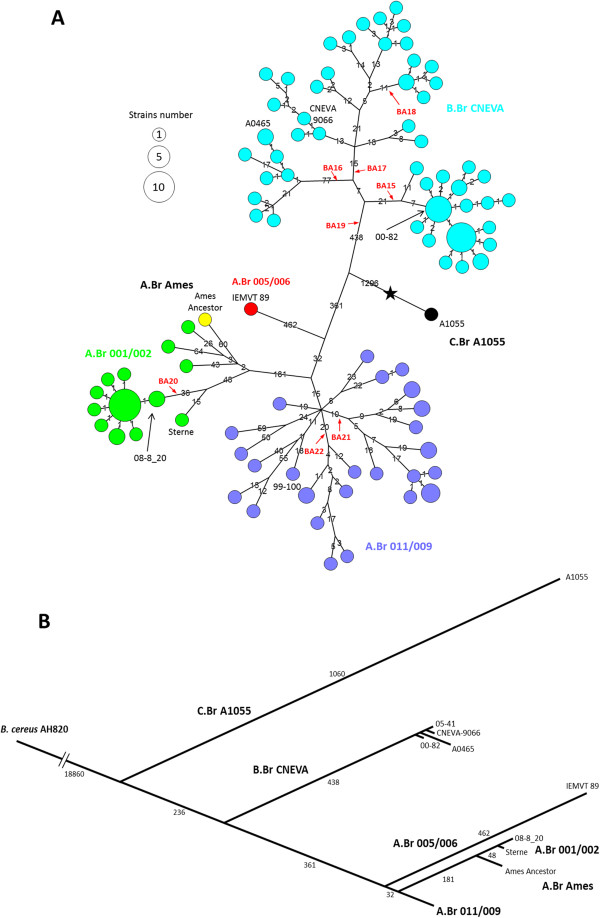
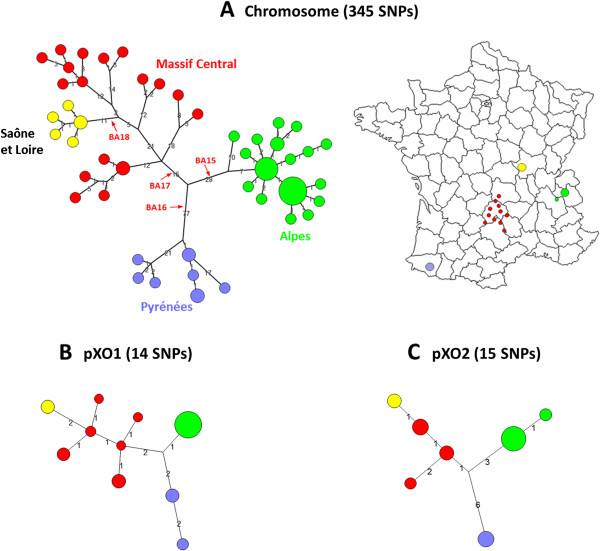
A total of 1581 chromosomal SNPs precisely establish the phylogenetic relationships existing between the French strains. Phylogeography patterns within the three canSNP sub-lineages present in France (i.e. B.Br.CNEVA, A.Br.011/009 and A.Br.001/002) were observed. One of the more remarkable findings was the identification of a variety of genotypes within the A.Br.011/009 sub-group that are persisting in the different regions of France. The 560 SNPs defining the A.Br.011/009- affiliated French strains split the Trans-Eurasian sub-group into six distinct branches without any intermediate nodes. Distinct sub-branches, with some geographic clustering, were resolved. The 345 SNPs defining the major B.Br CNEVA sub-lineage clustered three main phylogeographic clades, the Alps, the Pyrenees, and the Massif Central, with a small Saône-et-Loire sub-cluster nested within the latter group. The French strains affiliated to the minor A.Br.001/002 group were characterized by 226 SNPs. All recent isolates collected from the Doubs department were closely related. Identification of SNPs from whole-genome sequences facilitates high-resolution strain tracking and provides the level of discrimination required for outbreak investigations. Eight diagnostic SNPs, representative of the main French-specific phylogeographic clusters, were therefore selected and developed into high-resolution melting SNP discriminative assays.
This work has established one of the most accurate phylogenetic reconstruction of B. anthracis population structure in a country. An extensive next-generation sequencing (NGS) dataset of 122 French strains have been created that allowed the identification of novel diagnostic SNPs useful to rapidly determine the geographic origin of any strain found in France.
单核苷酸多态性(SNP)是对炭疽芽孢杆菌等单态病原体进行亚型分类的理想特征。在此,我们报告利用下一代测序技术来研究法国炭疽芽孢杆菌的历史、地理和遗传多样性。对在全国60年期间分离出的122株菌株进行了全基因组测序,并进行了比较分析,重点是发现SNP以区分菌株的区域亚组。
总共1581个染色体SNP精确地确定了法国菌株之间存在的系统发育关系。观察到法国存在的三个canSNP亚谱系(即B.Br.CNEVA、A.Br.011/009和A.Br.001/002)内的系统地理学模式。其中一个较为显著的发现是在A.Br.011/009亚组内鉴定出多种在法国不同地区持续存在的基因型。定义与A.Br.011/009相关的法国菌株的560个SNP将跨欧亚亚组分成六个不同的分支,没有任何中间节点。分辨出了具有一些地理聚类的不同亚分支。定义主要的B.Br CNEVA亚谱系的345个SNP将三个主要的系统地理进化枝聚类,即阿尔卑斯山、比利牛斯山和中央高原,在后者组内嵌套着一个小的索恩 - 卢瓦尔亚聚类。属于次要的A.Br.001/002组的法国菌株由226个SNP表征。从杜省收集的所有近期分离株密切相关。从全基因组序列中鉴定SNP有助于进行高分辨率菌株追踪,并提供疫情调查所需的区分水平。因此,选择了代表主要法国特异性系统地理聚类的八个诊断SNP,并将其开发成高分辨率熔解SNP鉴别分析方法。
这项工作建立了一个国家中最准确的炭疽芽孢杆菌种群结构系统发育重建之一。创建了一个包含122株法国菌株的广泛的下一代测序(NGS)数据集,该数据集能够鉴定出有助于快速确定在法国发现的任何菌株地理来源的新型诊断SNP。