Laboratory of Theory of Biopolymers, Faculty of Chemistry, University of Warsaw, Pasteura 1, Warsaw 02-093, Poland.
Bioinformatics. 2014 Aug 1;30(15):2150-4. doi: 10.1093/bioinformatics/btu184. Epub 2014 Apr 15.
Identification of flexible regions of protein structures is important for understanding of their biological functions. Recently, we have developed a fast approach for predicting protein structure fluctuations from a single protein model: the CABS-flex. CABS-flex was shown to be an efficient alternative to conventional all-atom molecular dynamics (MD). In this work, we evaluate CABS-flex and MD predictions by comparison with protein structural variations within NMR ensembles.
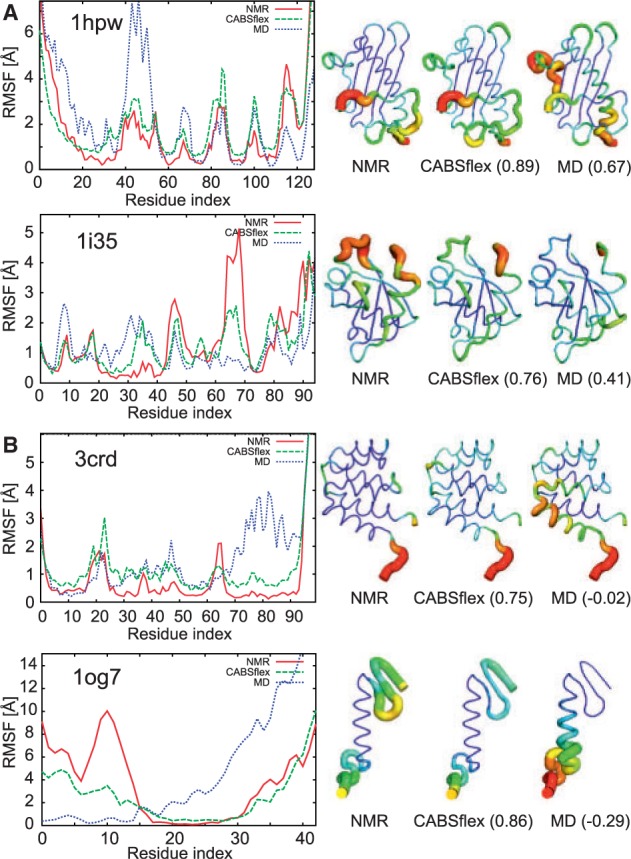
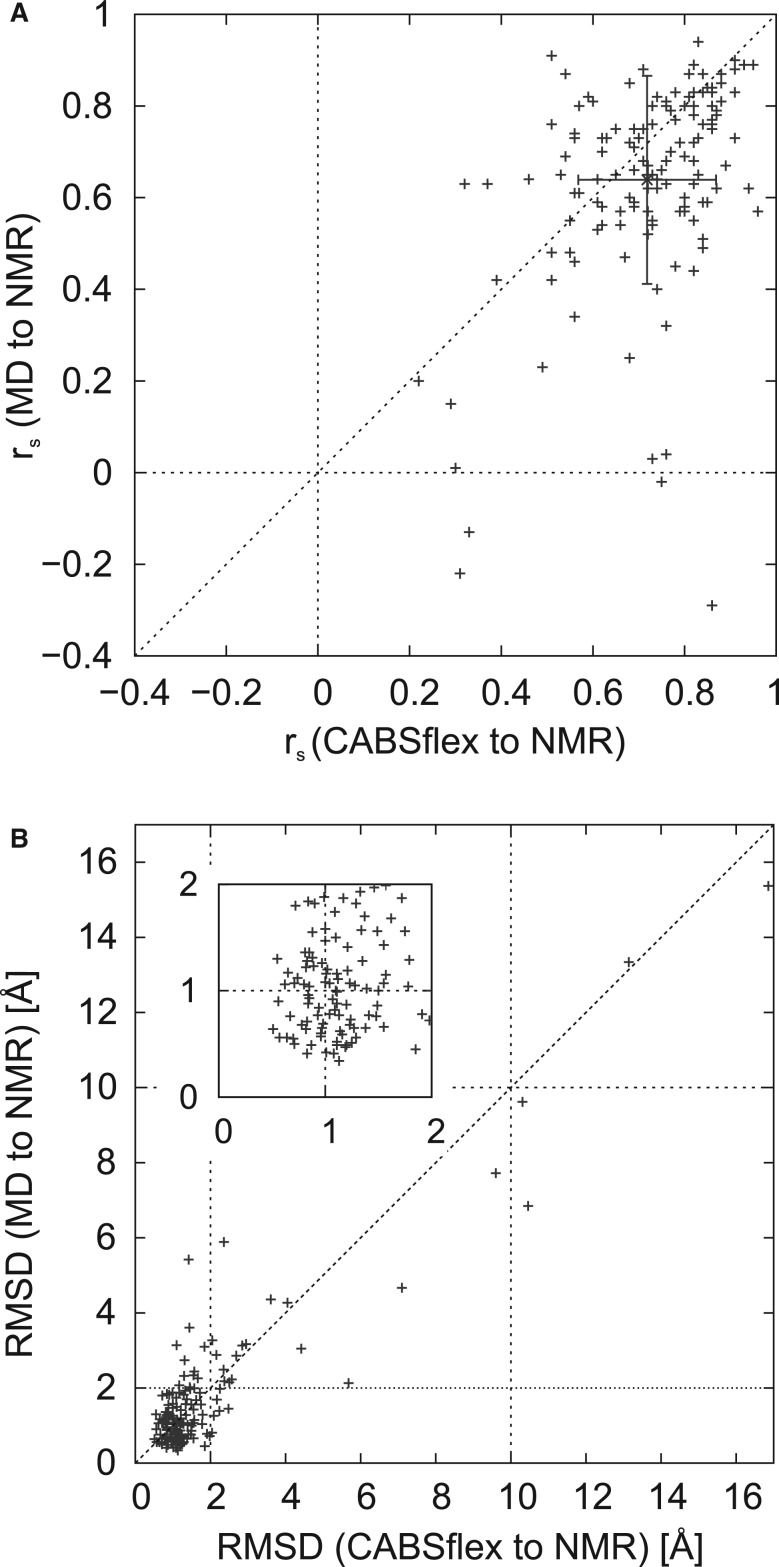
Based on a benchmark set of 140 proteins, we show that the relative fluctuations of protein residues obtained from CABS-flex are well correlated to those of NMR ensembles. On average, this correlation is stronger than that between MD and NMR ensembles. In conclusion, CABS-flex is useful and complementary to MD in predicting protein regions that undergo conformational changes as well as the extent of such changes.
The CABS-flex is freely available to all users at http://biocomp.chem.uw.edu.pl/CABSflex.
Supplementary data are available at Bioinformatics online.
识别蛋白质结构的柔性区域对于理解其生物功能非常重要。最近,我们开发了一种从单个蛋白质模型预测蛋白质结构波动的快速方法:CABS-flex。CABS-flex 被证明是传统全原子分子动力学(MD)的有效替代方法。在这项工作中,我们通过与 NMR 集合内的蛋白质结构变化进行比较来评估 CABS-flex 和 MD 的预测。
基于 140 个蛋白质的基准集,我们表明,从 CABS-flex 获得的蛋白质残基的相对波动与 NMR 集合中的波动很好地相关。平均而言,这种相关性强于 MD 和 NMR 集合之间的相关性。总之,CABS-flex 在预测经历构象变化的蛋白质区域以及此类变化的程度方面,是 MD 的有用且互补的方法。
CABS-flex 可在 http://biocomp.chem.uw.edu.pl/CABSflex 上免费供所有用户使用。
补充数据可在 Bioinformatics 在线获得。