Morton Matthew L, Bai Xiaodong, Merry Callie R, Linden Philip A, Khalil Ahmad M, Leidner Rom S, Thompson Cheryl L
Department of Family Medicine and Community Health, Case Western Reserve University, Cleveland, OH, USA.
Center for RNA Molecular Biology, Case Western Reserve University, Cleveland, OH, USA.
Lung Cancer. 2014 Jul;85(1):31-39. doi: 10.1016/j.lungcan.2014.03.020. Epub 2014 Mar 29.
Adenocarcinoma in situ (AIS) is an intermediate step in the progression of normal lung tissue to invasive adenocarcinoma. However, molecular mechanisms underlying this progression remain to be fully elucidated due to challenges in obtaining fresh clinical samples for downstream analyses. Formalin fixation and paraffin embedding (FFPE) is a tissue preservation system widely used for long-term storage. Until recently, challenges in working with FFPE precluded using new RNA sequencing technologies (RNA-seq), which would help clarify key pathways in cancer progression. Also, isolation techniques including laser-capture micro-dissection provide the ability to select histopathologically distinct tissues, allowing researchers to study transcriptional variations between tightly juxtaposed cell and tissue types.
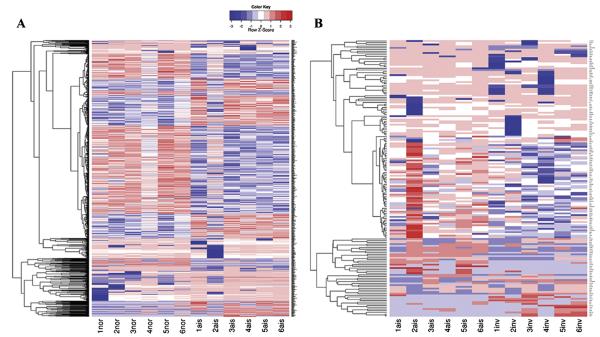
Utilizing these technologies and new alignment tools we examined differential expression of long intergenic non-coding RNAs (lincRNAs) and mRNAs across normal, AIS and invasive adenocarcinoma samples from six patients to identify possible markers of lung cancer progression.
RNA extracted and sequenced from these 18 samples generated an average of 198 million reads per sample. After alignment and filtering, uniquely aligned reads represented an average 35% of the total reads. We detected differential expression of a number of lincRNAs and mRNAs when comparing normal to AIS, or AIS to invasive adenocarcinoma. Of these, 5 lincRNAs and 31 mRNAs were consistently up- or down-regulated from normal to AIS and more so to invasive carcinoma. We validated the up-regulation of two mRNAs and one lincRNA by RT-qPCR as proof of principle.
Our findings indicate a potential role of not only mRNAs, but also lincRNAs in the progression to invasive adenocarcinoma. We anticipate that these findings will lay the groundwork for future experimental studies of candidate RNAs from FFPE to identify their functional roles in lung cancer.
原位腺癌(AIS)是正常肺组织向浸润性腺癌进展的中间阶段。然而,由于获取用于下游分析的新鲜临床样本存在挑战,这一进展背后的分子机制仍有待充分阐明。福尔马林固定和石蜡包埋(FFPE)是一种广泛用于长期保存的组织保存系统。直到最近,处理FFPE样本的挑战使得无法使用新的RNA测序技术(RNA-seq),而该技术有助于阐明癌症进展中的关键途径。此外,包括激光捕获显微切割在内的分离技术能够选择组织病理学上不同的组织,使研究人员能够研究紧密相邻的细胞和组织类型之间的转录差异。
利用这些技术和新的比对工具,我们检测了6例患者的正常、AIS和浸润性腺癌样本中长链基因间非编码RNA(lincRNA)和mRNA的差异表达,以确定肺癌进展的可能标志物。
从这18个样本中提取并测序的RNA,每个样本平均产生1.98亿条读数。经过比对和筛选,唯一比对的读数平均占总读数的35%。在比较正常组织与AIS,或AIS与浸润性腺癌时,我们检测到了一些lincRNA和mRNA的差异表达。其中,从正常组织到AIS,再到浸润性癌,有5种lincRNA和31种mRNA持续上调或下调。我们通过RT-qPCR验证了两种mRNA和一种lincRNA的上调,作为原理证明。
我们的研究结果表明,mRNA和lincRNA在向浸润性腺癌进展过程中都具有潜在作用。我们预计这些发现将为未来从FFPE样本中对候选RNA进行实验研究奠定基础,以确定它们在肺癌中的功能作用。