Lassen Amanda, Atefi Mohammad, Robert Lidia, Wong Deborah Jl, Cerniglia Michael, Comin-Anduix Begonya, Ribas Antoni
Department of Medicine, Division of Hematology-Oncology, David Geffen School of Medicine, University of California Los Angeles (UCLA), Los Angeles, CA, USA.
Mol Cancer. 2014 Apr 16;13:83. doi: 10.1186/1476-4598-13-83.
The clinical use of BRAF inhibitors for treatment of metastatic melanoma is limited by the development of drug resistance. In this study we investigated whether co-targeting the MAPK and the PI3K-AKT pathway can prevent emergence of resistance or provide additional growth inhibitory effects in vitro.
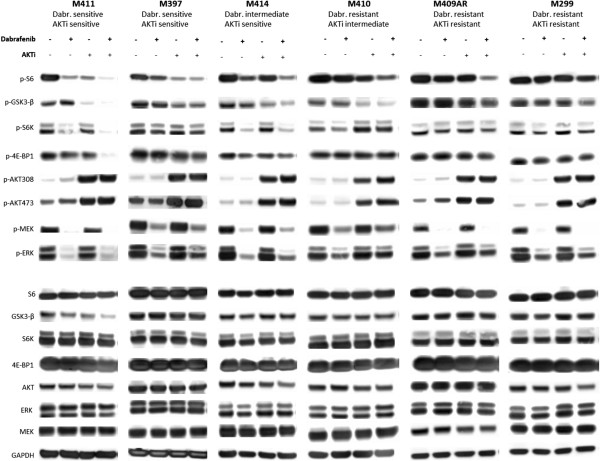
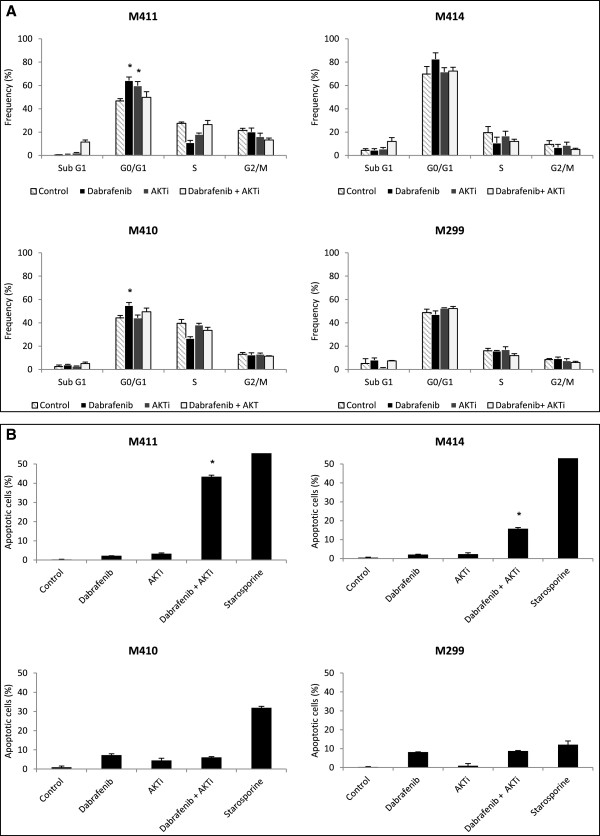
Anti-tumor effects of the combination of the BRAF inhibitor (BRAFi) dabrafenib and GSK2141795B (AKTi) in a panel of 23 BRAF mutated melanoma cell lines were evaluated on growth inhibition by an ATP-based luminescent assay, on cell cycle and apoptosis by flow cytometry and on cell signaling by western blot. Moreover, we investigated the possibilities of delaying or reversing resistance or achieving further growth inhibition by combining AKTi with dabrafenib and/or the MEK inhibitor (MEKi) trametinib by using long term cultures.
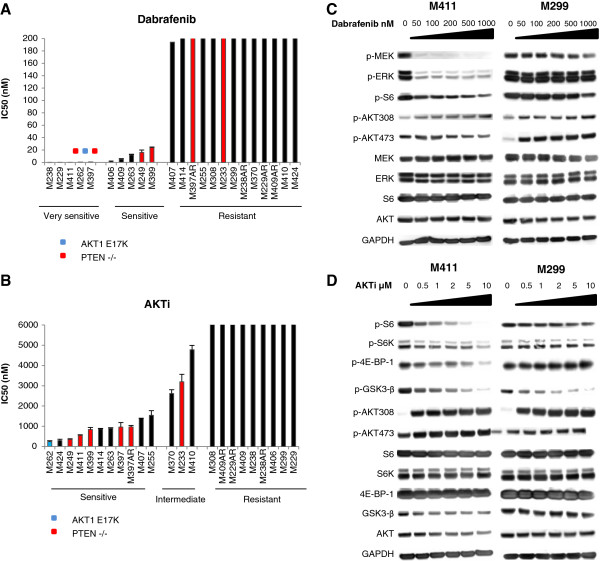
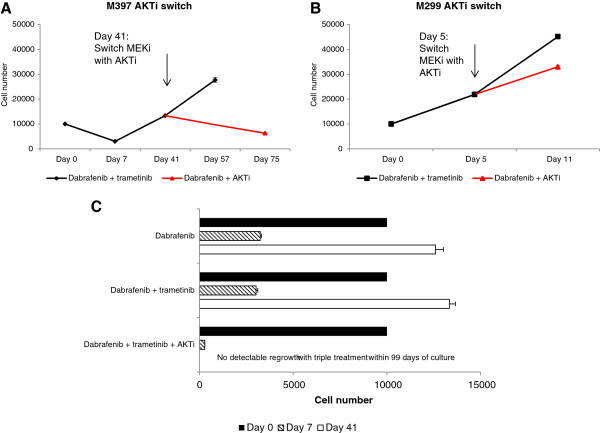
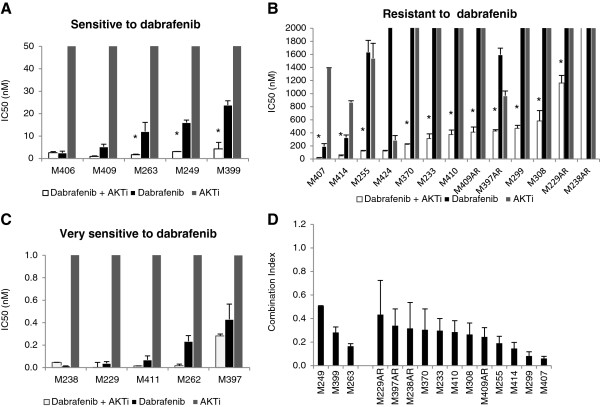
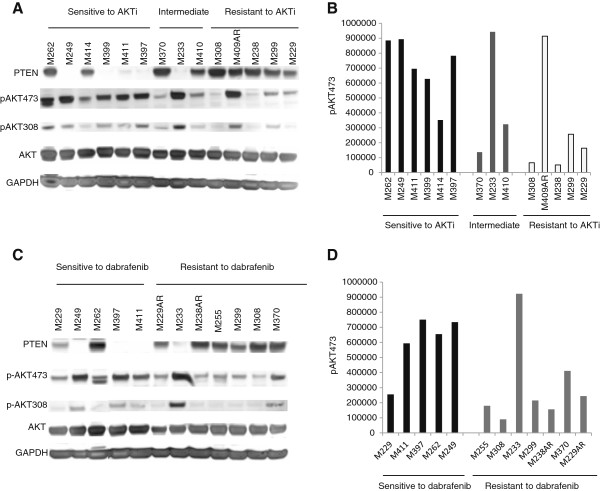
More than 40% of the cell lines, including PTEN-/- and AKT mutants showed sensitivity to AKTi (IC50 < 1.5 μM). The combination of dabrafenib and AKTi synergistically potentiated growth inhibition in the majority of cell lines with IC50 > 5 nM dabrafenib. Combinatorial treatment induced apoptosis only in cell lines sensitive to AKTi. In long term cultures of a PTEN-/- cell line, combinatorial treatment with the MAPK inhibitors, dabrafenib and trametinib, and AKTi markedly delayed the emergence of drug resistance. Moreover, combining AKTi with the MAPK inhibitors from the beginning provided superior growth inhibitory effects compared to addition of AKTi upon development of resistance to MAPK inhibitors in this particular cell line.
AKTi combined with BRAFi-based therapy may benefit patients with tumors harboring BRAF mutations and particularly PTEN deletions or AKT mutations.
BRAF抑制剂用于治疗转移性黑色素瘤的临床应用受到耐药性发展的限制。在本研究中,我们调查了联合靶向MAPK和PI3K-AKT通路是否可以预防耐药性的出现或在体外提供额外的生长抑制作用。
通过基于ATP的发光测定评估BRAF抑制剂(BRAFi)达拉非尼和GSK2141795B(AKTi)联合用药对23种BRAF突变黑色素瘤细胞系的抗肿瘤作用,通过流式细胞术评估对细胞周期和凋亡的影响,通过蛋白质免疫印迹评估对细胞信号传导的影响。此外,我们通过长期培养研究了将AKTi与达拉非尼和/或MEK抑制剂(MEKi)曲美替尼联合使用来延迟或逆转耐药性或实现进一步生长抑制的可能性。
超过40%的细胞系,包括PTEN基因敲除和AKT突变体,对AKTi敏感(IC50<1.5μM)。在大多数达拉非尼IC50>5 nM的细胞系中,达拉非尼和AKTi联合用药协同增强了生长抑制作用。联合治疗仅在对AKTi敏感的细胞系中诱导凋亡。在一个PTEN基因敲除细胞系的长期培养中,MAPK抑制剂达拉非尼和曲美替尼与AKTi联合治疗显著延迟了耐药性的出现。此外,在这个特定细胞系中,与在对MAPK抑制剂产生耐药性后添加AKTi相比,从一开始就将AKTi与MAPK抑制剂联合使用提供了更好的生长抑制效果。
AKTi联合基于BRAFi的治疗可能使携带BRAF突变,特别是PTEN缺失或AKT突变的肿瘤患者受益。