El Kaffas Ahmed, Nofiele Joris, Giles Anoja, Cho Song, Liu Stanley K, Czarnota Gregory J
Department of Radiation Oncology, Sunnybrook Health Sciences Centre, Toronto, Ontario, Canada; Imaging Research and Physical Sciences, Sunnybrook Health Sciences Centre, Toronto, Ontario, Canada; Departments of Medical Biophysics, University of Toronto, Toronto, Ontario, Canada.
Departments of Medical Biophysics, University of Toronto, Toronto, Ontario, Canada.
PLoS One. 2014 Apr 15;9(4):e93888. doi: 10.1371/journal.pone.0093888. eCollection 2014.
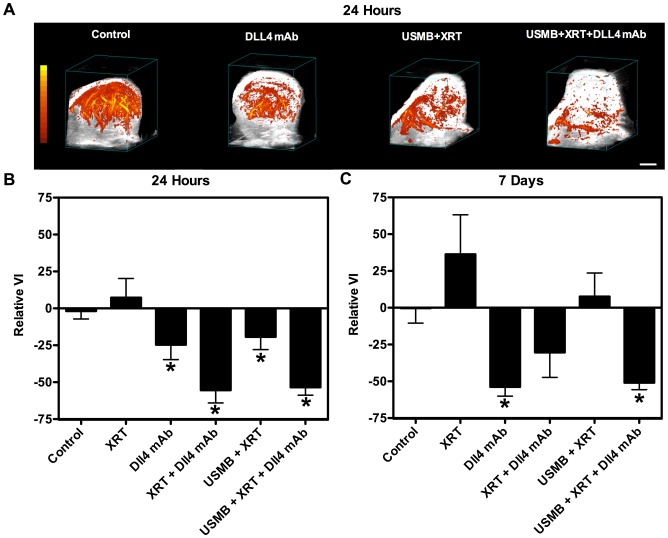
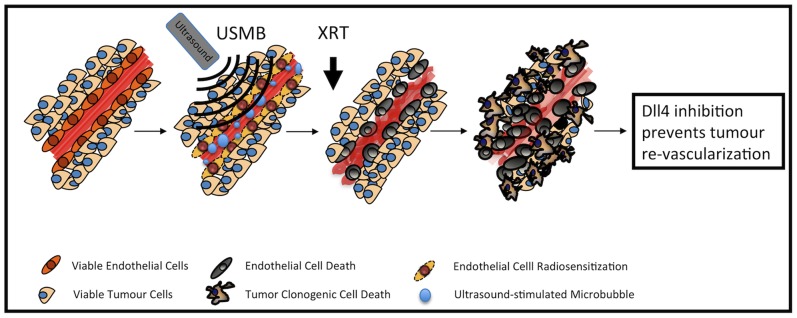
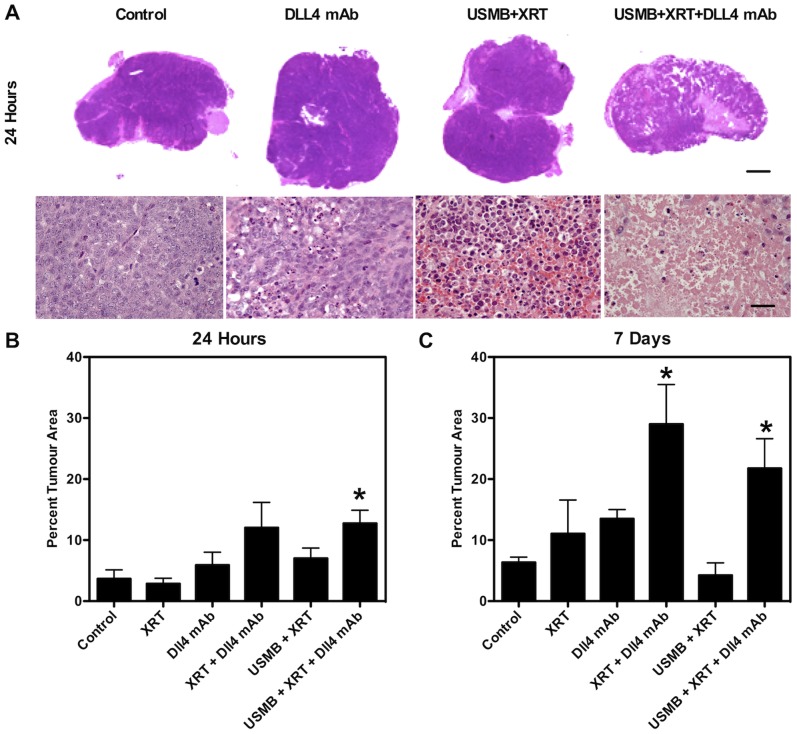
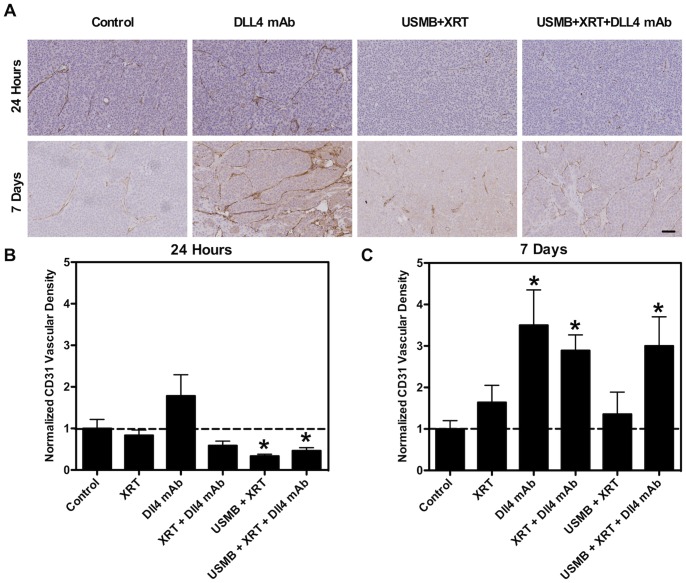
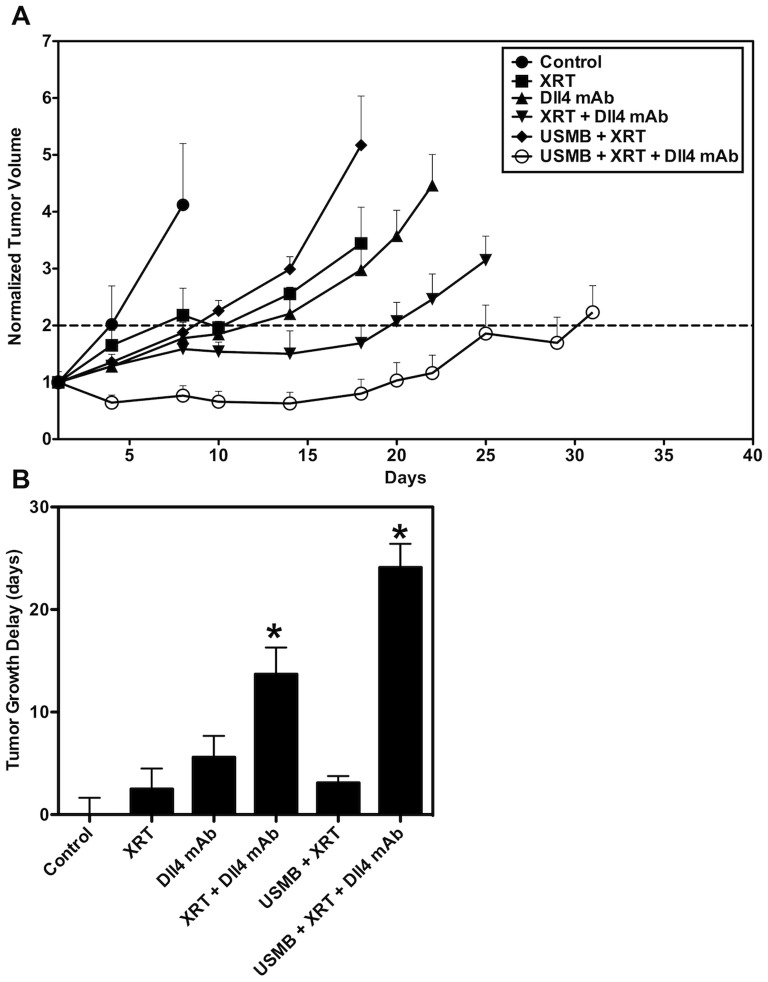
Tumour vasculature acts as an essential lifeline for tumour progression and facilitates metastatic spread. Novel vascular targeting strategies aiming to sustain vascular shutdown could potentially induce substantial damage, resulting in a significant tumour growth delay. We investigated the combination of two novel complementary vascular targeting agents with radiation therapy in a strategy aiming to sustain vascular disruption. Experiments were carried out with delta-like ligand 4 (Dll4) blockade (angiogenesis deregulator) treatment administered in combination with a radiation-based vascular destruction treatment in a highly aggressive well-perfused colon cancer tumour line implanted in female athymic nude mice. Tumours were treated with permutations of radiation, ultrasound-stimulated microbubbles (USMB) and Dll4 monoclonal antibody (mAb). Tumour vascular response was assessed with three-dimensional power Doppler ultrasound to measure active flow and immunohistochemistry. Tumour response was assessed with histochemical assays and longitudinal measurements of tumour volume. Our results suggest a significant tumour response in animals treated with USMB combined with radiation, and Dll4 mAb, leading to a synergistic tumour growth delay of up to 24 days. This is likely linked to rapid cell death within the tumour and a sustained tumour vascular shutdown. We conclude that the triple combination treatments cause a vascular shutdown followed by a sustained inhibition of angiogenesis and tumour cell death, leading to a rapid tumour vascular-based 'collapse' and a significant tumour growth delay.
肿瘤血管系统是肿瘤进展的重要生命线,并促进转移扩散。旨在维持血管闭塞的新型血管靶向策略可能会造成实质性损伤,导致肿瘤生长显著延迟。我们研究了两种新型互补血管靶向药物与放射治疗的联合应用,以维持血管破坏。实验在植入雌性无胸腺裸鼠体内的高度侵袭性、血供良好的结肠癌细胞系中进行,采用δ样配体4(Dll4)阻断(血管生成调节剂)治疗与基于放射的血管破坏治疗联合应用。用放射、超声激发微泡(USMB)和Dll4单克隆抗体(mAb)的不同组合处理肿瘤。用三维能量多普勒超声评估肿瘤血管反应以测量血流活性,并进行免疫组织化学分析。用组织化学分析和肿瘤体积的纵向测量评估肿瘤反应。我们的结果表明,接受USMB联合放射和Dll4 mAb治疗的动物出现显著的肿瘤反应,导致协同性肿瘤生长延迟长达24天。这可能与肿瘤内的快速细胞死亡和持续的肿瘤血管闭塞有关。我们得出结论,三联组合治疗导致血管闭塞,随后持续抑制血管生成和肿瘤细胞死亡,导致基于肿瘤血管的快速“崩溃”和显著的肿瘤生长延迟。