Lukaszuk Krzysztof, Ludwikowska Beata, Liss Joanna, Kunicki Michal, Sawczak Miroslaw, Lukaszuk Aron, Plociennik Lukasz, Jakiel Grzegorz, Wasniewski Tomasz, Woclawek-Potocka Izabela, Bialobrzeska Dorota
INVICTA Fertility and Reproductive Centre, 80-850 Gdansk, Poland ; Department of Nursing, Medical University, 80-952 Gdansk, Poland ; Department of Obstetrics and Gynecology, Faculty of Medical Sciences, Varmia and Masuria University, 10-561 Olsztyn, Poland ; INVICTA Fertility and Reproductive Centre, 00-019 Warsaw, Poland ; Department of Photophysics, IFFM Polish Academy of Sciences, 80-952 Gdansk, Poland.
INVICTA Fertility and Reproductive Centre, 80-850 Gdansk, Poland.
Biomed Res Int. 2014;2014:165352. doi: 10.1155/2014/165352. Epub 2014 Mar 11.
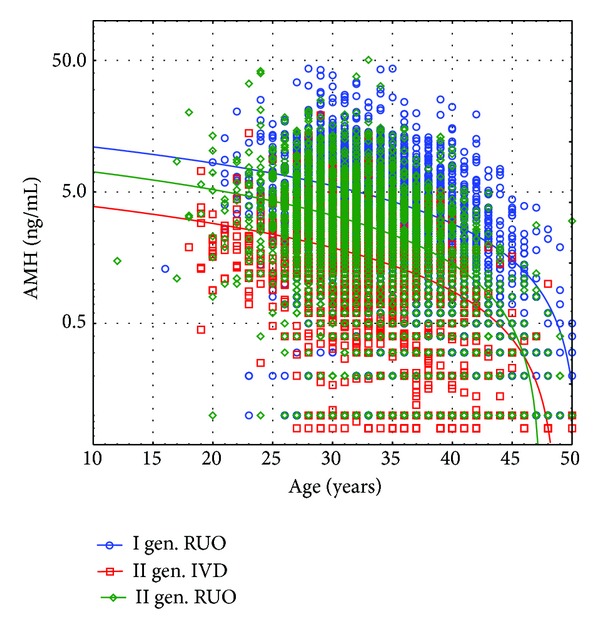
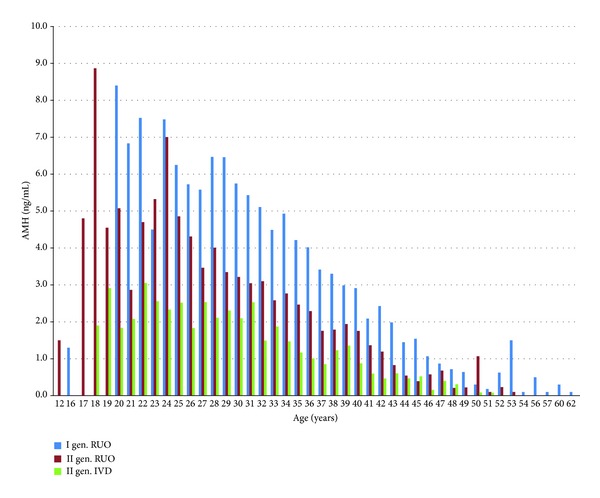
Anti-Müllerian hormone (AMH) measurements are widely used to optimize the stimulation protocols. First generation AMH kits correlated well with ovarian reserve and response to stimulation. In the present study we aimed to asses if the new generation kits share the same accurate correlations. Retrospective data were collected from 8323 blood samples. For comparison we used Immunotech I generation kit (ImI 4035 samples), Beckman Coulter II generation kit RUO (BCII RUO 3449, samples) and Beckman Coulter II generation kit with IVD certificate (BCII IVD 839 samples). We compared average AMH concentrations measured with different kits, as well as correlation between kits. We also compared average AMH concentrations in sera collected on different cycle days and samples of different quality of preservation. AMH serum concentrations differed for each kit, ranging 4.4 ± 4.12 (mean ± SD) for the ImI, 2.68 ± 3.15 for the BCII RUO, and 1.64 ± 2.85 for BCII IVD. The mean differences from an adjusted regression model were -48.7%, -40%, and -69.2%, respectively. In conclusion, the changes of the BC AMH kits are unpredictable; however, the improvement of them is still possible. It would be very dangerous to use elaborated stimulation protocol (based on the Ist generation AMH results) with the results from the IInd generation assays.
抗苗勒管激素(AMH)检测被广泛用于优化刺激方案。第一代AMH检测试剂盒与卵巢储备及刺激反应的相关性良好。在本研究中,我们旨在评估新一代试剂盒是否具有同样准确的相关性。我们收集了8323份血样的回顾性数据。为作比较,我们使用了免疫技术第一代试剂盒(ImI,4035份样本)、贝克曼库尔特第二代RUO试剂盒(BCII RUO,3449份样本)以及具有体外诊断试剂证书的贝克曼库尔特第二代试剂盒(BCII IVD,839份样本)。我们比较了用不同试剂盒测得的平均AMH浓度以及各试剂盒之间的相关性。我们还比较了在不同周期日采集的血清中的平均AMH浓度以及不同保存质量的样本。各试剂盒测得的AMH血清浓度有所不同,ImI试剂盒为4.4±4.12(均值±标准差),BCII RUO试剂盒为2.68±3.15,BCII IVD试剂盒为1.64±2.85。经调整的回归模型得出的平均差异分别为-48.7%、-40%和-69.2%。总之,贝克曼库尔特AMH试剂盒的变化不可预测;然而,其改进仍有可能。使用基于第一代AMH结果的精细刺激方案与第二代检测结果是非常危险的。