Lim Chi Wan, Su Yi, Yeo Si Yong, Ng Gillian Maria, Nguyen Vinh Tan, Zhong Liang, Tan Ru San, Poh Kian Keong, Chai Ping
Institute of High Performance Computing, A*STAR, Singapore, Singapore.
National Heart Centre Singapore, Singapore.
PLoS One. 2014 Apr 17;9(4):e93747. doi: 10.1371/journal.pone.0093747. eCollection 2014.
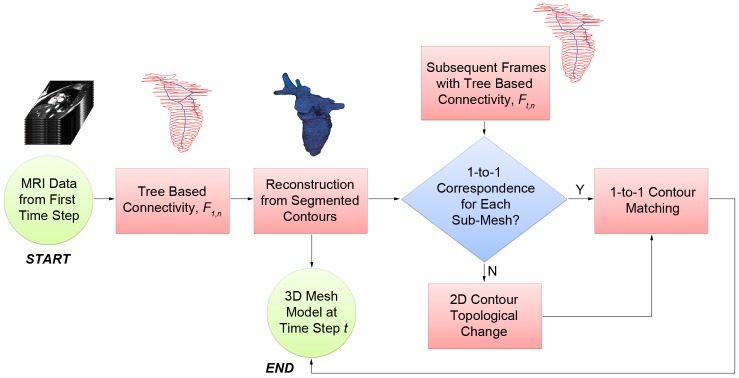
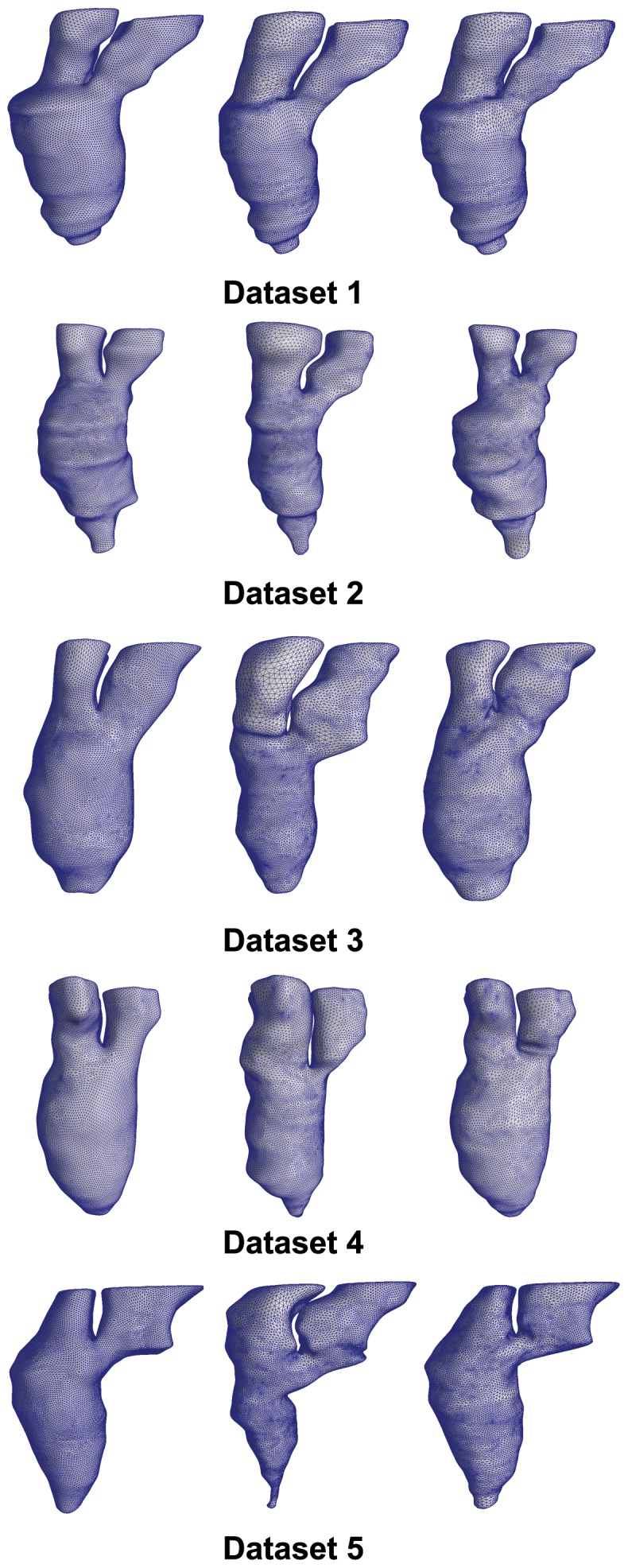
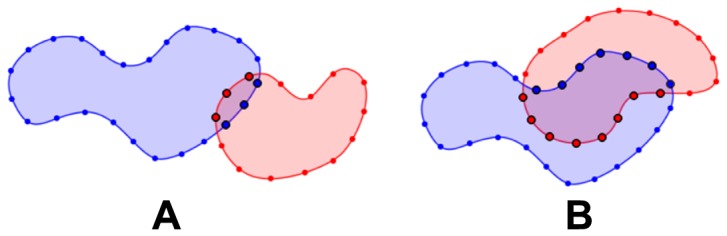
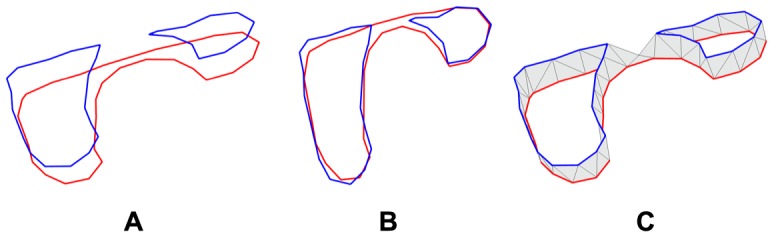
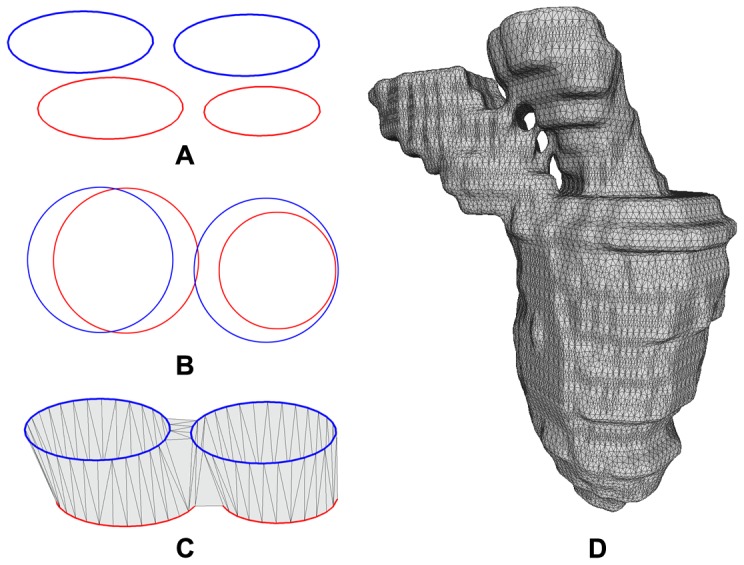
We propose an automatic algorithm for the reconstruction of patient-specific cardiac mesh models with 1-to-1 vertex correspondence. In this framework, a series of 3D meshes depicting the endocardial surface of the heart at each time step is constructed, based on a set of border delineated magnetic resonance imaging (MRI) data of the whole cardiac cycle. The key contribution in this work involves a novel reconstruction technique to generate a 4D (i.e., spatial-temporal) model of the heart with 1-to-1 vertex mapping throughout the time frames. The reconstructed 3D model from the first time step is used as a base template model and then deformed to fit the segmented contours from the subsequent time steps. A method to determine a tree-based connectivity relationship is proposed to ensure robust mapping during mesh deformation. The novel feature is the ability to handle intra- and inter-frame 2D topology changes of the contours, which manifests as a series of merging and splitting of contours when the images are viewed either in a spatial or temporal sequence. Our algorithm has been tested on five acquisitions of cardiac MRI and can successfully reconstruct the full 4D heart model in around 30 minutes per subject. The generated 4D heart model conforms very well with the input segmented contours and the mesh element shape is of reasonably good quality. The work is important in the support of downstream computational simulation activities.
我们提出了一种用于重建具有一一对应顶点的患者特异性心脏网格模型的自动算法。在此框架下,基于整个心动周期的一组边界勾勒的磁共振成像(MRI)数据,构建了一系列在每个时间步描绘心脏心内膜表面的3D网格。这项工作的关键贡献涉及一种新颖的重建技术,以生成在整个时间帧中具有一一对应顶点映射的心脏4D(即时空)模型。从第一个时间步重建的3D模型用作基础模板模型,然后进行变形以拟合后续时间步的分割轮廓。提出了一种确定基于树的连通性关系的方法,以确保网格变形期间的稳健映射。新颖之处在于能够处理轮廓的帧内和帧间2D拓扑变化,当按空间或时间序列查看图像时,这表现为轮廓的一系列合并和拆分。我们的算法已在五次心脏MRI采集上进行了测试,每个受试者大约30分钟就能成功重建完整的4D心脏模型。生成的4D心脏模型与输入的分割轮廓非常吻合,并且网格单元形状质量相当不错。这项工作对支持下游计算模拟活动很重要。