Seo Bo Ram, Min Kyoung-Jin, Cho Il Je, Kim Sang Chan, Kwon Taeg Kyu
Department of Immunology, School of Medicine, Keimyung University, Daegu, South Korea.
College of Oriental Medicine, Daegu Haany University, Gyeongsan, Korea; Medical Research Center for Globalization of Herbal Formulation, Daegu Haany University, Gyeongsan, Korea.
PLoS One. 2014 Apr 17;9(4):e95588. doi: 10.1371/journal.pone.0095588. eCollection 2014.
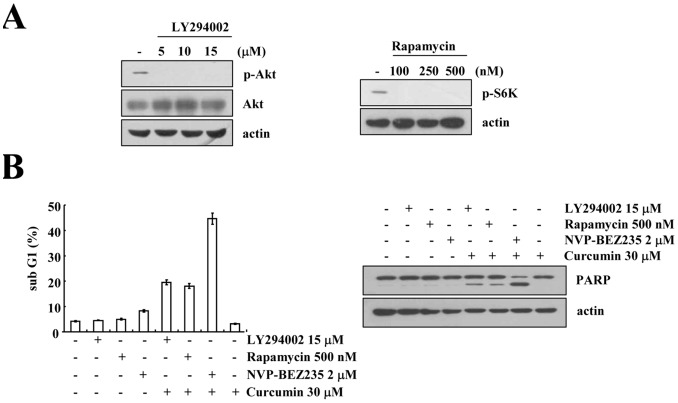
The PI3K/Akt and mTOR signaling pathways are important for cell survival and growth, and they are highly activated in cancer cells compared with normal cells. Therefore, these signaling pathways are targets for inducing cancer cell death. The dual PI3K/Akt and mTOR inhibitor NVP-BEZ235 completely inhibited both signaling pathways. However, NVP-BEZ235 had no effect on cell death in human renal carcinoma Caki cells. We tested whether combined treatment with natural compounds and NVP-BEZ235 could induce cell death. Among several chemopreventive agents, curcumin, a natural biologically active compound that is extracted from the rhizomes of Curcuma species, markedly induced apoptosis in NVP-BEZ235-treated cells. Co-treatment with curcumin and NVP-BEZ235 led to the down-regulation of Mcl-1 protein expression but not mRNA expression. Ectopic expression of Mcl-1 completely inhibited curcumin plus NVP-NEZ235-induced apoptosis. Furthermore, the down-regulation of Bcl-2 was involved in curcumin plus NVP-BEZ235-induced apoptosis. Curcumin or NVP-BEZ235 alone did not change Bcl-2 mRNA or protein expression, but co-treatment reduced Bcl-2 mRNA and protein expression. Combined treatment with NVP-BEZ235 and curcumin reduced Bcl-2 expression in wild-type p53 HCT116 human colon carcinoma cells but not p53-null HCT116 cells. Moreover, Bcl-2 expression was completely reversed by treatment with pifithrin-α, a p53-specific inhibitor. Ectopic expression of Bcl-2 also inhibited apoptosis in NVP-BE235 plus curcumin-treated cells. In contrast, NVP-BEZ235 combined with curcumin did not have a synergistic effect on normal human skin fibroblasts and normal human mesangial cells. Taken together, combined treatment with NVP-BEZ235 and curcumin induces apoptosis through p53-dependent Bcl-2 mRNA down-regulation at the transcriptional level and Mcl-1 protein down-regulation at the post-transcriptional level.
PI3K/Akt和mTOR信号通路对细胞存活和生长至关重要,与正常细胞相比,它们在癌细胞中高度激活。因此,这些信号通路是诱导癌细胞死亡的靶点。双PI3K/Akt和mTOR抑制剂NVP-BEZ235完全抑制了这两条信号通路。然而,NVP-BEZ235对人肾癌Caki细胞的细胞死亡没有影响。我们测试了天然化合物与NVP-BEZ235联合治疗是否能诱导细胞死亡。在几种化学预防剂中,姜黄素是一种从姜黄属植物根茎中提取的天然生物活性化合物,能显著诱导NVP-BEZ235处理细胞的凋亡。姜黄素与NVP-BEZ235联合处理导致Mcl-1蛋白表达下调,但mRNA表达未下调。Mcl-1的异位表达完全抑制了姜黄素加NVP-NEZ235诱导的凋亡。此外,Bcl-2的下调参与了姜黄素加NVP-BEZ235诱导的凋亡。单独使用姜黄素或NVP-BEZ235不会改变Bcl-2 mRNA或蛋白表达,但联合处理会降低Bcl-2 mRNA和蛋白表达。NVP-BEZ235与姜黄素联合处理降低了野生型p53的HCT116人结肠癌细胞中的Bcl-2表达,但对p53缺失的HCT116细胞没有影响。此外,用p53特异性抑制剂pifithrin-α处理可完全逆转Bcl-2表达。Bcl-2的异位表达也抑制了NVP-BE235加姜黄素处理细胞的凋亡。相比之下,NVP-BEZ235与姜黄素联合对正常人皮肤成纤维细胞和正常人系膜细胞没有协同作用。综上所述,NVP-BEZ235与姜黄素联合治疗通过转录水平上p53依赖的Bcl-2 mRNA下调和转录后水平上Mcl-1蛋白下调诱导凋亡。