Mo Xianwei, Yang Yang, Lai Hao, Xiao Jun, He Ke, Chen Jiansi, Lin Yuan
Department of Gastrointestinal Surgery, Tumor Hospital of Guangxi Medical University, 22 Shuangyong Road, Nanning, 530021, Guangxi Autonomous Region, China.
Tumour Biol. 2014 Aug;35(8):7351-9. doi: 10.1007/s13277-014-1812-5. Epub 2014 Apr 18.
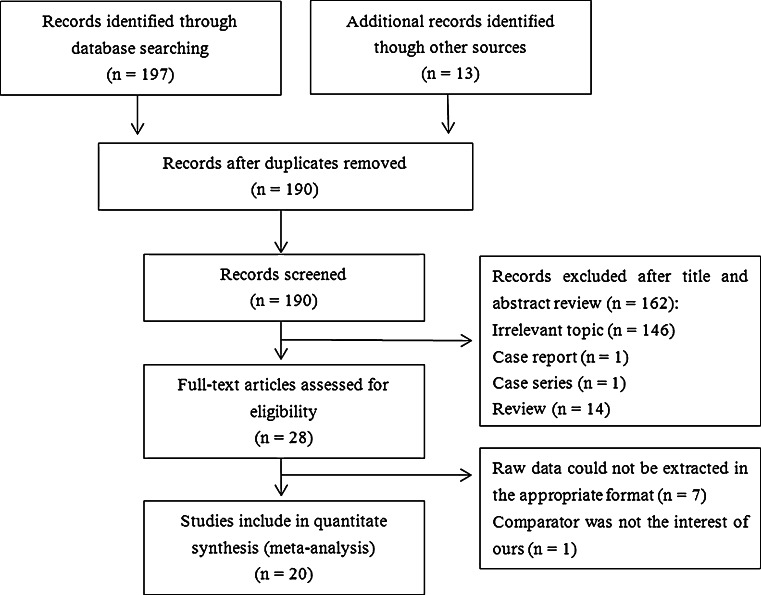
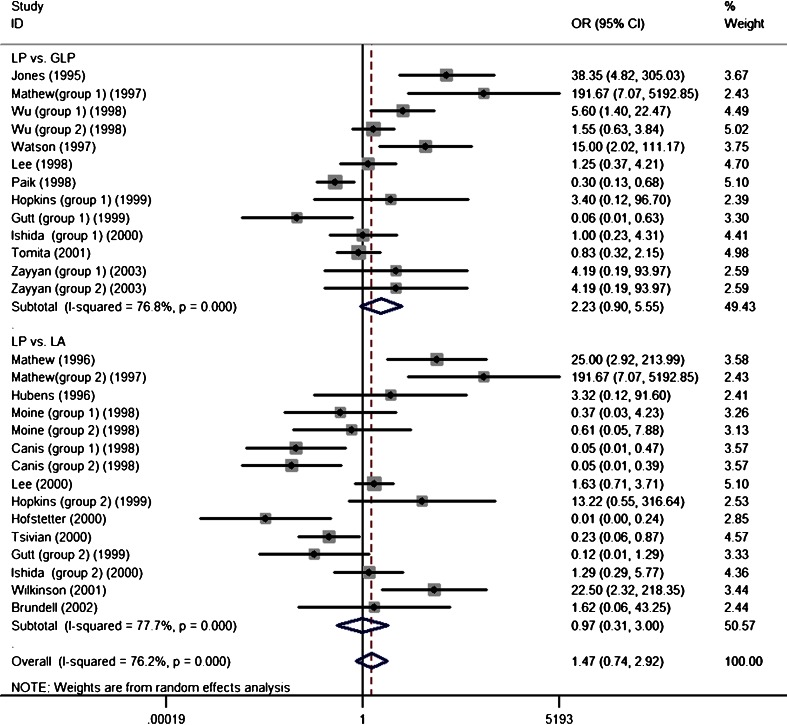
The mechanisms involved in the development of wound metastasis following laparoscopic abdominal tumor surgery remain unclear. The aim of this study was to accurately assess whether the duration of carbon dioxide pneumoperitoneum (CDP) during laparoscopic abdominal tumor surgery enhances wound metastases. We conducted a systematic review of PubMed, Cochrane Library, and Embase through December 2013 to identify animal experiments comparing wound recurrence between laparoscopic and gasless laparoscopic procedures or open procedures. The outcome of interest was the number of animals with a wound tumor. Meta-regression was used to assess whether heterogeneity was explained by study level covariates (animal model, study size, CDP pressure, duration, and evaluated time). Twenty randomized control studies involving 1,229 animals were included. Wound recurrence was not significant in the laparoscopic surgery (LP) vs. gasless laparoscopic surgery (GLP) subgroups [odds ratio (OR), 2.23; 95 % confidence interval (CI), 0.90-5.55; P = 0.08) or the LP vs. laparotomy (LA) subgroups (OR, 0.97; 95 % CI, 0.31-3.00; P = 0.08). Overall postoperative wound recurrence results were not significantly different between the study groups and controls (OR, 1.47; 95 % CI, 0.74-2.92; P = 0.28). A meta-regression analysis showed that the outcome was not correlated with the covariates (animal model: P = 0.82; evaluated time: P = 0.30; pressure of CDP: P = 0.12; duration time: P = 0.80). Current evidence suggests that CDP does not enhance wound metastases following laparoscopic abdominal tumor surgery. Additional large sample, well-designed, randomized, controlled trials are needed to further confirm whether CDP duration in laparoscopic abdominal tumor surgery significantly enhances wound recurrence.
腹腔镜腹部肿瘤手术后伤口转移发生的相关机制仍不清楚。本研究的目的是准确评估腹腔镜腹部肿瘤手术期间二氧化碳气腹(CDP)的持续时间是否会增加伤口转移。我们对截至2013年12月的PubMed、Cochrane图书馆和Embase进行了系统评价,以识别比较腹腔镜手术与免气腹腹腔镜手术或开放手术之间伤口复发情况的动物实验。感兴趣的结果是出现伤口肿瘤的动物数量。采用Meta回归分析评估研究水平的协变量(动物模型、研究规模、CDP压力、持续时间和评估时间)是否可以解释异质性。纳入了20项涉及1229只动物的随机对照研究。在腹腔镜手术(LP)与免气腹腹腔镜手术(GLP)亚组中,伤口复发无显著性差异[比值比(OR)为2.23;95%置信区间(CI)为0.90 - 5.55;P = 0.08],在LP与开腹手术(LA)亚组中也无显著性差异(OR为0.97;95%CI为0.31 - 3.00;P = 0.08)。研究组和对照组之间总体术后伤口复发结果无显著差异(OR为1.47;95%CI为0.74 - 2.92;P = 0.28)。Meta回归分析表明,结果与协变量无关(动物模型:P = 0.82;评估时间:P = 0.30;CDP压力:P = 0.12;持续时间:P = 0.80)。目前的证据表明,CDP不会增加腹腔镜腹部肿瘤手术后的伤口转移。需要更多大样本、设计良好的随机对照试验来进一步证实腹腔镜腹部肿瘤手术中CDP持续时间是否会显著增加伤口复发。