Department of Traslational Research and New Technology in Medicine and Surgery, University of Pisa, Italy ; These authors contributed equally to this work.
Department of Traslational Research and New Technology in Medicine and Surgery, University of Pisa, Italy.
Biol Sport. 2013 Dec;30(4):301-9. doi: 10.5604/20831862.1077557. Epub 2013 Nov 25.
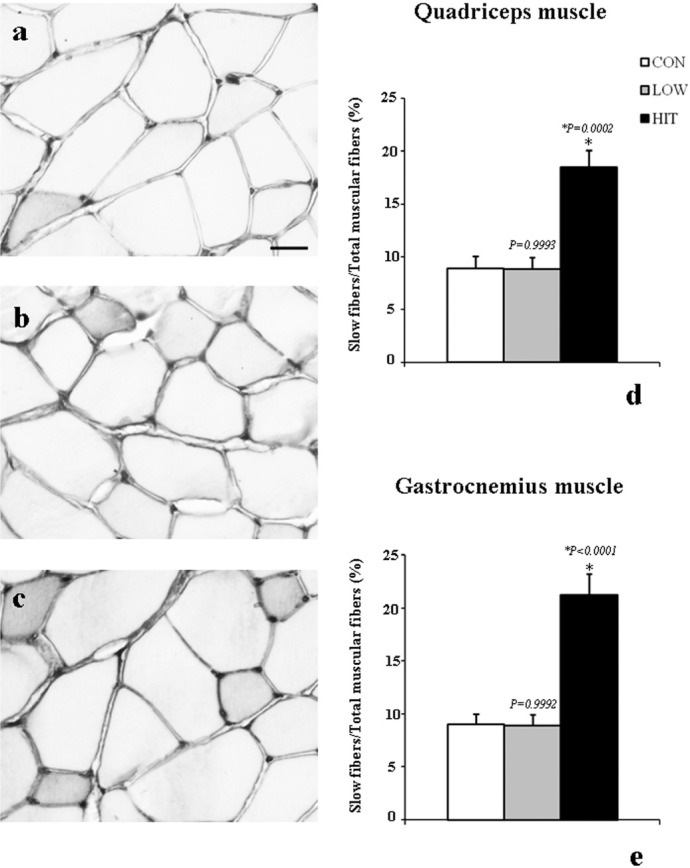
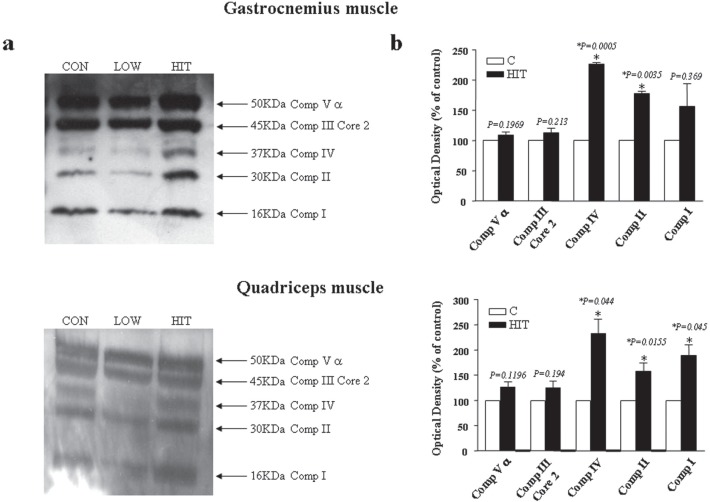
the quadriceps and the gastrocnemius. Mice were run daily on a motorized treadmill, at a velocity corresponding to 60% or 90% of the maximal running velocity. Blood lactate and body weight were measured during exercise training. We found that at the end of training the body weight significantly increased in high-intensity exercise mice compared to the control group (P=0.0268), whereas it decreased in low-intensity exercise mice compared to controls (P=0.30). In contrast, the food intake was greater in both trained mice compared to controls (P < 0.0001 and P < 0.0001 for low-intensity and high-intensity exercise mice, respectively). These effects were accompanied by a progressive reduction in blood lactate levels at the end of training in both the exercised mice compared with controls (P=0.03 and P < 0.0001 for low-intensity and high-intensity exercise mice, respectively); in particular, blood lactate levels after high-intensity exercise were significantly lower than those measured in low-intensity exercise mice (P=0.0044). Immunoblotting analysis demonstrated that high-intensity exercise training produced a significant increase in the expression of mitochondrial enzymes contained within gastrocnemius and quadriceps muscles. These changes were associated with an increase in the amount of slow fibres in both these muscles of high-intensity exercise mice, as revealed by the counts of slow fibres stained with specific antibodies (P < 0.0001 for the gastrocnemius; P=0.0002 for the quadriceps). Our results demonstrate that high-intensity exercise, in addition to metabolic changes consisting of a decrease in blood lactate and body weight, induces an increase in the mitochondrial enzymes and slow fibres in different skeletal muscles of mice, which indicates an exercise-induced increase in the aerobic metabolism.
在本研究中,我们研究了两种不同的运动方案对小鼠两种特定肌肉(股四头肌和比目鱼肌)的纤维组成和代谢的影响。小鼠每天在电动跑步机上以 60%或 90%的最大跑步速度进行跑步。在运动训练过程中测量血乳酸和体重。我们发现,在训练结束时,高强度运动组小鼠的体重与对照组相比显著增加(P=0.0268),而低强度运动组小鼠的体重与对照组相比则下降(P=0.30)。相比之下,两种训练组小鼠的食物摄入量均大于对照组(低强度和高强度运动组分别为 P < 0.0001 和 P < 0.0001)。这些影响伴随着两种运动组小鼠在训练结束时血乳酸水平的逐渐降低(分别为 P=0.03 和 P < 0.0001);特别是,高强度运动后的血乳酸水平明显低于低强度运动组(P=0.0044)。免疫印迹分析表明,高强度运动训练导致比目鱼肌和股四头肌中包含的线粒体酶的表达显著增加。这些变化与高强度运动组小鼠这两种肌肉中慢纤维数量的增加有关,这通过用特异性抗体染色的慢纤维计数来揭示(比目鱼肌为 P < 0.0001;股四头肌为 P=0.0002)。我们的结果表明,高强度运动除了引起血乳酸和体重的代谢变化外,还会导致不同骨骼肌中线粒体酶和慢纤维的增加,这表明运动引起了有氧代谢的增加。