Igarashi Tsutomu, Miyake Noriko, Fujimoto Chiaki, Yaguchi Chiemi, Iijima Osamu, Shimada Takashi, Takahashi Hiroshi, Miyake Koichi
Department of Ophthalmology, Nippon Medical School, Tokyo, Japan ; Department of Biochemistry and Molecular Biology, Division of Gene Therapy Research Center for Advanced Medical Technology, Nippon Medical School, Tokyo, Japan.
Department of Biochemistry and Molecular Biology, Division of Gene Therapy Research Center for Advanced Medical Technology, Nippon Medical School, Tokyo, Japan.
Mol Vis. 2014 Apr 11;20:488-96. eCollection 2014.
To assess the feasibility of a gene therapeutic approach to treating choroidal neovascularization (CNV), we generated an adeno-associated virus type 8 vector (AAV2/8) encoding an siRNA targeting vascular endothelial growth factor (VEGF), and determined the AAV2/8 vector's ability to inhibit angiogenesis.
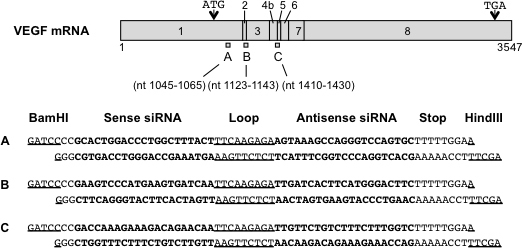
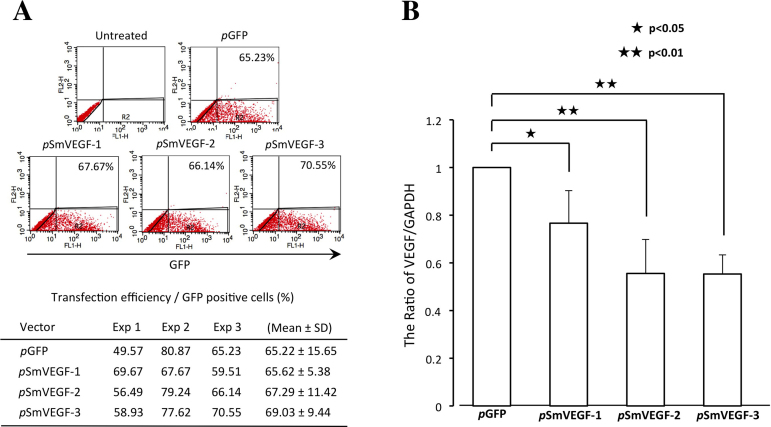
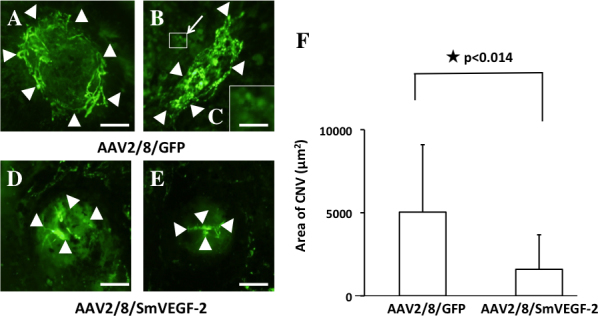
We initially transfected 3T3 cells expressing VEGF with the AAV2/8 plasmid vector psiRNA-VEGF using the H1 promoter and found that VEGF expression was significantly diminished in the transfectants. We next injected 1 μl (3 × 10(14) vg/ml) of AAV2/8 vector encoding siRNA targeting VEGF (AAV2/8/SmVEGF-2; n = 12) or control vector encoding green fluorescent protein (GFP) (AAV2/8/GFP; n = 14) into the subretinal space in C57BL/6 mice. One week later, CNV was induced by using a diode laser to make four separate choroidal burns around the optic nerve in each eye. After an additional 2 weeks, the eyes were removed for flat mount analysis of the CNV surface area.
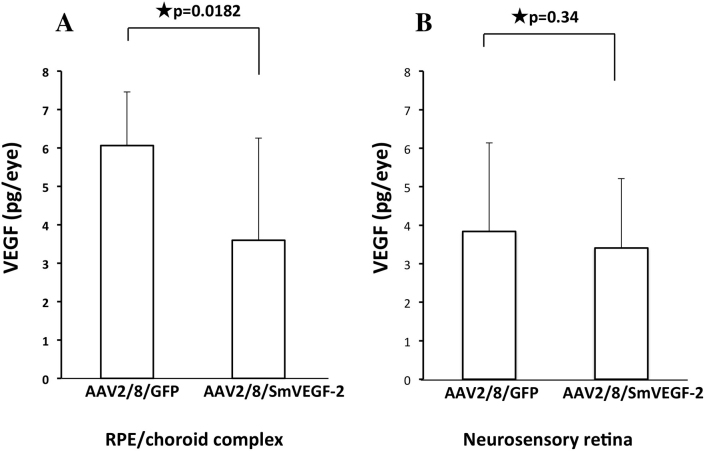
Subretinal delivery of AAV2/8/SmVEGF-2 significantly diminished CNV at the laser lesions, compared to AAV8/GFP (1597.3 ± 2077.2 versus 5039.5 ± 4055.9 µm(2); p<0.05). Using an enzyme-linked immunosorbent assay, we found that VEGF levels were reduced by approximately half in the AAV2/8/SmVEGF-2 treated eyes.
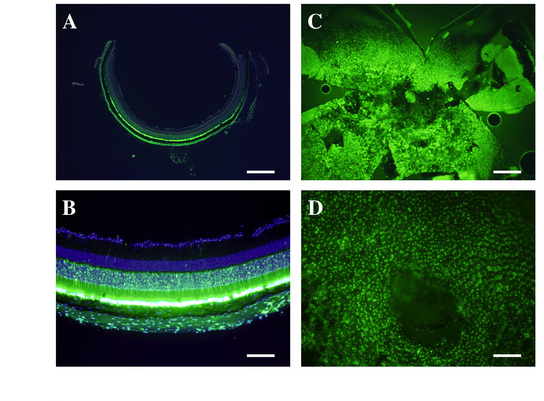
These results suggest that siRNA-VEGF can be expressed across the retina and that long-term suppression of CNV is possible through the use of stable AAV2/8-mediated siRNA-VEGF expression. In vivo gene therapy may thus be a feasible approach to the clinical management of CNV in conditions such as age-related macular degeneration.
为评估基因治疗方法治疗脉络膜新生血管(CNV)的可行性,我们构建了一种编码靶向血管内皮生长因子(VEGF)的小干扰RNA的8型腺相关病毒载体(AAV2/8),并确定了AAV2/8载体抑制血管生成的能力。
我们首先使用H1启动子,用AAV2/8质粒载体psiRNA-VEGF转染表达VEGF的3T3细胞,发现转染细胞中VEGF表达显著降低。接下来,我们将1 μl(3×10¹⁴vg/ml)编码靶向VEGF的小干扰RNA的AAV2/8载体(AAV2/8/SmVEGF-2;n = 12)或编码绿色荧光蛋白(GFP)的对照载体(AAV2/8/GFP;n = 14)注射到C57BL/6小鼠的视网膜下间隙。一周后,用二极管激光在每只眼睛的视神经周围进行四次单独的脉络膜烧灼以诱导CNV。再过2周后,摘除眼球进行CNV表面积的平铺分析。
与AAV8/GFP相比,视网膜下注射AAV2/8/SmVEGF-2可显著减少激光损伤处的CNV(1597.3±2077.2与5039.5±4055.9平方微米;p<0.05)。使用酶联免疫吸附测定法,我们发现AAV2/8/SmVEGF-2处理的眼睛中VEGF水平降低了约一半。
这些结果表明,siRNA-VEGF可在整个视网膜中表达,并且通过稳定的AAV2/8介导的siRNA-VEGF表达可以长期抑制CNV。因此,体内基因治疗可能是一种治疗年龄相关性黄斑变性等疾病中CNV的可行临床方法。