Swartz Center for Computational Neuroscience, Institute for Neural Computation, University of California San Diego, CA, USA.
Front Hum Neurosci. 2014 Mar 31;8:182. doi: 10.3389/fnhum.2014.00182. eCollection 2014.
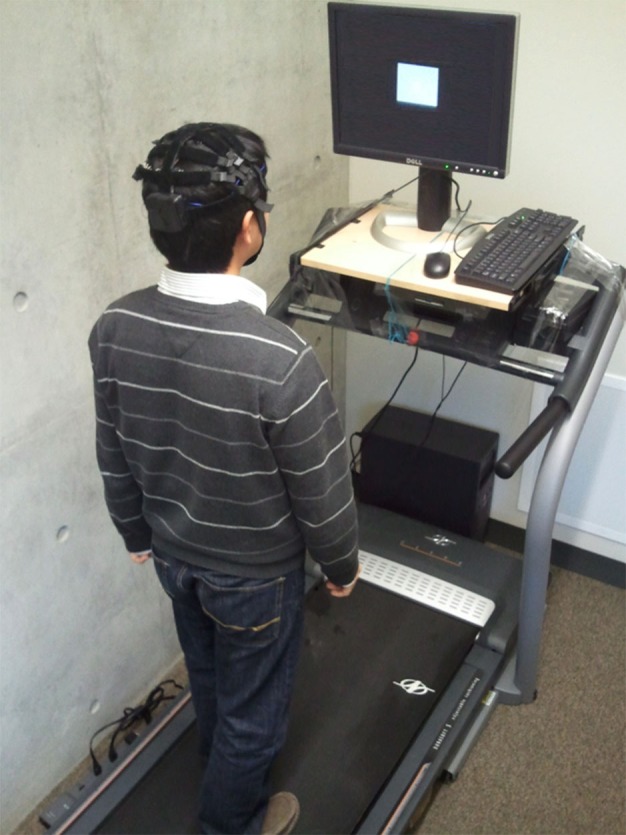
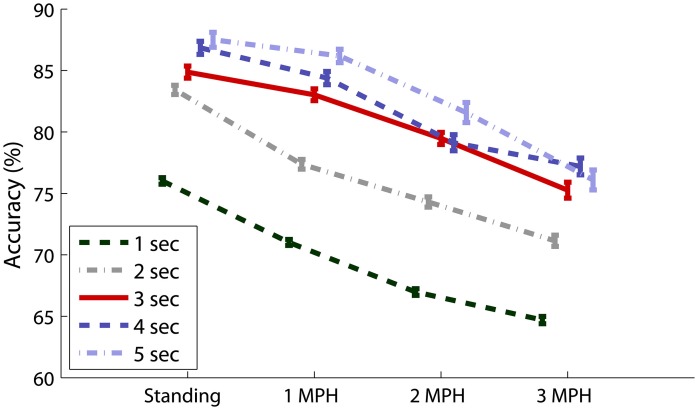
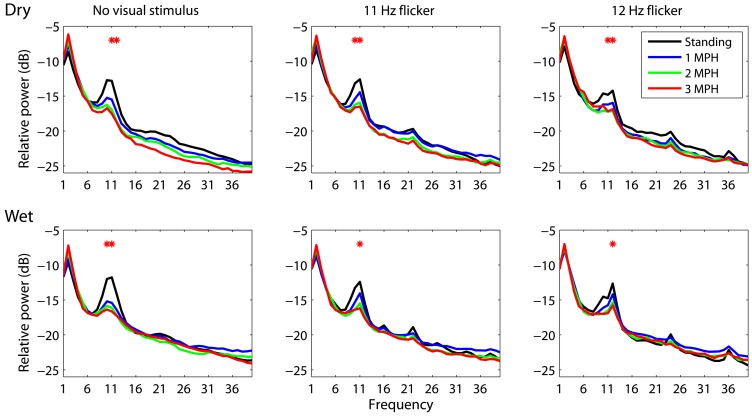
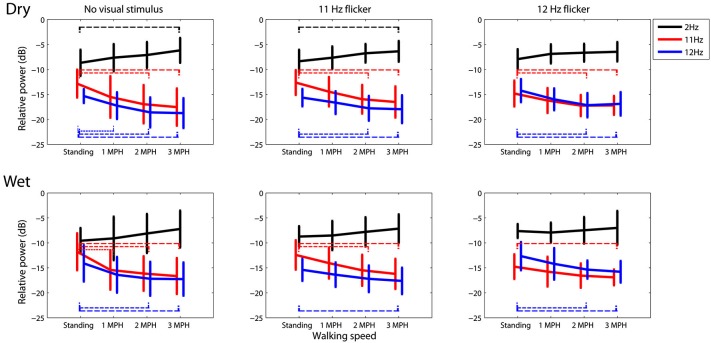
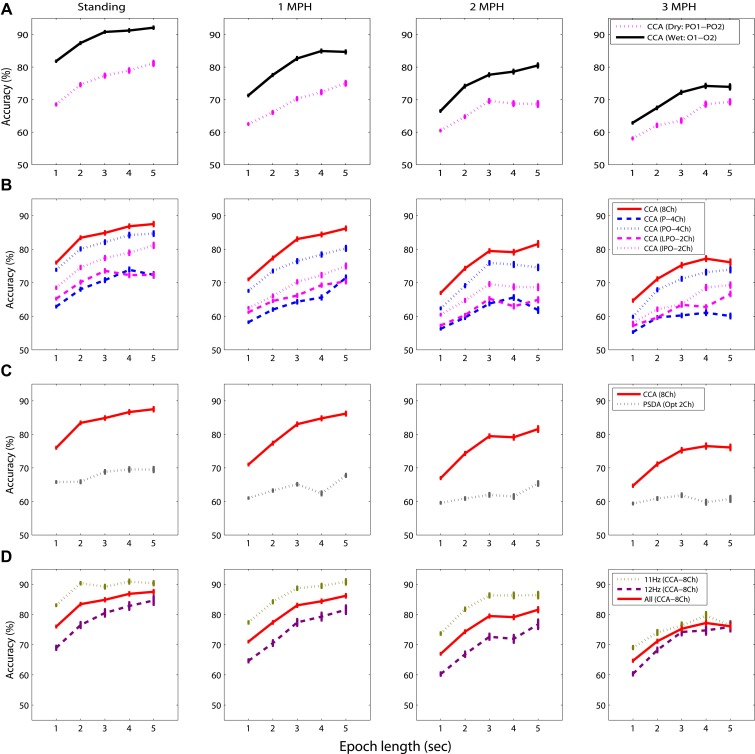
Recent advances in mobile electroencephalogram (EEG) systems, featuring non-prep dry electrodes and wireless telemetry, have enabled and promoted the applications of mobile brain-computer interfaces (BCIs) in our daily life. Since the brain may behave differently while people are actively situated in ecologically-valid environments versus highly-controlled laboratory environments, it remains unclear how well the current laboratory-oriented BCI demonstrations can be translated into operational BCIs for users with naturalistic movements. Understanding inherent links between natural human behaviors and brain activities is the key to ensuring the applicability and stability of mobile BCIs. This study aims to assess the quality of steady-state visual-evoked potentials (SSVEPs), which is one of promising channels for functioning BCI systems, recorded using a mobile EEG system under challenging recording conditions, e.g., walking. To systematically explore the effects of walking locomotion on the SSVEPs, this study instructed subjects to stand or walk on a treadmill running at speeds of 1, 2, and 3 mile (s) per hour (MPH) while concurrently perceiving visual flickers (11 and 12 Hz). Empirical results of this study showed that the SSVEP amplitude tended to deteriorate when subjects switched from standing to walking. Such SSVEP suppression could be attributed to the walking locomotion, leading to distinctly deteriorated SSVEP detectability from standing (84.87 ± 13.55%) to walking (1 MPH: 83.03 ± 13.24%, 2 MPH: 79.47 ± 13.53%, and 3 MPH: 75.26 ± 17.89%). These findings not only demonstrated the applicability and limitations of SSVEPs recorded from freely behaving humans in realistic environments, but also provide useful methods and techniques for boosting the translation of the BCI technology from laboratory demonstrations to practical applications.
近年来,移动脑电图 (EEG) 系统的发展,其特点是无准备的干式电极和无线遥测,使得移动脑机接口 (BCI) 在我们的日常生活中的应用成为可能并得到了促进。由于当人们在积极的生态环境中与高度受控的实验室环境中表现不同,因此尚不清楚当前面向实验室的 BCI 演示可以在多大程度上转化为具有自然运动的用户的可操作 BCI。理解自然人类行为和大脑活动之间的内在联系是确保移动 BCI 的适用性和稳定性的关键。本研究旨在评估使用移动 EEG 系统在具有挑战性的记录条件下(例如行走)记录的稳态视觉诱发电位 (SSVEP) 的质量,SSVEP 是有前途的 BCI 系统之一。为了系统地探索行走运动对 SSVEP 的影响,本研究要求受试者在以 1、2 和 3 英里/小时 (MPH) 的速度运行的跑步机上站立或行走,同时感知视觉闪烁(11 和 12 Hz)。本研究的实验结果表明,当受试者从站立切换到行走时,SSVEP 幅度趋于恶化。这种 SSVEP 抑制可能归因于行走运动,导致从站立(84.87 ± 13.55%)到行走(1 MPH:83.03 ± 13.24%,2 MPH:79.47 ± 13.53%,3 MPH:75.26 ± 17.89%)的 SSVEP 检测明显恶化。这些发现不仅证明了在现实环境中从自由行为的人类记录的 SSVEP 的适用性和局限性,而且还为从实验室演示到实际应用的 BCI 技术的翻译提供了有用的方法和技术。